the full picture — June 17, 2026
|

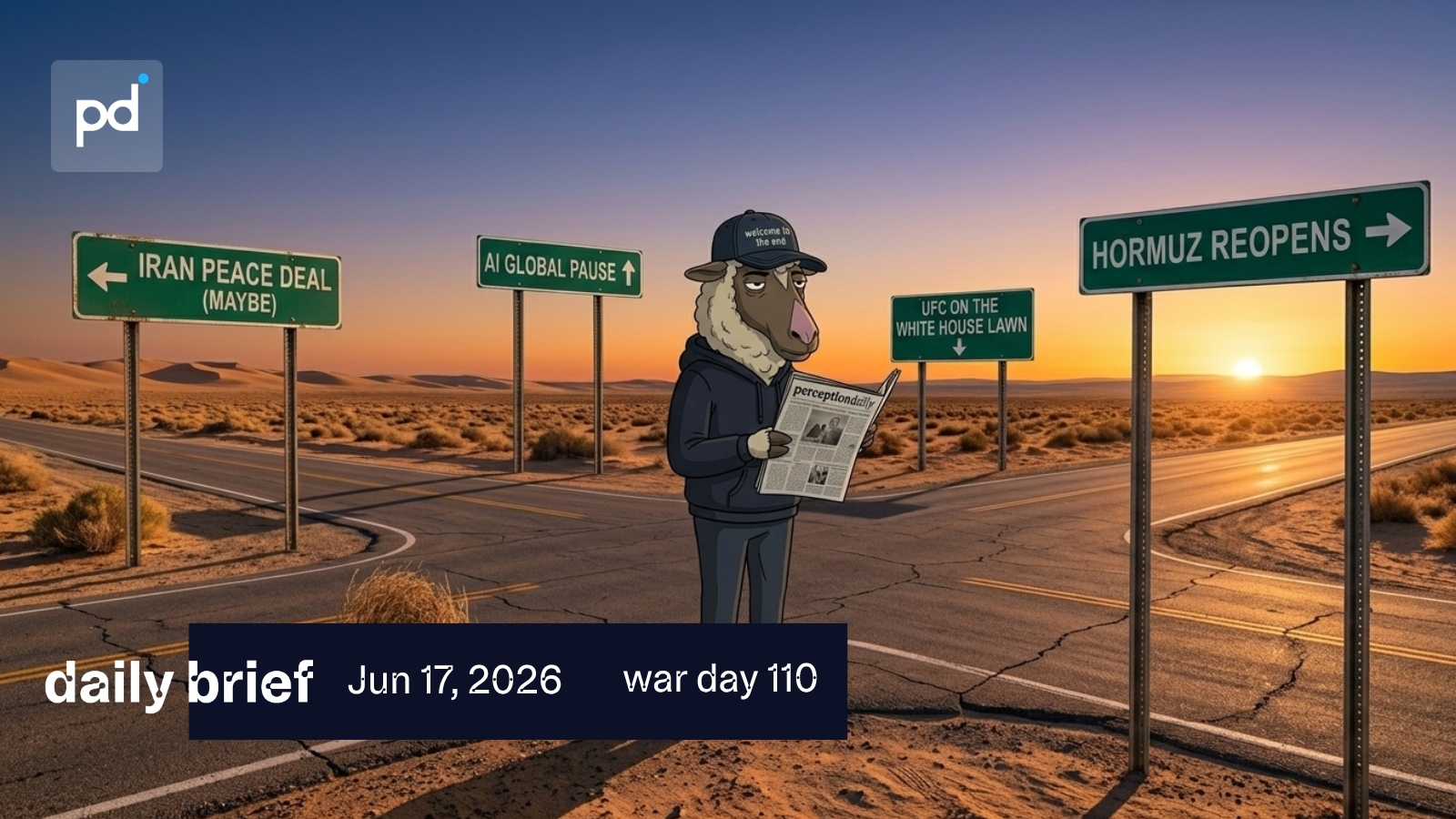 |
A tanker sits motionless at the mouth of the Strait of Hormuz, its captain watching the blinking cursor on a shipping terminal screen. The order to transit has been issued by three governments. The paperwork is signed. The flags are ready. But the captain waits — because forty miles to the northwest, an IDF drone is still circling over southern Beirut, and nobody has told the insurance underwriter what that means for the hull policy. It is Day 110 of the war. The deal is — technically — done. The ceremony is Friday. The oil is — technically — already moving. And the man most likely to blow the whole thing up is calling his American patron to ask for a meeting he already knows he will not get on his terms. This is not a peace. This is a sixty-day timeout between two sides who haven't agreed on what the game is.
|
DEFCON
2
/ 5
|
FRAGILE AGREEMENT, SIGNATURE PENDING
We are technically 48 hours from the Geneva signing. Open conflict is suspended and oil markets are pricing in peace. But Israel has signed nothing with Iran, Netanyahu does not know the nuclear terms, and the IDF is still operating in Lebanon. The DEFCON drops from 1 to 2 not because the threat is resolved — but because the risk of immediate escalation is momentarily contained by the diplomatic window. One IDF strike on Beirut before Friday, or one Netanyahu announcement that Israel is not bound by the MOU, resets the clock to zero.
|
 SHORT ON TIME? READ THIS ONE SHORT ON TIME? READ THIS ONE |
↓ |
| ① | The fact that counts today |
The Geneva MOU: A Ceasefire Framework That Defers Every Hard Question to a Sixty-Day Clock Nobody Controls
The United States and Iran reached an agreement on June 14 to settle a conflict that has closed the Strait of Hormuz and sent shockwaves through global oil markets. Pakistani Prime Minister Shehbaz Sharif, who served as mediator between Washington and Tehran, announced that the deal will be officially signed Friday in Switzerland — with the MOU set to trigger the reopening of the Strait and begin sixty days of negotiations on sanctions and Iran's nuclear program. Though the full text has not been officially released, the draft deal is reportedly fourteen points in total. The first three agree to an "immediate and permanent termination of military operations on all fronts," respect for both countries' sovereignty, and a sixty-day countdown to negotiate a "final deal." Trump called it "complete." Markets believed him. The centrifuges, almost certainly, kept spinning.
Here is what Predictive History reads in this moment: every actor is behaving exactly as their incentives demand. Trump made no mention of the nuclear issue in his initial announcements, though this is the main reason he cited for launching the war. In an interview with the New York Times, he later said Iran would be permitted low-level nuclear enrichment — a position directly contradicting his previous insistence on dismantling Iran's entire nuclear program. Iran gets relief from the naval blockade, the promise of resumed oil exports, and sixty days of breathing room. Trump gets the headline, the ceremony, and the Truth Social post that reads like a peace treaty even though it is not one. Pakistan and Qatar get the diplomatic credit they needed. Everyone wins — on paper, for now.
The problem is the man who was not in the room. Netanyahu has yet to publicly comment in detail on the deal, and an Israeli official told NBC News he is seeking a meeting with President Trump to discuss it. The MOU proposal makes no mention of what becomes of Iran's nuclear program or its stockpile of highly enriched uranium. Netanyahu stated publicly that any final agreement must eliminate the nuclear danger — meaning "dismantling Iran's nuclear enrichment sites and removing its enriched nuclear material from its territory." That is not what is on the table in Geneva. That gap is not a diplomatic nuance. It is the entire war.
The US Defense Intelligence Agency has reportedly elevated the counterintelligence threat posed by Israel to its highest level. Recent US intelligence reports indicate that Israeli spy agencies have allegedly been eavesdropping on American negotiators specifically working on the peace deal with Iran. Targets reportedly include Trump envoy Steve Witkoff, Pentagon top policy official Elbridge Colby, and one of his deputies, Michael DiMino IV. Think about what this tells you about the state of the alliance: Israel and the United States jointly launched this war four months ago, and today the Pentagon rates Israel as a 'critical' counterintelligence threat. The ally is spying on the negotiator. The negotiator is signing a deal the ally opposes. And the ceremony is in forty-eight hours.
| The ally is spying on the negotiator, the negotiator is signing a deal the ally opposes, and everyone is still calling it a partnership. |
Experts remain cautious, noting that the MOU leaves many challenging issues unresolved. "We have been here before only to discover the parties cannot bridge the remaining gaps," said CFR senior fellow Steven Cook. "Negotiations on the outstanding issues, especially on Iran's nuclear program, will be long and difficult." The sixty-day clock starts Friday. Iran gets Hormuz. The centrifuge question gets a working group. And somewhere in Jerusalem, a prime minister is deciding whether the meeting with Trump comes before or after he goes back on television.

| ② | THREE FRONTS |
Lebanon Is the Live Wire the Geneva Deal Forgot to CutIran has warned that Israeli attacks in Lebanon must stop as part of the agreement with the US. Israel's Defense Minister has separately said Israel will not withdraw from occupied Lebanese territory. The MOU covers Lebanon in theory. The IDF operates in Lebanon in practice. One is a document. The other is a military. |

The White House Pulled Anthropic's Most Powerful AI Models Offline — and Handed Europe Its Best Argument for Tech SovereigntyLast Friday, the White House imposed sweeping export controls over Anthropic's newly released Fable 5 and Mythos 5 AI systems, prompting the company to abruptly disable the systems entirely. The White House's decision looked set to dominate the G7 summit in France — the EU said it underlined the bloc's need for "technological sovereignty," while Canada's leader argued it showcased the risk of relying on a small cluster of powerful US tech firms. Washington just proved Europe's point for them. |

Fed Holds Rates, Signals a Hike, and Warsh Rewrites the Script — Markets FallThe Federal Reserve said Wednesday it is keeping its interest rate unchanged for the fourth straight time, but signaled that a rate hike is ahead. The dot plot erased the earlier indication for one cut this year and pushed any reductions into 2027 and 2028, as policymakers weigh the durability of an inflation spike brought on by the Iran war. The peace deal was supposed to fix the inflation problem. Warsh just told you he doesn't believe it yet. |

PERCEPTION INDEX
| ◄ Underestimating | Calibrate | Overestimating ► |
| 🔴 Geneva Signing (June 19) ⬇️ Not peace — a sixty-day pause with opaque clauses and no nuclear resolution. 🔴 Israel's Position ⬇️ Netanyahu is outside the text of the deal: the most explosive variable being ignored. 🔴 Brent Crude Decline ⬆️ Markets are pricing in peace — governments haven't signed it yet. 🔴 Hormuz Reopening 🌡️ Deal is nearly done, but tanker operators will only re-enter with hard security guarantees. 🔴 Iran Nuclear Program Post-MOU ⬇️ The centrifuges are not in the text — and almost nobody is talking about it enough. 🔴 Lebanon ⬇️ The IDF is still operating — Lebanon is the most underestimated fuse in the whole deal. 🔴 European Fuel Prices 🌡️ The drop at the pump is coming, but not this week — refineries need time. |
|
DON'T LOOK UP
Today: Brent falling below $80 has not yet translated to lower prices at the pump — refineries take weeks to pass through crude price changes.
Within 30 days: If Hormuz reopens on Friday as scheduled, European gasoline and diesel prices should begin declining between late June and July — with consumers noticing the difference in early to mid-July at the earliest. If the current situation persists: Even with a deal signed, gas, flights, and food prices across Europe will remain above pre-war levels for months. The IEA projects global oil supply fell by nearly 4 million barrels per day on average in 2026 — that structural damage does not reverse overnight. |
| ③ | The hidden thread |
The Geneva Deal, the Anthropic Shutdown, and the Fed's Hike Signal Are All the Same Story: The End of Cheap Assumptions
For four years, the world ran on three comfortable assumptions: that the Middle East would stay volatile but manageable, that American AI companies would serve the world freely as a commercial proposition, and that the Federal Reserve would eventually cut its way back to easy money. In the space of seventy-two hours, all three have cracked simultaneously. That is not a coincidence. It is the same structural shift wearing three different masks.
The Geneva MOU defers the nuclear question to sixty days of negotiations that may produce nothing, while oil markets have already priced in a resolution. Oil prices remained near three-month lows as the IEA warned of a looming supply surplus — projecting global oil supply could rise by 8 million barrels a day while demand grows by only 2 million, creating significant oversupply. Meanwhile, the inflation surge has posed a quandary for policymakers trained to look past short-term supply shocks — but recent inflation indicators have posted multi-year highs, with the CPI for May indicating a 4.2% annual rate. The war lit the inflation fire. The deal may extinguish the oil shock. But the fire has already spread to wages, services, and expectations — and a signature in Geneva does not put that out. The Fed knows this. That is why Warsh signaled hikes, not cuts.
And then there is the Anthropic shutdown — the story that sounds like a tech regulatory spat but is actually a dress rehearsal for the new geometry of power. The showdown marks a striking escalation in the Trump administration's approach to AI — by using national security authorities to force a leading US AI company to withdraw a flagship product, the White House has signaled a willingness to intervene directly in the development and distribution of cutting-edge AI models, potentially setting a new precedent. At the same G7 where world leaders were discussing the Iran deal and the global economy, G7 leaders discussed a plan to grant select "trusted partners" access to advanced AI models from US firms such as Anthropic. Access to AI is now a diplomatic currency, as scarce and as contested as enriched uranium. The Geneva deal and the Anthropic shutdown are the same negotiation in two different rooms.
| ④ | Weak signal · watch this |
Buried beneath the Geneva headlines and the SpaceX-Cursor deal is a quieter development: OECD government inventories have fallen by 163 million barrels over the conflict period to their lowest level since December 1990, as the pace of emergency stock releases accelerated. Strategic reserves across the Western world have been used as a war tool — a managed bleed to keep prices from catastrophic levels during Hormuz closure. The US Strategic Petroleum Reserve is at its lowest point in decades. The buffer is gone.
This matters enormously in six months. A reopened Strait rebuilds commercial flows — but it does not rebuild strategic reserves, which take years and political will to refill. If any second shock hits energy markets in 2027 — another regional conflict, a hurricane season that disrupts US production, a Chinese demand surge as their economy recovers — the West will have almost no emergency cushion left. The Geneva deal may end this war. It cannot un-drain the reserve. The world just learned how thin its safety net actually is, and is already moving on before anyone has thought about what comes next.
If the Geneva MOU defers the nuclear question to sixty days of future talks — and those talks fail — does the United States go back to war, or does it accept a nuclear-capable Iran and call it diplomacy?
Day 110. The deal is signed — almost. The strait is open — almost. The war is over — almost. The word 'almost' is doing a lot of heavy lifting in the Middle East this week, and it has been doing so for about seventy years. Trump gets his ceremony. Iran gets its oil revenues. Israel gets frozen out of a negotiation it helped start. The centrifuges keep spinning under a document that doesn't mention them. Meanwhile, a tanker captain in the Gulf of Oman is still waiting for someone to tell him the insurance is sorted. It isn't. It won't be, for a while. The smartest move in any peace agreement is always the same: read the footnotes. Nobody ever does. — perceptiondaily · the full picture
|


welcome to the end
the full picture · daily intelligence briefing
|