the full picture — June 18, 2026
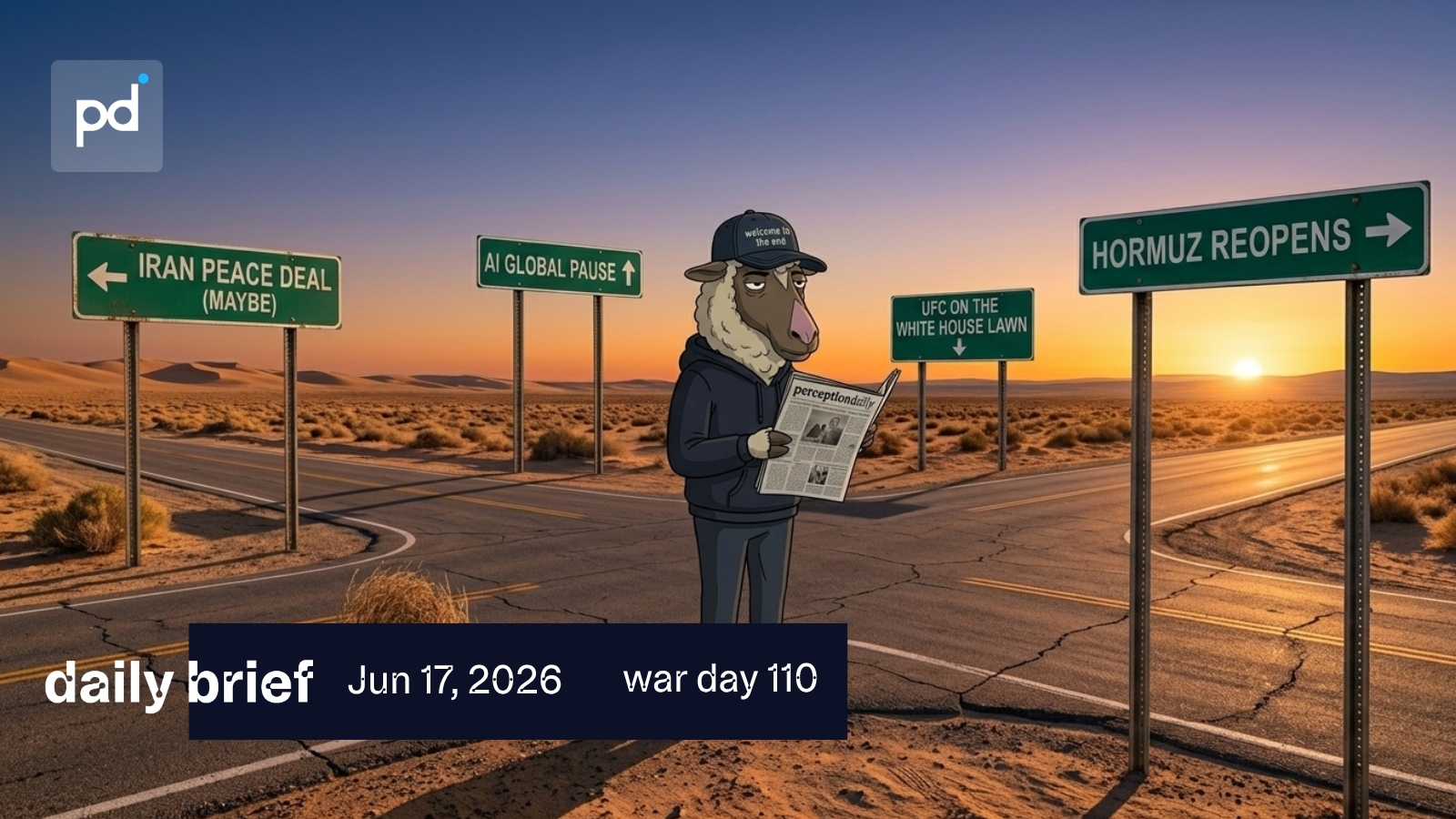 |
A tanker sits at the mouth of the Strait of Hormuz. Its captain has been waiting since March. The charts show open water ahead — $2 billion in crude below his feet, a buyer in Yokohama, a bonus if he clears the strait by Friday. He has read the headlines. He has not yet received the insurance clearance. He will wait. In Geneva, diplomats in dark suits rehearse handshakes for a ceremony the whole world is watching. On a hillside in Jerusalem, a prime minister who was not invited to the negotiations prepares his third press conference in five days to explain why this is actually a victory. In Washington, a new Federal Reserve chairman just told markets that the war-driven inflation spike may require a rate hike — and then refused to submit his own forecast. Everyone is performing certainty. Nobody has it. This is what Day 110 looks like: not the end of a war, but the beginning of a much more complicated game — one where the most dangerous player wasn't at the table.
|
DEFCON
2
/ 5
|
FRAGILE AGREEMENT, SIGNATURE PENDING
We are technically 48 hours from the Geneva signing. Open conflict is suspended, oil prices are falling, and the diplomatic machinery is running. But Israel has not signed anything with Iran directly, Netanyahu does not know the nuclear terms of the MOU, and the IDF continues to operate autonomously in Lebanon. The DEFCON drops from 1 to 2 not because the threat is resolved — but because the immediate escalation risk is temporarily contained by a 48-hour diplomatic window that could still shatter.
|
 SHORT ON TIME? READ THIS ONE SHORT ON TIME? READ THIS ONE |
↓ |
| ① | The fact that counts today |
The US-Iran MOU Is Not a Peace Deal. It Is a 60-Day Deadline with Opaque Nuclear Clauses and an Excluded Israel.
The United States and Iran have announced agreement on a framework that includes a 60-day ceasefire and reopens the Strait of Hormuz. The MOU, slated to be signed on June 19 in Geneva, paves the way for negotiations on Iran's nuclear ambitions — the central driver of the war. The draft agreement, per Iranian state media, includes the suspension of sanctions on oil sales, a commitment to reach a final agreement on nuclear issues within 60 days of signing, and the release of $24 billion in frozen Iranian assets during the negotiation period. The markets have already priced the signing as though it were the armistice itself. Crude oil fell toward $75 per barrel on Wednesday, sliding for the fifth straight session and reaching its lowest level since early March, as expectations of increased supply continued to weigh on prices. That is the market's bet. The bet may be premature.
The problem is structural, not atmospheric. Iran will repeat past pledges it has made to never acquire nuclear weapons, and it will now engage in technical negotiations with the United States on the future of its nuclear program. Over the next 60 days, those talks will focus on the status of Iran's stockpile of highly enriched uranium and its ability to enrich uranium. That language should give pause to anyone who remembers that Iran has made the same pledges before. The last time Iran and the United States secured a comprehensive nuclear accord was in 2015, after two years of negotiations. Tehran has signaled an unwillingness to compromise on key demands and will try to play for time, knowing that Trump is unlikely to resume the military campaign in the run-up to the November midterm elections. The MOU is not a solution. It is a structured delay — designed to give both sides a domestic win before the harder questions destroy the room.
Then there is the Israel variable, which is not a variable so much as a loaded weapon left on the table. The Israeli government was not shown the memorandum of understanding drafted to end the war with Iran, an Israeli government official told NBC News — the latest sign of growing tension between the United States and Israel. Shortly after President Trump said he had given a copy of the MOU to Israel, the same source said Israel still had not seen the draft. Trump told the G7 summit on Tuesday that "without me, there would be no Israel," calling Netanyahu "crazy" and using an expletive to describe his poor judgment. The rupture between Washington and Jerusalem is no longer sub-diplomatic. It is public, bilateral, and accelerating. Netanyahu's absence from the negotiations has become a perilous hindrance ahead of career-defining elections before the end of October.
Critics say Netanyahu led Trump into the war with Iran while overpromising what it could achieve, and Trump now might be dragging Israel out before it feels ready. They say the prime minister misjudged Trump's appetite for a protracted conflict, was outflanked by Iran in negotiations, and grew increasingly sidelined by the region's other major players. This is the core of the Predictive History read on Day 110: the actor with the most to lose from the current settlement — Israel — has no formal veto over it, but retains full operational capability to blow it up. Israel's more focused fight against Iran-backed Hezbollah in Lebanon still has the power to disrupt the broader American efforts to resolve its regionwide, monthslong war with Iran. The match is not out. Someone left the fuse attached.
| The MOU stops the guns. It does not stop the centrifuges — and the only actor capable of stopping those unilaterally was not invited to Geneva. |
The US Defense Intelligence Agency has reportedly elevated the counterintelligence threat posed by Israel. Recent US intelligence reports indicate that Israeli spy agencies have allegedly been eavesdropping on American negotiators, specifically those working on the potential peace deal with Iran. That detail — barely covered in Western outlets — is the clearest signal of where the Washington-Jerusalem relationship actually stands on Day 110. When allies start listening to each other's back-channel calls, the alliance has moved into a different register entirely. The signing in Geneva is 24 hours away. Netanyahu's request for a Trump meeting has not been formally granted. The Lebanese front is quiet — for now. But "all Hezbollah has to do is get one rocket across into northern Israel, and then the pressure on Netanyahu will ramp up," said Daniel Shapiro, former US Ambassador to Israel. "It's going to be very hard to resist. And that gives a lot of power to control this dynamic to Hezbollah, and essentially to Iran."

| ② | THREE FRONTS |
Trump Calls Netanyahu "Crazy" at G7 as Israel Is Frozen Out of Its Own War's Peace Terms The deal is a major blow for Israel and specifically Prime Minister Benjamin Netanyahu, who considers Iran an existential threat. The deeper wound is strategic: Israel started this war as America's co-belligerent and is ending it as a spectator — with a prime minister facing elections in October, a public that is furious, and a patron who just called him crazy in front of the G7. That is not an alliance. That is a liability relationship. |

Anthropic Files Confidential IPO at $965 Billion Valuation — The AI Safety Company Is Now Worth More Than Most Countries' GDP Anthropic has confidentially submitted draft paperwork for a public listing, having recently raised $65 billion at a $965 billion valuation — eclipsing OpenAI's value for the first time. Anthropic's advances in coding and cybersecurity capabilities have rattled markets and enticed new business customers. The company that built its brand on AI safety is now racing OpenAI and SpaceX to Wall Street — which tells you everything you need to know about where "safety" ranks against permanent capital access in a compute arms race. |

Fed Chair Warsh's First Meeting Ends With a Rate Hike Signal, a Truncated Statement, and a Market Selloff Kevin Warsh's first meeting as Federal Reserve chairman concluded Wednesday with no change in interest rates and a nod to possible hikes ahead — including the removal of key language indicating a bias toward future cuts, within a dramatically shorter policy statement. Since the Iran war began February 28, inflation has accelerated to a three-year high of 4.2%, lifted mostly by costlier gas. Trump picked Warsh to cut rates. The war gave Warsh a reason not to. The peace deal may now give the Fed cover to pause — but not to pivot. |

PERCEPTION INDEX
| ◄ Underestimating | Calibrate | Overestimating ► |
| 🔴 Geneva Signing (June 19) ⬇️ This is not peace — it's a pause with opaque clauses and no Israeli signature. 🔴 Israel's Position ⬇️ Netanyahu excluded from the MOU text: the most explosive variable nobody is adequately pricing. 🔴 Brent Crude Decline ⬆️ Markets are pricing peace as done — governments haven't signed it yet, and tankers won't move without insurance. 🔴 Hormuz Reopening 🌡️ Deal is signed, but shipping companies demand real security guarantees before entering the strait. 🔴 Iran Nuclear Post-MOU ⬇️ The centrifuges are not in the text — and almost no one is covering this loudly enough. 🔴 Lebanon ⬇️ The IDF is still operating — this is the most underestimated trigger in the entire deal. 🔴 European Fuel Prices 🌡️ The pump price drop is coming, but not this week — refinery lag means weeks, not days. |
|
DON'T LOOK UP
Today: Brent below $76 has not yet translated into lower prices at the pump — refineries require weeks to pass through the discount.
Within 30 days: If Hormuz reopens on Friday as planned, European petrol and diesel prices begin to fall between late June and July — but only if tanker operators receive credible security guarantees and begin transit. If the nuclear clause remains unresolved: The 60-day window expires without a comprehensive agreement on enrichment, the MOU collapses, and energy prices, flight costs, and food prices remain structurally elevated above pre-war levels for months — possibly through year-end, according to analysts. |
| ③ | The hidden thread |
The Peace Deal, the IPO, and the Rate Hike Are the Same Story: Who Controls the Cost of the Future?
Strip away the headlines and a single logic connects today's three fronts. The Geneva MOU is a negotiation over who controls energy flows — the fundamental input cost of the global economy. The Anthropic IPO is a negotiation over who controls compute — the fundamental input cost of the AI economy. The Fed's hawkish pivot is a negotiation over who controls the price of capital — the discount rate applied to every future cash flow on earth. All three are happening simultaneously. All three are unresolved. The market is treating each as though it were a separate story. It is one story.
Here is the game theory version: a peace deal that reopens Hormuz lowers energy costs, which gives the Fed more room to hold rates steady rather than hike, which keeps the cost of capital from crushing the AI infrastructure buildout that Anthropic and its peers depend on. Warsh himself has previously pointed to AI as a technology that could expand the economy's ability to produce goods and services cheaply, which would over time bring down inflation. Even then, many economists were skeptical. At least in the short run, analysts note that soaring investment in semiconductors and computing equipment is contributing to higher inflation. The irony is neat: AI spending is itself an inflationary force, which is part of why the Fed cannot cut, which is part of why AI companies need IPO capital rather than private debt. The loop is closed and it runs through Hormuz.
The deeper structural point is this: the 2026 world is organized around three chokepoints — the Strait of Hormuz for energy, the NVIDIA-to-datacenter pipeline for compute, and the Federal Reserve's rate corridor for capital. OECD government inventories fell to their lowest level since December 1990 as the pace of emergency stock releases accelerated. Meanwhile, Anthropic grew from $1 billion in annualized revenue at the end of 2024 to $30 billion by April 2026 — a 30-fold increase in 16 months. No enterprise software company in recorded history has compounded at this rate at this scale. After Warsh concluded his press conference, stocks sold off as traders projected a better than 90% chance of a rate hike by October. The S&P 500 closed down 1.2%, the Nasdaq Composite fell 1.3%, and the Dow slid 506 points. The peace deal at Hormuz was supposed to be the tailwind. Warsh just took it away.
| ④ | Weak signal · watch this |
On June 18-19, the UN Institute for Disarmament Research is hosting its Global Conference on AI, Security and Ethics in Geneva — at the Palais des Nations, a fifteen-minute drive from where the US-Iran MOU will be signed. The UNIDIR conference will examine the implications of artificial intelligence for international peace and security. As innovation accelerates across governments, industry, and research institutions, aligning technological development with policy frameworks has become essential. The coming years will be pivotal in defining the trajectory of AI governance in the security domain. Nobody in the mainstream press has noted the coincidence.
The proximity is not accidental in a symbolic sense. The world's governments are simultaneously negotiating the terms of human warfare at one table and the terms of AI in military systems at another, in the same city, on the same days — and the two conversations are not connected. Within six months, that gap becomes the central governance problem of the decade: as AI-enabled targeting, surveillance, and logistics become embedded in every military's operational layer, peace deals written by human diplomats will need enforcement mechanisms that neither side's AI systems were designed to respect. Geneva has always been where the rules of war are written after the fact. The question is whether the next war will move faster than the diplomats can convene.
If Netanyahu is excluded from the nuclear terms of a deal that his country's military actions helped create — and if he retains full operational capacity to blow it up — what exactly is the enforcement mechanism for Friday's signature?
Day 110. They are signing a memo in Geneva. The centrifuges are still spinning in Natanz. The tanker captain is still waiting for his insurance clearance. And Netanyahu is calling Washington asking for a meeting that has not been scheduled. Markets have priced the peace. History has not delivered it. The last time a 'framework' like this was signed in Geneva, it took two years to become an actual deal — and then someone walked out of it. This time, the someone who is most likely to walk is standing outside the building with a full tank of jet fuel and elections in October. Enjoy the rally while it lasts. It has already started to reverse. — perceptiondaily · the full picture
|


welcome to the end
the full picture · daily intelligence briefing
|