the full picture — June 18, 2026
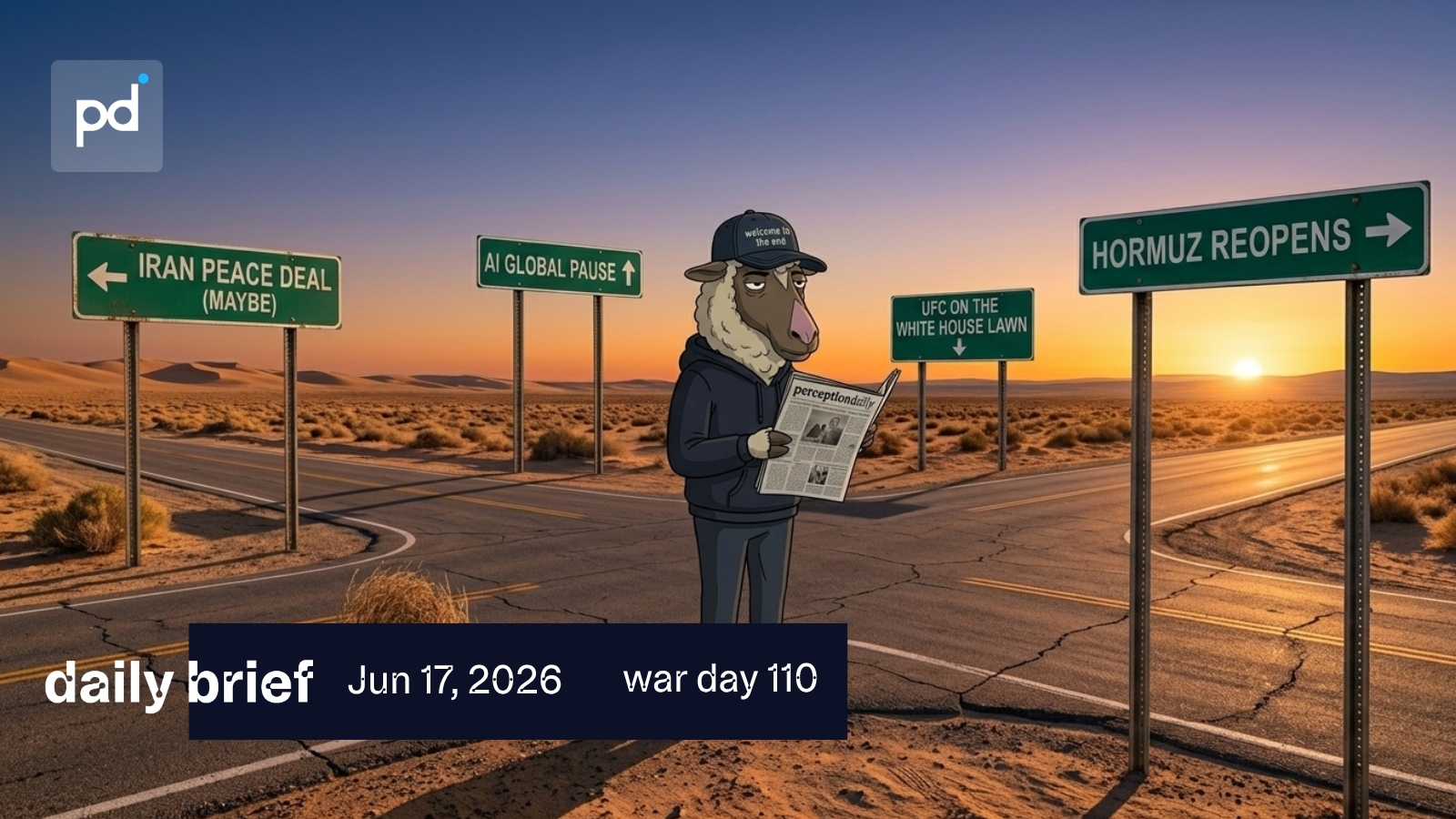 |
Geneva, Thursday evening. A diplomat slides a folder across a table in a conference room at the Palais des Nations. Across the corridor — forty meters away — the UN's global conference on AI and military security is wrapping up its second day. Outside, the lake is still. In 36 hours, the United States and Iran will sign a memorandum of understanding that markets have already decided to believe. The folder contains 14 points. Nobody in Jerusalem has read them. This is not a peace deal. This is a scheduled performance of one — and the distance between those two things is precisely where the next war lives.
|
DEFCON
2
/ 5
|
FRAGILE AGREEMENT, SIGNATURE PENDING
We are technically 48 hours from the Geneva signing. Open conflict is suspended, and oil markets are pricing in peace. But Israel has not been shown the MOU text — confirmed by an Israeli government official — and Netanyahu has stated publicly that, with or without a deal, Israel will prevent Iran from acquiring nuclear weapons. The Lebanese front remains active, with IDF operations continuing in the south. DEFCON drops from 1 to 2 not because the threat is resolved, but because the immediate escalation risk is temporarily contained within the diplomatic window.
|
 SHORT ON TIME? READ THIS ONE SHORT ON TIME? READ THIS ONE |
↓ |
| ① | The fact that counts today |
Israel Was Not Shown the Iran MOU. That Is Not an Oversight — It Is the Story.
As of Wednesday, the Israeli government had not been shown the memorandum of understanding drafted to end the war with Iran — and then it got stranger. Shortly after President Trump said he had given a copy of the MOU to Israel, the same Israeli government source said Israel still had not seen the draft. That is not a bureaucratic gap. That is a controlled exclusion. Washington is telling Jerusalem: this deal is happening, and your job is to accept it. The predictive logic here is cold and clear. Trump wants to extricate the US amid political pressure, while Israel is still pushing to topple the Iranian government. These are not compatible objectives — which is why the deal was negotiated around Israel, not with it. The Israeli government's absence in the negotiations has become a perilous hindrance for Netanyahu, who faces career-defining elections before the end of October. He went to war alongside the Americans, absorbed Iranian ballistic missiles, and now watches a deal get signed in Geneva that his own team has not read. The domestic reckoning is already arriving: in a survey from the Israeli Democracy Institute published two weeks ago, 57.5% of Israelis said they believe ending the conflict under the currently discussed framework would not be compatible with Israel's security interests. The deeper problem is structural. The MOU's nuclear provisions are deliberately vague — designed to get signatures on Friday, not to solve the problem that started the war. While details of the deal, scheduled to be signed on 19 June in Switzerland, have yet to be clarified and several issues remain outstanding. The centrifuges are almost certainly not in the text. Iran's enrichment infrastructure survives the signing. And Netanyahu has said directly: "With an agreement or without an agreement — Iran will not have nuclear weapons." That is not a diplomatic statement. That is a declaration of future action. What locks this into genuine danger is the Lebanon variable. Iran's Foreign Minister Abbas Aragchi said Israel's continued attacks on Lebanon violate the MOU — and though Israel's northern border has been mostly quiet, fighting between Israel and Hezbollah has continued in southern Lebanon. Iran has been explicit: it will not accept a deal that excludes Lebanon. Israel will not accept a deal that leaves Hezbollah intact. The MOU tries to paper over this contradiction with 14 points. The contradiction does not care.
| The Geneva MOU ends the military operations. It does not end the conflict that made them necessary — and everyone signing it knows this. |
There is one more layer that the headlines keep burying: the Pentagon's Defense Intelligence Agency recently upgraded Israel's counterintelligence threat level from "high" to "critical" — the most serious designation in its internal assessment system. The warning was based on Israeli intelligence agencies intensifying efforts to collect information on US military personnel, government officials, and policy discussions — specifically those shaping Washington's approach toward Iran. One of the officials targeted is Trump's special envoy Steve Witkoff — the man who negotiated the MOU. An ally spying on the negotiations it was excluded from, ahead of a signing it has not endorsed. The structural tension between Washington and Jerusalem has now crossed into operational counterintelligence territory. That is a different kind of crisis — and it has barely begun.

| ② | THREE FRONTS |
Iran Will Reopen Hormuz. The Tankers Are Not Convinced. Crude oil slid toward $75 per barrel on Wednesday, its lowest level since early March, as the US and Iran prepare to sign their interim deal in Switzerland on Friday — but shipping companies remain cautious about the long-term durability of the agreement. The market is pricing in a handshake. The captains who have to sail through Hormuz are pricing in something else entirely: the gap between those two calculations is where the next price spike hides. |

The US Government Just Classified Anthropic's AI as a Munition — Then Refused to Explain Why. The US government ordered Anthropic to suspend access by foreign nationals to its most capable AI models over national security concerns about cybersecurity vulnerabilities — Anthropic complied but disputes the directive, arguing the standard would halt all new frontier model deployments across the AI industry. Washington just told Silicon Valley that frontier AI is now a weapons category — and the rules of engagement are made up as they go. The battle has revived long-simmering concerns throughout the AI industry that the White House has placed a bullseye on their reliance on foreign AI talent. |

Warsh's First Fed Meeting: Rates Held, Rate Hike Signaled, Forward Guidance Abolished. Kevin Warsh's first meeting as Federal Reserve chairman concluded with no change in interest rates, a nod to possible hikes ahead, and the removal of key language indicating a bias toward future cuts — within a dramatically shorter policy statement. Trump nominated Warsh hoping for lower rates — but a wartime spike in energy prices has pushed rate cuts off the table entirely. The man Trump installed to make money cheaper just told markets it might get more expensive. Geneva's peace dividend and Warsh's hawkish pivot arrived on the same afternoon. Markets processed the contradiction by selling everything. |

PERCEPTION INDEX
| ◄ Underestimating | Calibrate | Overestimating ► |
| 🔴 Geneva Signing (June 19) ⬇️ This is not peace — it is a pause with deliberately opaque clauses. 🔴 Israel's Position ⬇️ Netanyahu excluded from the text: an explosive variable the world is treating as a footnote. 🔴 Brent Crude Decline ⬆️ Markets are pricing in peace — the governments involved have not yet signed it. 🔴 Hormuz Reopening 🌡️ Deal looks sealed, but tankers only re-enter with concrete security guarantees. 🔴 Iran Nuclear Post-MOU ⬇️ The centrifuges are not in the text — and almost nobody is saying so loudly enough. 🔴 Lebanon ⬇️ The IDF is still operating — this remains the most underestimated fuse in the entire deal. 🔴 European Fuel Prices 🌡️ The drop at the pump is coming — but not this week, and not painlessly. |
|
DON'T LOOK UP
Today: Brent below $80 has not yet translated into lower prices at the pump — refineries take weeks to pass through price changes.
Within 30 days: If Hormuz reopens after Friday's signing, European gasoline and diesel prices begin falling between late June and July — with a lag built into every link of the supply chain. If the Hormuz closure had persisted beyond May: This scenario has technically been averted — but gas prices, airfare, and food costs will remain above pre-war levels for months, according to analysts. The damage to global inventory buffers is structural: OECD government inventories fell to their lowest level since December 1990 as the pace of emergency stock releases accelerated. |
| ③ | The hidden thread |
Geneva, Anthropic, and Warsh Walk Into a Bar: Three Stories, One Regime Change
The Geneva MOU, the Anthropic export ban, and the Warsh Fed pivot look like three separate news cycles. They are not. They are three expressions of the same structural moment: American power is being re-centralized, re-weaponized, and re-priced — simultaneously, in diplomacy, technology, and money. The pattern is not coincidental. It is policy.
Start with the logic of control. The US move to bar foreign access to Anthropic's best AI models underscores the Trump administration's newfound willingness to exert control over a pivotal industry — and reminds Silicon Valley that it's working with an imperfectly understood technology with uncertain impact. The same administration that excluded its closest Middle Eastern ally from a war-ending memorandum is now telling its most innovative AI companies that their products are munitions subject to export licensing. In both cases, Washington is asserting the same thing: we decide who gets access, and we decide when. Through their dot plot, Fed officials removed their prior outlook for a rate cut and indicated that a hike is possible — sending borrowing costs in the same direction as AI access controls and diplomatic leverage: upward, and inward.
The historical parallel is the 1944–1947 period, when the US used its monopoly on atomic technology, its creditor status, and its diplomatic architecture to restructure the global order simultaneously. Today's assets are different — AI capability, dollar hegemony, military reach — but the logic is identical. Primacy is re-asserted not in one domain but across all of them at once. The difference is that in 1947, the US was building an order. In 2026, it is renegotiating the terms of one it already built — selectively, bilaterally, and without much warning. Geneva gets a 60-day ceasefire. Anthropic's foreign employees lose access to the model they built. Warsh shortens his press conferences and abolishes forward guidance. The message is the same in every case: the rules are ours, and we are rewriting them.
| ④ | Weak signal · watch this |
A small item at the margin of this week's Geneva coverage: the UN Institute for Disarmament Research is holding its Global Conference on AI, Security and Ethics on June 18–19 at the Palais des Nations in Geneva — examining the implications of artificial intelligence for international peace and security — in the same building, on the same days, as the US-Iran MOU signing. The conference is not making headlines. It should be.
The reason it matters in six months is this: as innovation accelerates across governments, industry, and research institutions, aligning technological development with policy frameworks has become essential — and the coming years will be pivotal in defining the trajectory of AI governance in the security domain. The Anthropic ban just demonstrated — with blunt, unilateral force — what AI governance looks like when the multilateral process fails to move fast enough. If UNIDIR's conference produces frameworks that no major power has agreed to be bound by, the Anthropic precedent becomes the actual rulebook: export bans issued at 5pm on a Friday, without public explanation, to companies that built the models their own employees can no longer touch. That is the world we are already in. Geneva is hosting two conversations about the future simultaneously — and only one of them is being reported.
If the Geneva MOU is signed Friday and Israel attacks a Hezbollah position in Lebanon on Saturday — which clause gets invoked, which country is responsible, and who exactly enforces it?
A deal signed without the Israelis reading it, an AI model banned without the company being told why, and a central banker who abolishes forward guidance on his first day. Three institutions, three power plays, one week. Everyone is calling this a breakthrough. What it actually is: a moment where the people writing the rules stopped pretending the old rules apply. The centrifuges are still spinning in Natanz. The Anthropic engineers still can't open their own model. And Warsh just told the market that cheaper money isn't coming. You can call that de-escalation if you want. I call it the opening act. |


welcome to the end
the full picture · daily intelligence briefing
|