the full picture — June 18, 2026
 |
Geneva, Thursday morning. A diplomat slides a fourteen-point document across a table in a rented conference room at the Palais des Nations. The text is six pages long. One paragraph covers Iran's nuclear program. Outside, a UN security conference on AI and warfare is wrapping up in the same building. Tanker captains in the Persian Gulf are refreshing their phones, waiting for the green light to transit the Strait. In Jerusalem, Benjamin Netanyahu's office releases a statement confirming he still does not know what is in the agreement being signed tomorrow in his ally's name. This is not a diplomatic breakthrough. This is a contract signed by three parties — with the most dangerous variable left off the signature page.
|
DEFCON
2
/ 5
|
FRAGILE AGREEMENT — SIGNATURE PENDING
We are technically 24 hours from the Geneva signing ceremony. Iran's plans for Friday's signing have not changed, with Foreign Ministry spokesman Esmaeil Baghaei confirming the ceremony is proceeding as scheduled. The conflict is suspended, not resolved. Israel's Prime Minister Netanyahu, in his first public comments on the US-Iran agreement, said he and Trump "do not always see eye to eye" — while Israel and Hezbollah continued fighting in southern Lebanon. DEFCON drops from 1 to 2 not because the threat is resolved, but because the risk of immediate escalation is temporarily contained by the 48-hour diplomatic window.
|
 SHORT ON TIME? READ THIS ONE SHORT ON TIME? READ THIS ONE |
↓ |
| ① | The fact that counts today |
The Geneva MOU: A 14-Point Framework With One Nuclear Paragraph and No Israeli Signature
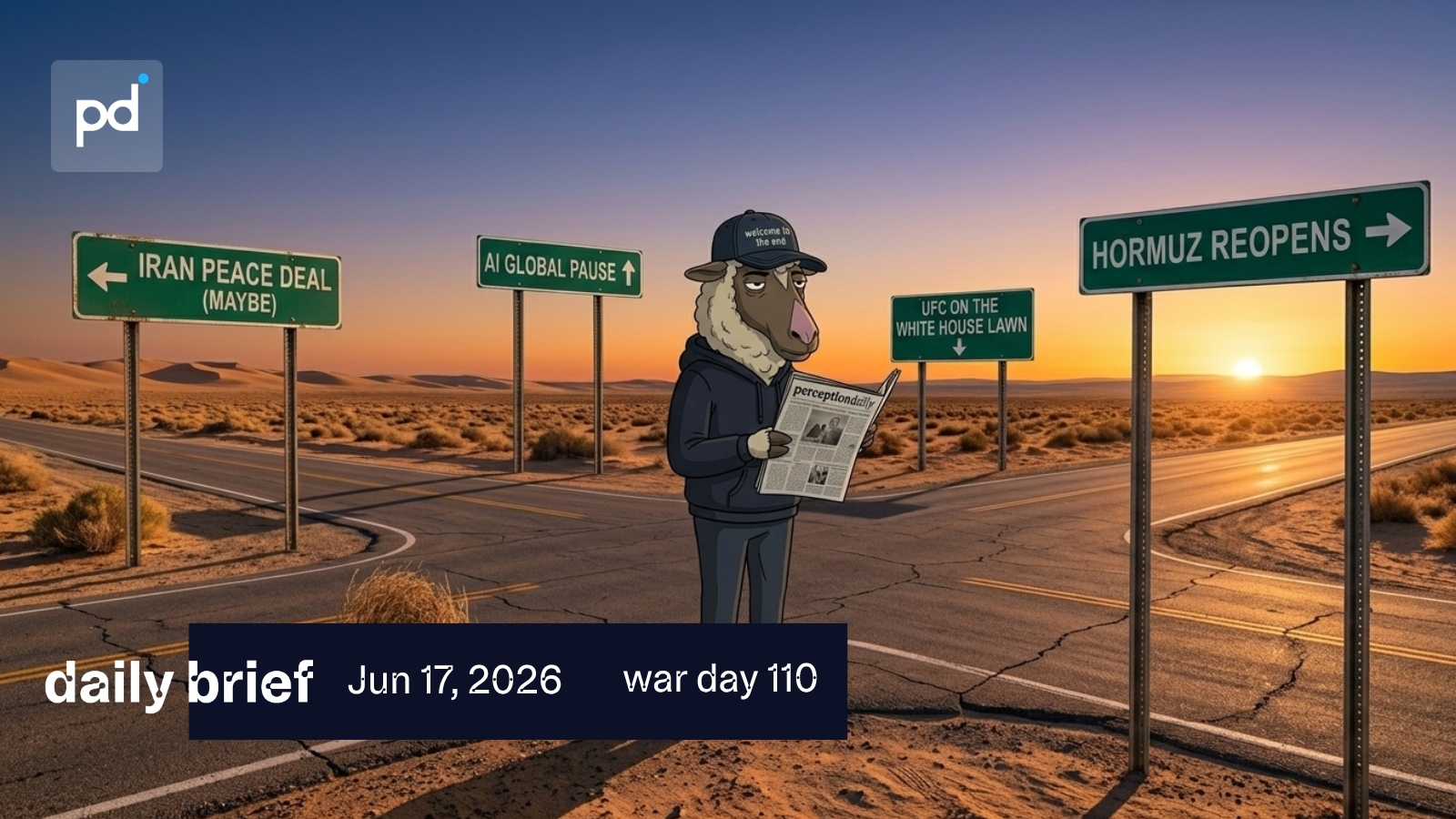
The United States and Iran reached a foundational agreement on June 14 to settle a three-and-a-half month conflict that closed the Strait of Hormuz and shook global oil markets. Pakistani Prime Minister Shehbaz Sharif — serving as mediator — announced the deal will be officially signed Friday in Switzerland. The initial memorandum opens with the Strait of Hormuz, a chokepoint for nearly one-fifth of the world's oil, before launching sixty days of negotiations on sanctions and Iran's nuclear program. The US government has not officially released the full text, but officials confirm the draft deal runs fourteen points in total — the first three agreeing to an "immediate and permanent termination of military operations on all fronts," respect for sovereignty, and a sixty-day countdown to a "final deal." JD Vance is expected to attend in person. Trump will not.
Here is what the Predictive History framework tells you to look at: not what was signed, but what was left out. The text of the Iran agreement includes a single paragraph related to Iran's nuclear program — and even that paragraph, per nuclear analysts, sets only a minimum standard rather than a binding ceiling. The fate of Iran's nuclear program remains unresolved for now — and Trump made no mention of the nuclear issue in his initial posts, though this is the main reason he cited for launching the war in February. In an interview with The New York Times, Trump said Iran would be permitted low-level nuclear enrichment — a reversal from his earlier position calling for the dismantling of Iran's entire nuclear program. Every actor in this negotiation knows what the centrifuges represent. The agreement chooses not to say it out loud.
Netanyahu acknowledged uncertainty about the agreement itself, telling reporters: "We still do not know what the agreement will be." This is the operative explosive in the deal. While intelligence-gathering between friendly nations is not unusual, some US officials reportedly believe recent Israeli activities have gone beyond what Washington traditionally considers acceptable among allies — specifically because Israel is seeking greater insight into US negotiating positions with Iran. The Pentagon's intelligence arm has raised the assessed threat level on Israeli spying from "high" to "critical" in recent weeks. The US and Israel fought this war together, built the targeting packages together, flew the B-2 missions together — and now Washington is treating Jerusalem as an adversarial intelligence actor. That is not a detail. That is the relationship.
Experts remain cautious, as the MOU leaves many challenging issues unresolved. "We have been here before only to discover the parties cannot bridge the remaining gaps," said Steven Cook, a senior fellow for Middle East studies at the Council on Foreign Relations. "Negotiations on the outstanding issues, especially on Iran's nuclear program, will be long and difficult." The structural reality is this: Friday's signing ends the shooting war. It does not end the strategic competition. Iran's enrichment infrastructure — damaged but not dismantled — remains the centrepiece of the next sixty days of talks. And Israel, which has no seat at that table, retains every military option it had before the MOU was conceived.
| Friday's ceremony ends the shooting war. The centrifuges will still be spinning when the ink dries. |
Crude oil fell toward $75 per barrel on Wednesday, sliding for the fifth straight session and reaching its lowest level since early March, as expectations of increased supply weighed on prices ahead of the signing. Iran will be able to immediately begin exporting oil once the agreement takes effect — but shipping companies remain cautious about the deal's long-term durability. In its first outlook for 2027, the IEA said global oil supply could rise by 8 million barrels a day while demand grows by only 2 million barrels per day, creating significant potential oversupply. The market is already pricing the peace. The question nobody is asking is what happens to that price if Netanyahu calls Trump on Saturday morning and announces Israel is not bound by the MOU on Lebanon.

| ② | THREE FRONTS |
Israel Spied on Its Own Ally's Nuclear Negotiators — and Washington Just Made It Official A Defense Intelligence Agency report assessed that Israel's "ability to conduct human espionage and technical collection is at a 'critical level'" — stemming from concerns that Israel was surveilling top US officials to obtain information on internal deliberations over the war in Iran. Two countries that jointly planned and executed the strikes on Iran's nuclear facilities are now formally at odds over what happens next. The alliance held for the war. It is cracking on the peace. |

The AI Token Reckoning: OpenAI Considers Drastic Price Cuts as the 'Tokenmaxxing' Era Collapses OpenAI is weighing significant token price cuts as it braces for a pricing war with rival Anthropic, whose Claude Code tool has surged among developers. Both companies are bleeding billions on compute costs while racing toward trillion-dollar IPOs. DeepSeek V4 Flash costs approximately $0.14 per million input tokens compared to $5 per million for OpenAI's GPT-5.5 — making it roughly 36 to 107 times cheaper depending on token type. Silicon Valley built a gold rush on AI adoption and is now discovering the gold is mostly Chinese, open-source, and nearly free. |

Warsh's Fed Debut: Rates Held, But Nine FOMC Members Signal a Hike Is Coming With inflation at its highest level in more than three years, the Federal Reserve held its benchmark interest rate steady Wednesday — the first rate decision under the leadership of new chairman Kevin Warsh. Stocks fell and short-term Treasury yields jumped as investors reacted to several Fed officials penciling in a rate hike for 2026. Trump nominated Warsh hoping for cuts. He got a central banker who refuses to give forward guidance, revamped the policy statement in his first week, and has nine colleagues who think borrowing costs need to go up. The Iran peace dividend in oil prices bought Warsh a few weeks. It may not buy him the year. |

PERCEPTION INDEX
| ◄ Underestimating | Calibrate | Overestimating ► |
| 🔴 Geneva Signing (June 19) ⬇️ Not peace — a pause with opaque clauses; the hardest issues are deferred, not resolved. 🔴 Israel's Position ⬇️ Netanyahu outside the text: the most explosive variable in the deal is being systematically ignored. 🔴 Brent Crude Decline ⬆️ Markets are pricing peace — but governments haven't yet delivered it, and tankers are still waiting. 🔴 Hormuz Reopening 🌡️ Deal is signed, but shipping companies will only re-enter the Strait once concrete security guarantees are in place. 🔴 Iran Nuclear Program Post-MOU ⬇️ The centrifuges are not in the text — and almost nobody is talking about it enough. 🔴 Lebanon ⬇️ The IDF is still operating — this is the most underestimated fuse attached to the entire deal. 🔴 European Fuel Prices 🌡️ The pump-price drop is coming, but refinery lag means it won't arrive this week or next. |
|
DON'T LOOK UP
Today: Brent below $76 has not yet translated into lower prices at the pump — refineries take weeks to pass through crude cost reductions, and tanker operators are still demanding security guarantees before re-entering the Strait.
Within 30 days: If Hormuz reopens on Friday as planned, European petrol and diesel prices should begin declining between late June and July — providing modest but real relief to consumers and lowering energy-driven inflation pressures. If the diplomatic window collapses: Oil prices, airfares, and food costs will remain above pre-war levels for months — and the IEA's warning of a structural 2027 supply surplus becomes irrelevant if the Strait closes again. The Strategic Petroleum Reserves of OECD governments, already at their lowest level since December 1990, would offer almost no buffer for a second shock. |
| ③ | The hidden thread |
The Price of Everything: How Oil, AI Tokens, and Interest Rates Are All Running the Same Play
At first glance, today's three fronts are unrelated: a Middle East peace deal, a Silicon Valley price war, and a Federal Reserve chairman's debut. Look at the underlying mechanics and they are telling the same story. Every actor in every domain is being forced to reprice something they thought they controlled. Iran thought it controlled the Hormuz lever — and it did, until the diplomatic cost became unbearable. OpenAI thought it controlled AI pricing — and it did, until DeepSeek turned the model into a commodity and enterprises started cancelling licences. The Fed thought it controlled the inflation narrative — and it did, until a war in the Persian Gulf pushed CPI to 4.2% and made rate cuts politically and economically untenable.
The connecting tissue is energy. Since the Iran war started in late February, inflation has flared amid higher oil and gas prices, pushing the Consumer Price Index to an annual rate of 4.2% in May — the highest since April 2023. That single number has locked Warsh into a hawkish posture on his first day, with updated forecasts from FOMC members suggesting they expect to raise interest rates by a quarter percentage point this year — a complete reversal from December's projection of a cut. Higher rates mean higher capital costs for AI infrastructure. Running next-generation AI models requires astronomical computing infrastructure, with on-demand pricing for Nvidia's H100 GPUs running from $1.49 to nearly $7 per hour across major hyperscalers. When money is expensive and compute is expensive simultaneously, the "tokenmaxxing" era doesn't just fade — it collapses. The Iran war did not just burn oil. It burned the conditions that made the AI spending frenzy possible.
The deeper pattern is a simultaneous crisis of pricing power across three asymmetric domains. In geopolitics, America is discovering it cannot price the Iran deal without Israel's buy-in. In AI, any margin recovery at OpenAI or Anthropic becomes "a math problem with no clean solution" as long as Chinese labs keep open-sourcing frontier-grade models. In monetary policy, a Fed chairman appointed to cut rates is being dragged toward hiking them by a war he had no role in starting. These are not separate crises. They are the same resource shock — oil — running through three different systems and breaking the assumptions each system was built on. Geneva tomorrow changes the oil price. It does not change the architecture.
| ④ | Weak signal · watch this |
Today at the Palais des Nations in Geneva — the same building where the US-Iran MOU will be signed tomorrow — UNIDIR concluded its Global Conference on AI, Security and Ethics. The conference examined the implications of artificial intelligence for international peace and security, noting that aligning technological development with policy frameworks has become essential and that the coming years will be pivotal in defining the trajectory of AI governance in the security domain. Almost no major outlet covered it. The irony is structural: the diplomatic machinery managing the war being discussed in one room, and the governance frameworks for the AI systems that will fight the next war being discussed next door.
In six months, this confluence will look prescient. The MOU commits the US and Iran to sixty days of nuclear talks — but those talks will occur in a world where AI-enabled surveillance, targeting, and signals intelligence have fundamentally altered what "verification" means. The IAEA inspectors returning to Iran under the MOU's terms will be operating with AI-assisted monitoring tools that did not exist during the JCPOA era. The question of whether Iran is cheating will increasingly be answered not by human analysts, but by pattern-recognition systems — systems subject to exactly the kind of bias, dual-use exploitation, and governance gaps that the UNIDIR conference spent two days trying to address. The next nuclear crisis will not begin with a satellite image. It will begin with an algorithm flagging an anomaly that a policymaker has thirty minutes to interpret.
If Israel was spying on the US negotiators who designed the very deal meant to prevent Iran from going nuclear — what does Israel know about the agreement's weaknesses that we don't?
Fourteen points. One nuclear paragraph. Zero Israeli signatures. That is what the world is calling a peace deal tomorrow. The markets believe it. The tanker captains are cautiously optimistic. Trump wrote 'ships of the world, start your engines' and called it done. But Netanyahu still does not know what is in the text — or so he says — and the DIA has his intelligence services rated 'critical threat' to American national security. You do not spy on your closest ally's chief negotiator because you trust the outcome. You spy because you have already decided to be ready for when the deal falls apart. Shep has seen this play before. It is called 'the ceasefire before the next war.' The only open question is how long the intermission lasts. |


welcome to the end
the full picture · daily intelligence briefing
|