the full picture — June 17, 2026
|
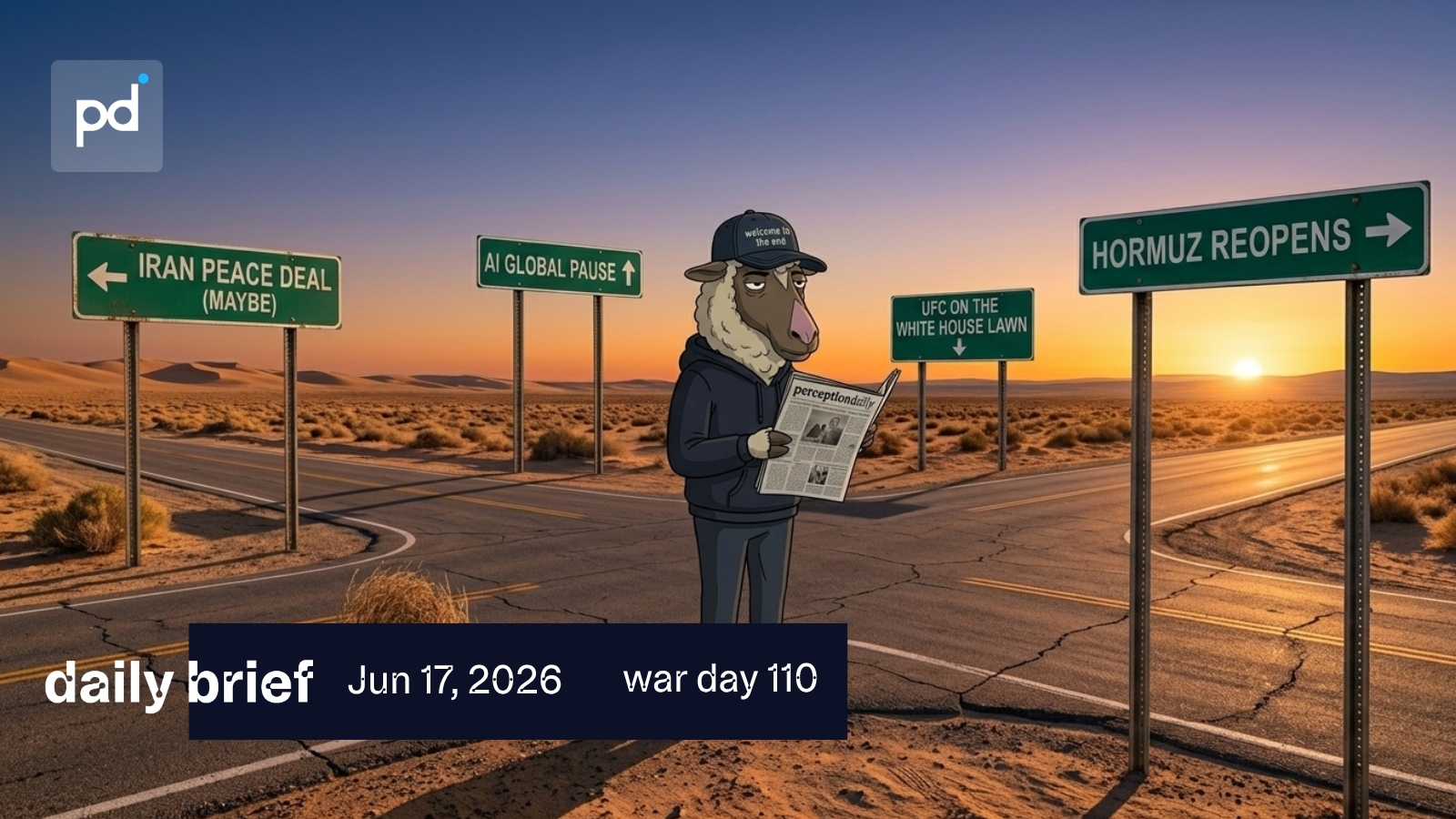
| Geneva, Thursday evening. A diplomat leans over a document in a conference room at the Palais des Nations, forty-eight floors of marble and good intentions above the lake. The paper is roughly a page and a half long. It says very little — deliberately. He checks the time. Two days until the signing. Two hundred meters away, in a different wing of the same building, a UN conference on AI in military systems is also meeting. Nobody finds this funny. This is not a resolution. This is the architecture of a future war that hasn't been scheduled yet. |
|
DEFCON 2 |
FRAGILE DEAL, SIGNATURE PENDING We are technically 48 hours from the Geneva signing. The agreement extends the current US-Iran ceasefire for 60 days, with the goal in upcoming talks being a permanent end to the war — but the fate of Iran's nuclear program remains unresolved for now. DEFCON drops from 1 to 2 not because the threat is resolved, but because the immediate escalation risk is temporarily contained by the diplomatic window. The Lebanese front remains hot, Netanyahu has not signed anything, and the text of the MOU has still not been made public. |
① THE FACT THAT COUNTS TODAY
The Geneva MOU Is a Ceasefire With Good PR — The Centrifuges Are Not in the Text
Recent US-Iran announcements of a memorandum of understanding center on extending the existing ceasefire for 60 days, reopening the Strait of Hormuz, and launching follow-on talks covering Iran's nuclear program, sanctions relief, and related regional issues such as Lebanon — with formal signing slated for June 19 in Switzerland. Trump has called it the "Trump deal" and declared it complete. Markets have priced it as peace. CNN determined that between March 23 and June 9, Trump had claimed at least 38 times that a deal was imminent. That number tells you everything about the gap between the announcement and the architecture.
Here is what the text actually contains, per the Bloomberg leak: a 14-point plan that would end the fighting — including in Lebanon — and open the Strait of Hormuz, but which leaves the most contentious issues, including the fate of Iran's nuclear program, to a 60-day period of negotiations toward a "final agreement." Israel isn't mentioned in the draft MOU at all. That omission is not an oversight. It is a structural feature. Washington needed a deal it could sign. Tehran needed a deal it could survive domestically. The US is also working to get as much oil out of the Strait of Hormuz as possible so that global supply can be restocked — in case Trump decides to resume the war. One official argued the US is not risking much because the bulk of sanctions relief will only be given if Tehran makes concessions in subsequent nuclear negotiations. In other words: the deal is also a reloading operation.
The most important actor in the room is the one who didn't sign anything. Netanyahu, in his first comments on the US-Iran agreement, said he and Trump "do not always see eye to eye." Meanwhile, Israel and Iran-backed Hezbollah continued fighting in southern Lebanon, with both sides claiming responsibility for strikes. On Monday evening, Netanyahu held a news conference in which he hardly addressed the agreement in his eight-minute opening statement. When asked, he said, "We still do not know what the agreement will be." This is not diplomatic ambiguity. A sitting prime minister whose country fought a 110-day war is publicly telling his public he hasn't read the contract. That is either a lie or a catastrophic breakdown in US-Israel coordination — and both explanations are alarming.
There are a number of wild cards that could blow this all up, particularly Israel and its ongoing aggression against Hezbollah in Lebanon. Israel has not signed on to this deal, and Trump has basically raised a lot of concerns that Netanyahu has been going too far and is hurting Trump's efforts to reach peace. Trump at the G7 publicly criticized Israeli strikes in Beirut, telling reporters that when two drones fall harmlessly into a desert, you do not knock down buildings in response. For the first time in this war, Washington's irritation with Jerusalem is on the record — and on the record in Evian, in front of cameras, with every G7 leader watching.
| The MOU is a page and a half long and kicks the hardest question — what happens to Iran's centrifuges — to a negotiation that hasn't started yet and involves a party that hasn't agreed to participate. |
The US says Iran has laid mines in the strait, and Trump said the strait will be opened for mine removal after the deal is signed on Friday. Shipping companies remain cautious about the long-term durability of the arrangement, and tankers from other nations are expected to resume passage through the Strait of Hormuz only once the agreement takes effect. The physical infrastructure of the crisis — mines, blockades, naval posture — will outlast the diplomatic ink by weeks or months. And somewhere above the lake in Geneva, AI governance experts and arms-control negotiators are meeting in the same building where two sides will sign a deal about a war that was partly enabled by precision weapons whose targeting logic nobody has fully regulated. The irony is not lost. It just isn't being discussed.
② THREE FRONTS
|
GEOPOLITICS Trump Publicly Breaks With Netanyahu Over Lebanon — For the First Time, On Camera, At the G7 Trump criticized Israel's handling of its conflict with Hezbollah, saying: "I am not saying they should not protect themselves. I am saying when two drones are shot into the desert and dropped harmlessly, you do not have to knock down buildings in Beirut." Read the subtext: Trump needs the Geneva signing to be his legacy moment before the midterms, and Netanyahu's unilateral operations in Lebanon are the single variable most capable of blowing up the deal before the ink dries. The US-Israel relationship has just been repriced — in public, in France, with the G7 watching. |
|
AI & TECH SpaceX Acquires AI Coding Startup Cursor for $60 Billion — The Largest VC-Backed Startup Acquisition in History Shares of SpaceX gained roughly 16% on Tuesday, topping Amazon and Microsoft by market cap, making it the fourth most valuable company in the US — and the Cursor deal is designed to help revitalize the company's efforts to compete with rivals like Anthropic and OpenAI. Nearly $26 trillion of SpaceX's stated total addressable market was centered around AI efforts, and the company sees a potential $2.4 trillion AI infrastructure business including satellite-based compute — making Cursor a central piece of that pitch to investors. A rocket company has just become one of the most consequential AI players on the planet by buying a coding tool whose market share was already falling. Welcome to the era where valuation is the product. |
|
MARKETS Fed Holds Rates, Signals Hike Ahead — Warsh's First Meeting Sends Stocks Down and Yields Surging With inflation at its highest level in more than three years, the Federal Reserve held its benchmark interest rate steady Wednesday and signaled its next move could be a rate increase — the first decision under the leadership of new Fed chairman Kevin Warsh. Trump appointed Warsh to cut interest rates and has joked he would sue his Fed chairman if he doesn't lower borrowing costs — but many of Warsh's colleagues signaled in their economic outlook that they anticipate hiking rates at some point this year. The man Trump picked to be dovish just presided over the most hawkish signal in three years. The Iran deal may have cut the oil price, but it has not cut inflation — and the Fed just told the White House that. |
📊 PERCEPTION INDEX
|
⬇️ UNDERESTIMATING ⬆️ OVERESTIMATING 🌡️ CALIBRATE 🔴 Geneva Signing (June 19) ⬇️ Not peace — a 60-day pause with opaque clauses and no nuclear resolution.
🔴 Israel's Position ⬇️ Netanyahu outside the text: a wildcard variable the markets are ignoring entirely. 🔴 Brent Price Drop ⬆️ Markets are pricing in a signed peace — governments haven't delivered one yet. 🔴 Hormuz Reopening 🌡️ Deal is inked, but tankers only enter when they get real security guarantees. 🔴 Iran Nuclear Program Post-MOU ⬇️ The centrifuges aren't in the text — nobody is talking about this enough. 🔴 Lebanon ⬇️ The IDF is still operating — it remains the most underestimated fuse in the whole deal. 🔴 European Fuel Prices 🌡️ The pump price drop is coming, but not this week — refinery cycles take time. |
☄️ DON'T LOOK UP
|
Today: Brent below $80 has not yet translated into lower prices at the pump — refineries take weeks to transmit the savings downstream.
Within 30 days: If Hormuz reopens Friday as planned, European petrol and diesel prices begin declining between late June and July — but only if tanker operators judge the security environment safe enough to re-enter the strait. If the Hormuz disruption had persisted beyond May: That scenario is now technically superseded — but the structural damage is not. Gas, aviation fuel, and food prices will remain above pre-war levels for months, according to energy analysts, regardless of what happens in Geneva on Friday. |
③ THE HIDDEN THREAD
The Geneva Deal, the SpaceX IPO, and the Fed Hike Are the Same Story: Everyone Is Buying a Future That Hasn't Been Delivered Yet
There is a pattern running through today's three fronts that nobody in the mainstream press is connecting. In geopolitics, markets priced in a Geneva peace deal before anyone read the text — and the text, when it leaked, turned out to be "a page and a half" deferring the hardest questions to negotiations that haven't started. In tech, SpaceX went public at a $2 trillion valuation and immediately spent $60 billion acquiring a coding tool, with investors buying a $26 trillion total addressable market that exists entirely in a pitch deck. In finance, Trump appointed a Fed chair to cut rates — and the Fed just signaled a hike. In each case, the price was paid for a promise. The promise has not been delivered. The gap between price and delivery is the structural story of 2026.
The Cursor acquisition caps a period of surging M&A activity in the venture-backed startup market — through June 16, venture-backed M&A totaled $182.7 billion, a 71% increase in deal value year-over-year. That number is not disconnected from the oil shock. When energy prices spiked after Hormuz closed, institutional capital fled commodities and rotated into tech and AI — assets that appear insulated from physical geography. SpaceX's IPO was the beneficiary of a 110-day war that pushed investors into the only sector that seemed war-proof. Now that the war is allegedly ending, the capital stays — because the narrative has already been sold. "Already-elevated inflation was compounded by higher energy prices associated with conflict in the Persian Gulf," as one former Fed official noted — meaning the war literally built the inflationary pressure that now forces a potential rate hike that will cool the very AI investment frenzy the war helped create.
Warsh now faces a difficult choice: the Fed typically seeks to combat inflation by lifting interest rates — but taking such a step would likely attract the ire of the White House and could lift the cost of mortgages and auto loans just before the midterm elections. The circular logic is this: the Iran war pushed up inflation, forcing a potential rate hike, which would slow the economy, which would hurt Trump politically, which is why Trump needs the Geneva deal to land perfectly on Friday. Netanyahu bombing Beirut on Thursday is not just a Middle East problem. It is a Fed problem. It is a SpaceX valuation problem. It is a midterm problem. Every system is downstream of the same 48-hour window — and every system is priced as if the window has already closed cleanly.
④ WEAK SIGNAL
|
WATCH THIS In the same week that the Geneva deal dominated every headline, the UN Institute for Disarmament Research held its Global Conference on AI, Security and Ethics in Geneva — running consecutively to the Iran MOU signing, in the same city, at the same Palais des Nations. As innovation accelerates across governments, industry, and research institutions, aligning technological development with policy frameworks has become essential — and the coming years will be pivotal in defining the trajectory of AI governance in the security domain. Nobody in the major press noticed. A war that was conducted using drone swarms, precision AI-guided strikes, and satellite intelligence was ended — provisionally — in the same building where diplomats were debating whether AI weapons should have governance frameworks at all.
The signal here is structural: the tools used to fight the war are advancing faster than the treaties designed to constrain them. The enterprise AI coding market has grown rapidly as large companies reduce their reliance on human software engineers — but behind that civilian story is a military one. AI coding agents are being used to write autonomous weapons software faster than arms-control lawyers can define what autonomous weapons are. Within six months, the SpaceX-Cursor integration — a system combining orbital compute, AI coding agents, and one of the world's largest private rocket fleets — will exist as a vertically integrated entity with no clear regulatory counterpart. The UNIDIR conference in Geneva this week is the world's attempt to get ahead of that. It is approximately four years too late. |
If the Geneva MOU leaves Iran's enrichment infrastructure intact, and if Israel has explicitly said it is not bound by the agreement, and if the US is restocking oil reserves in case Trump decides to resume the war — what exactly has been resolved?
|
SHEP CLOSES They signed a page and a half. A page and a half to end 110 days of war, close the world's most important chokepoint, and defuse a nuclear program that's been the Middle East's central anxiety for thirty years. The markets celebrated. The tanker captains are still waiting for written security guarantees before they move. That's the difference between someone who trades risk and someone who sails into it. Netanyahu hasn't read the document. The centrifuges are still spinning. The Fed just told Trump it might have to raise rates. And in Geneva, in the same building where the peace deal will be signed on Friday, diplomats spent Wednesday debating whether AI weapons need ethics frameworks -- roughly four years after the AI weapons were deployed. Shep's read: this isn't the end of the war. It's the intermission. The question isn't whether it resumes. It's which match lights the fuse first -- Lebanon, the centrifuges, or Warsh's dot plot. — perceptiondaily · the full picture |