perceptiondaily — brief september 26 2026
Trump rejected Iran's seven-day ceasefire plan. WSJ reports he expects to resume bombing after November midterms. At the UN, Iran proposes. Washington calculates. Hormuz stays shut. Brent climbs past $105.
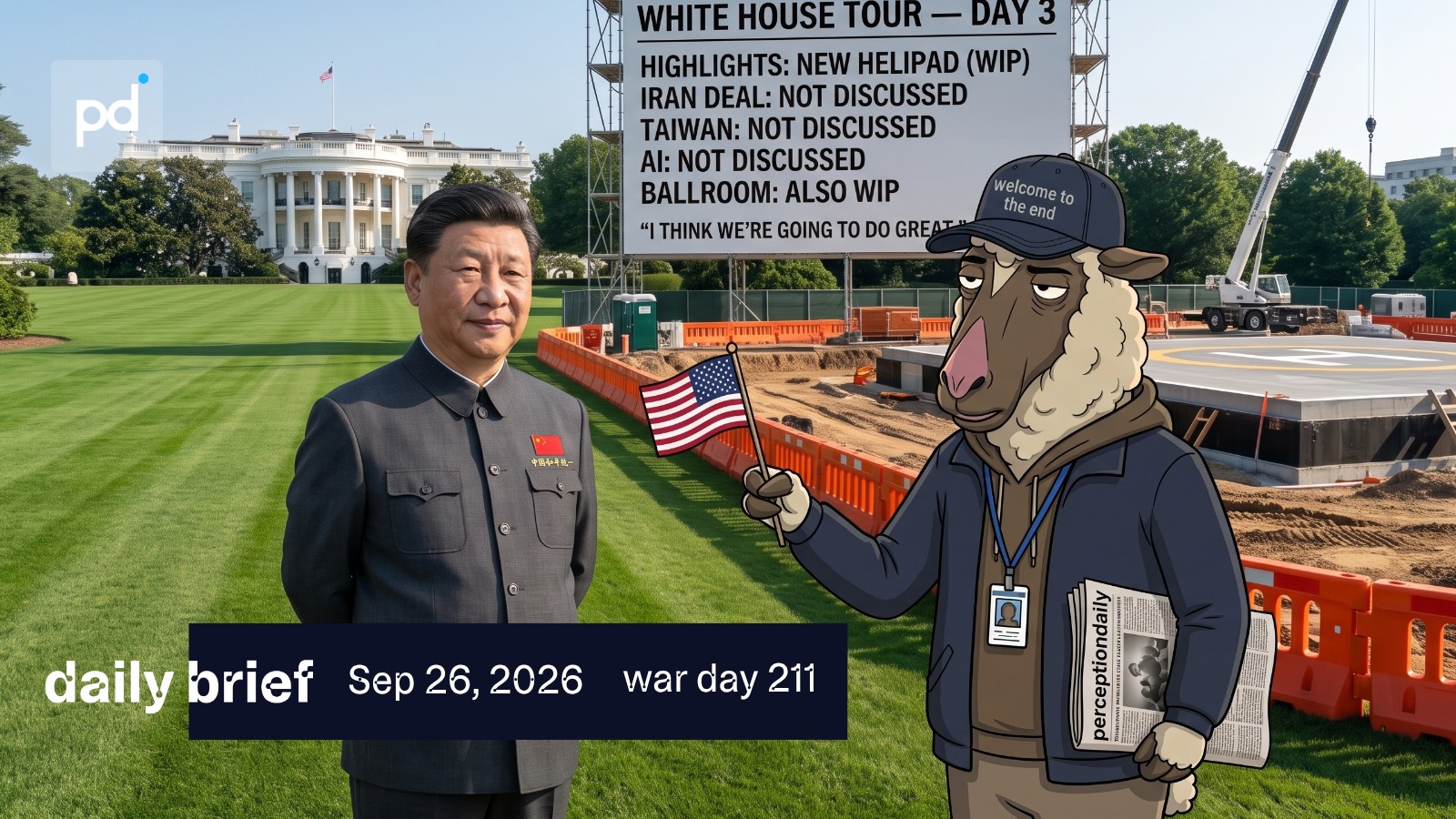
🚨 OPENING
Trump says no to Iran. And waits for November.
The Wall Street Journal reveals today what many suspected but no one had yet put in writing: Trump has rejected Iran's seven-day ceasefire proposal and told aides he expects to resume bombing Tehran after the November midterm elections. The source is unambiguous — US officials cited by the WSJ. The rejection is formal. The calendar is electoral.
Iran's proposal was concrete. Foreign Minister Araghchi had presented it on the sidelines of the UN General Assembly in New York, handing it directly to US envoys Steve Witkoff and Jared Kushner: a 60-day regionwide ceasefire roadmap that would pause the fighting, begin a phased reopening of the Strait of Hormuz, and end the American naval blockade of Iranian ports. Iran had also conveyed, through Qatar, a separate seven-day plan to reopen Hormuz — provided Washington lifted oil sanctions, ended the naval blockade, and observed a ceasefire that included Lebanon.
Trump responded with a post on Truth Social: a map of the Persian Gulf with the Strait of Hormuz circled and labelled "Trump Strait." The rejection comes as a meme, but the substance is brutal. Seven months of war, a provisional agreement signed in June — the Islamabad Memorandum — declared "over" on July 8, broken negotiations and now another window shut. The engine of this war is called November.
📍 MILITARY SITUATION
🇺🇸 US FRONT
CENTCOM has maintained operational silence — this is the sixth day without official strike communications. On the ground, Iran's fire pause has held for over fifteen days but remains fragile.
🇮🇷 IRAN FRONT
Iran's fire pause is holding, but Tehran maintains the de facto closure of the Strait of Hormuz. The IRGC has not claimed any new attacks in the past 48 hours.
🌊 HORMUZ
The strait is effectively closed to unauthorized commercial traffic. The IEA has already described this as the "largest supply disruption in the history of the global oil market." The Saudi East-West pipeline, shut down on September 11, has been partially restored.
✈️ ISRAEL / NETANYAHU FRONT
Netanyahu addressed the UN General Assembly on September 25, declaring that the Iranian regime is nearing structural collapse and that any agreement allowing Tehran's government to survive constitutes a strategic failure. He was in New York for one day only. He left without meeting the Iranian delegation.
🇫🇷 UN FRONT
France is drafting a UN Security Council resolution reaffirming freedom of navigation in the Strait of Hormuz, invoking the Law of the Sea and supporting peaceful initiatives for safe passage. The UN Panel of Experts monitoring mandate expires on September 26 or 27.
🌡️ CALIBRA — Netanyahu did not fly to New York to block peace: he flew to set the political price of any deal Washington might accept without him. His UN speech is a pre-emptive maneuver.
🔑 KEY DEVELOPMENT OF THE DAY
Today's real development is not Trump's rejection — that was predictable. It is the confirmed timeline: after the midterms. This means the Strait of Hormuz will in all likelihood remain closed for at least another six to seven weeks, until the US elections on November 3. Trump is reluctant to launch large-scale military operations now, but the diplomatic rejection maintains the status quo — Hormuz shut, naval blockade in force. For Europe, this translates directly into elevated energy prices through the entire autumn. Goldman Sachs had already warned: if Gulf output stays four million barrels per day below pre-war levels, Brent could exceed $120 in 2027.
☄️ DON'T LOOK UP
Today: Brent trades between $105 and $107. Fuel is expensive, energy bills are high, flights cost more.
Within 30 days: No deal before November 3 US midterms. Energy prices will stay elevated through the entire European autumn.
If Hormuz stays closed past May: Goldman Sachs projects Brent above $120 in 2027. Technical recession in Europe, rationing not excluded.
⚡ ENERGY AND MARKETS
Brent is trading today between $105.36 and $107.17 per barrel, pushing higher. WTI hovers around $98–100. European TTF gas reflects the pressure from the Hormuz closure and the Saudi East-West pipeline disruption, now partially restored. Trump's rejection of the Iranian plan reinforces upward price pressure. Goldman Sachs keeps its base-case Brent forecast at $85 for December 2026, but warns the worst-case scenario sends prices above $120 if the Gulf remains locked.
📌 PERCEPTION INDEX - how to read it
⬇️ YOU'RE UNDERESTIMATING IT - more important than it seems
⬆️ YOU'RE OVERESTIMATING IT - emotional reaction > real weight
🌡️ CALIBRATE - reality is more nuanced than the dominant narrative
📊 PERCEPTION INDEX - SUMMARY
🔴 Trump rejects ceasefire ............... ⬇️ Not a surprise: pre-planned electoral tactic
🔴 Iran's 7-day Hormuz plan ............... 🌡️ Concrete but conditional on difficult concessions
🔴 Netanyahu at UN against deal ............... ⬇️ Structural move, not cosmetic: sets the political price
🔴 France drafts UN Hormuz resolution ............... 🌡️ Useful signal, but lacks enforcement mechanism
🔴 Brent at $105–107 ............... ⬇️ Already partially pricing worst case, further upside risk
🔴 Islamabad Memorandum defunct ............... ⬆️ It was never truly operational after July
🔴 CENTCOM silent for 6 days ............... ⬇️ May conceal post-midterm operational preparations
🎖️ PERCEPTION DEFCON INDEX
🔴 DEFCON 1 — Active war / post-electoral escalation imminent
The war is in a tactical pause, not a strategic one. Trump has rejected diplomacy and named a precise timeline for resuming hostilities: after November. Hormuz is closed. The naval blockade holds. Energy markets are absorbing the shock but would not withstand a second cycle of massive strikes.
Escalation triggers: US resumes bombing Iranian infrastructure after November 3 / new IRGC attack on US military vessels in the Strait.
De-escalation signals: Washington responds positively to Iranian plan via Qatar / partial Hormuz reopening even without a formal agreement.
perceptiondaily by thesmallmediacompany warfare intelligence. next brief: tomorrow at 7.00am.