perceptiondaily — brief september 23 2026
First direct US-Iran contact in months: Witkoff and Araghchi meet at the UN, Brent drops below $100. Hormuz could reopen in seven days. But Tehran sets impossible conditions — and the IRGC contradicts its own diplomats.
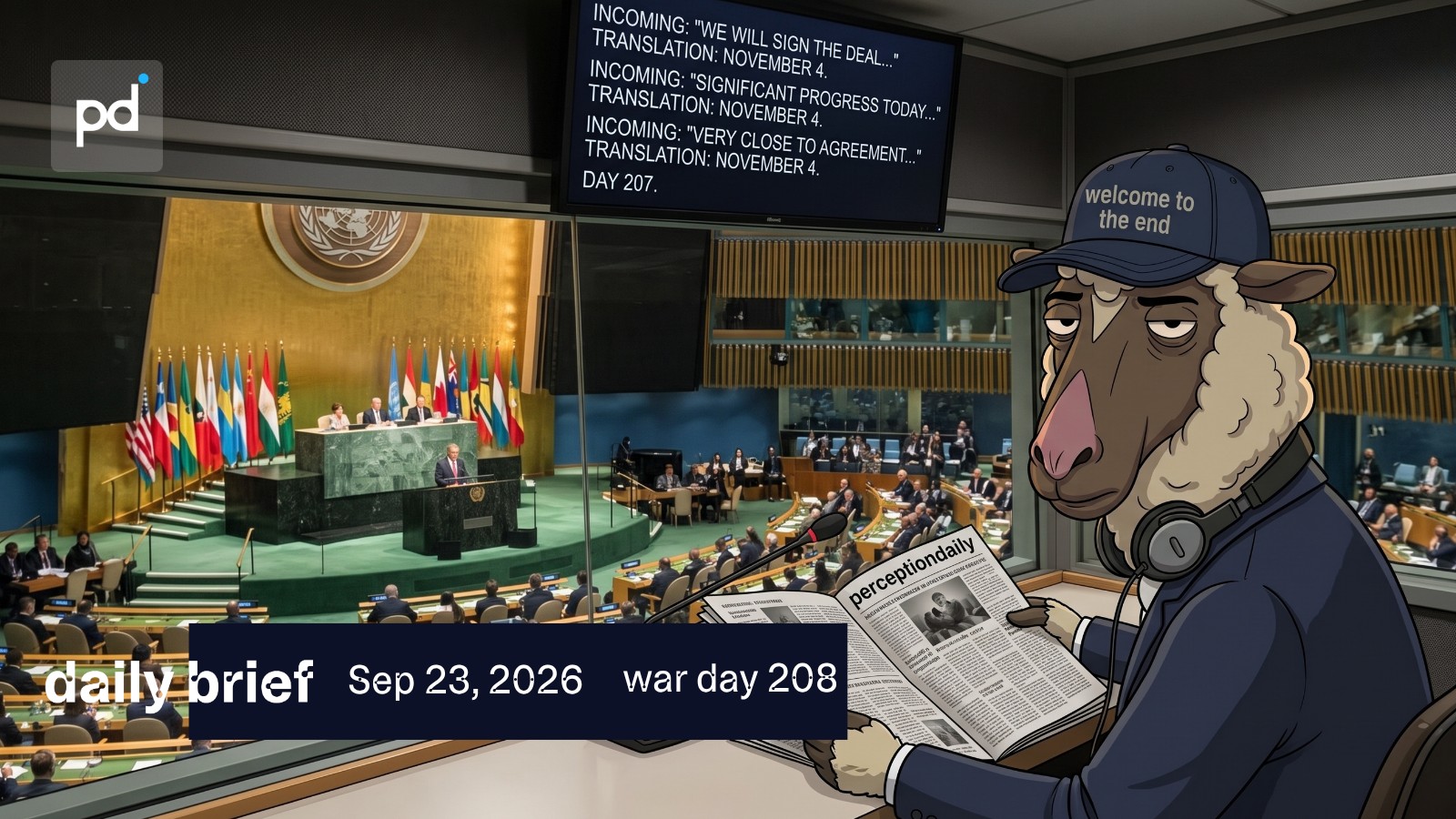
🚨 OPENING
TALKS AT THE UN. BUT THE IRGC ISN'T BUYING IT.
In New York, on the sidelines of the United Nations General Assembly, something happened that hadn't been seen in months: Iranian Foreign Minister Abbas Araghchi and US Special Envoy Steve Witkoff met in person. The first public direct contact between the two sides since the June ceasefire collapsed. Witkoff described the talks as "constructive and promising," adding that mediators would continue their work. Iran's state media confirmed the meeting, specifying it was held at the American side's request and that Araghchi used it to restate Tehran's conditions.
Those conditions are well known and remain non-negotiable on Iran's side: immediate lifting of the US naval blockade, release of $24 billion in frozen assets, and an end to the war on all fronts including Lebanon. In return, a senior Iranian official told Reuters that Iran is ready to reopen the Strait of Hormuz within seven days. One week. Markets reacted immediately: Brent dropped below $100 a barrel for the first time in a week, settling at $98.
But there is a structural problem that no press release can hide. While Araghchi negotiated at the Glass Palace, an IRGC spokesman declared that Iran refuses any contact with Americans and that accounts with the enemy are settled only through arms. The dual track — external diplomacy, internal rejection — is Tehran's tactical signature throughout this war. President Pezeshkian was due to address the General Assembly on September 23: what he says — or doesn't say — about Hormuz from the UN podium matters more than any Witkoff statement.
📍 MILITARY SITUATION
🔥 FIRE PAUSE - DAY 14
The IRGC has not claimed any new attacks for the fourteenth consecutive day. CENTCOM has maintained silence for four days. Neither side has confirmed or denied two tanker strikes that occurred on September 21.
---
🛢️ SEPTEMBER 21 TANKER STRIKES
Two tankers struck on September 21 remain without official attribution. Iran advanced five claims about its own naval operations — none confirmed by Washington.
---
🇾🇪 YEMEN FRONT
The Houthis are in operational pause but the US security alert issued on September 19 remains active in the Najran region. Saudi Arabia on alert for a possible resumption of the Houthi campaign against Saudi energy infrastructure.
---
🏗️ UNDERGROUND NUCLEAR SITE
CSIS satellite imagery reveals a new construction phase at Pickaxe Mountain, Iran's underground nuclear facility. More building activity in 2026 than at any point in the site's recorded history.
---
🇮🇱 ISRAEL - NETANYAHU AT THE UN
Netanyahu made one of the shortest US trips of his career: UN speech, no meeting with Trump. A quiet signal of tension between Washington and Tel Aviv over how to handle diplomacy.
🌡️ CALIBRA — The fire pause is not a ceasefire. It is the negotiating window both sides have an interest in not blowing up while diplomats are visible.
🔑 KEY DEVELOPMENT OF THE DAY
IRAN'S DUAL REGIME: ARAGHCHI TALKS, THE IRGC DENIES
The most underrated fact of the day is not the Witkoff-Araghchi meeting. It is the simultaneous public denial by the IRGC. A Revolutionary Guards spokesman declared that Iran refuses any contact with the US and that dealings with the enemy happen only through arms. Araghchi himself, when asked by Al Jazeera, had to clarify that the meeting "does not constitute negotiations." This split is not a diplomatic accident: it is strategy. Tehran keeps the channel open to use it as leverage on Brent and markets, while conceding nothing concrete. Who really commands — the Foreign Ministry or the Pasdaran — is a question no Western analyst has a confident answer to.
☄️ DON'T LOOK UP
Today: Energy bills across Europe remain 18–22% above pre-war averages. Brent at $98 is not relief — it is still an emergency.
Within 30 days: If a Hormuz deal fails to materialize, prices will resume climbing as Europe's energy winter begins.
If Hormuz stays closed beyond May: The IEA has already classified this as the largest supply disruption in the history of the global oil market — with structural impacts on fertilizers, transport, and inflation in Europe for years.
⚡ ENERGY AND MARKETS
Brent: $98/barrel — dropped below $100 for the first time in a week after Iran's Hormuz reopening offer. WTI: $91/barrel. The decline is 3% in 24 hours. Saudi Arabia meanwhile restarted its East-West Pipeline, adding downward pressure on prices. Goldman Sachs maintains its forecast of Brent above $120 in 2027 if Gulf output stays 4 million barrels/day below pre-war levels.
📌 PERCEPTION INDEX - how to read it
⬇️ YOU ARE UNDERESTIMATING IT - more important than it seems
⬆️ YOU ARE OVERESTIMATING IT - emotional reaction > real weight
🌡️ CALIBRATE - reality is more nuanced than the dominant narrative
📊 PERCEPTION INDEX - SUMMARY
🔴 Witkoff–Araghchi meeting ................. 🌡️ Real contact, but not negotiations: IRGC contradicts it
🔴 7-day Hormuz reopening offer .............. ⬆️ Impossible conditions make this a tactical move, not sincere
🔴 Brent below $100 ......................... ⬆️ Premature optimism: crisis structure unchanged
🔴 14-day fire pause ......................... ⬇️ Military silence is the most important diplomatic signal
🔴 Netanyahu without Trump .................. ⬇️ Washington–Tel Aviv rift underestimated by media
🔴 IRGC underground nuclear construction ..... ⬇️ Nuclear file advances while everyone watches Hormuz
🔴 Saudi Arabia pipeline restart ............. 🌡️ Regional de-escalation signal, but fragile
🎖️ PERCEPTION DEFCON INDEX
⚠️ DEFCON 2 — CRITICAL THRESHOLD
The war enters day 208 with the first direct diplomatic contact in months, but Iran's dual decision-making regime — diplomats vs. IRGC — makes any agreement structurally unstable. The fire pause holds at day fourteen, markets react with hope, but Tehran's conditions to reopen Hormuz remain politically undeliverable for Washington without a de facto retreat.
Escalation triggers:
— New IRGC attack on US or Israeli vessels in the next 48 hours
— Public collapse of the Hormuz offer followed by an American military response
De-escalation signals:
— Pezeshkian announces a unilateral Hormuz moratorium from the UN podium
— CENTCOM resumes communications and acknowledges the Iranian fire pause
perceptiondaily by thesmallmediacompany warfare intelligence. next brief: tomorrow at 7.00am.