perceptiondaily — brief june 18 2026
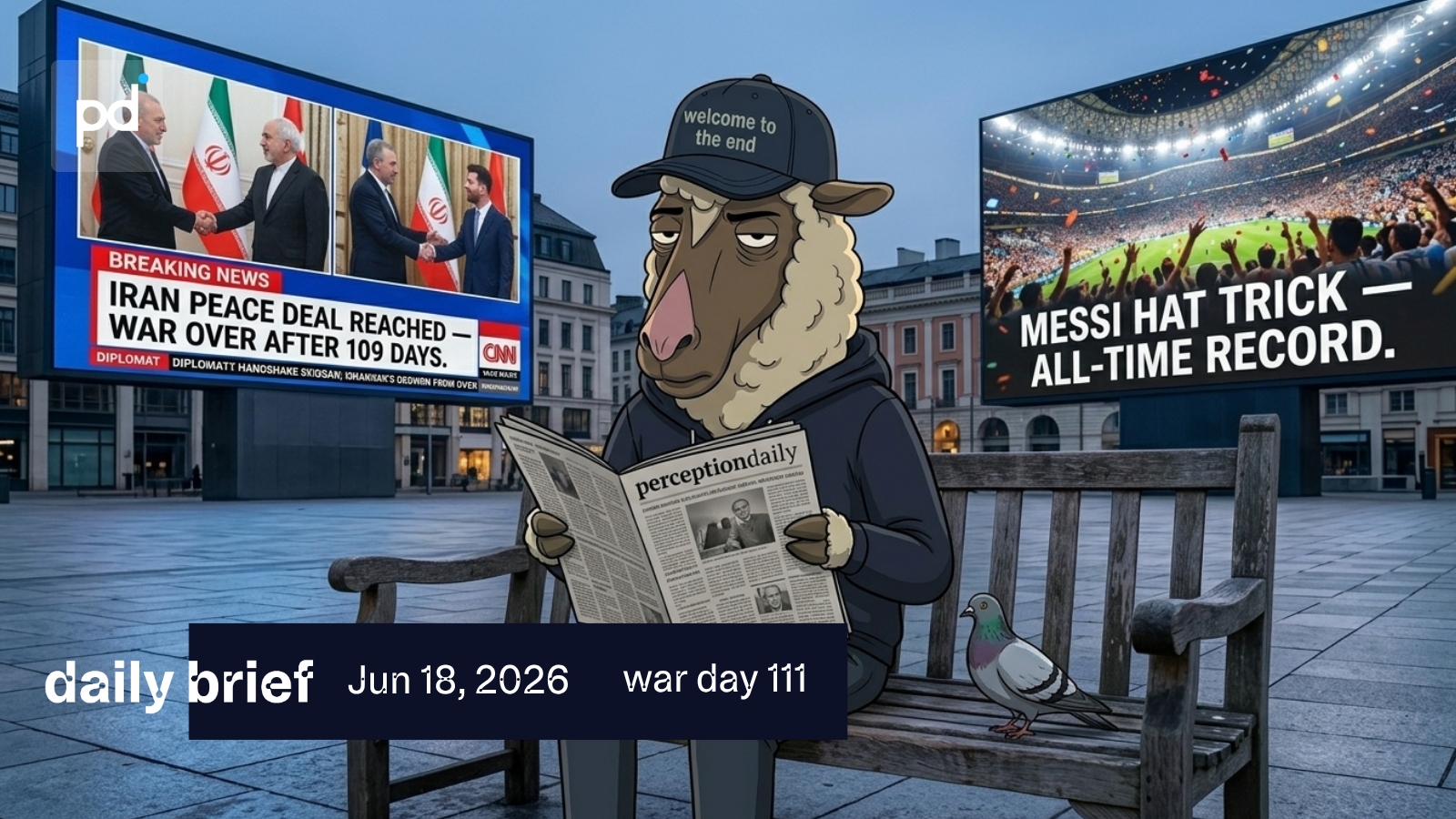
Trump signs the US-Iran memorandum at Versailles: Hormuz set to reopen, 60 days to settle the nuclear file. The deal exists on paper. Israel stays in Lebanon and keeps striking. The war is not over — it just changed form.
🚨 OPENING
THE VERSAILLES SIGNATURE: THE DEAL EXISTS. THE PEACE DOESN'T.
Last night, in the same hall where World War I ended in 1919, Trump signed a memorandum of understanding with Iran. Macron stood beside him. Iranian President Pezeshkian signed in digital form from Tehran. The MoU is real. It is signed. But it is not the end of the war — it is the beginning of 60 days to determine whether an end is actually possible.
The deal calls for the reopening of the Strait of Hormuz, a halt to military operations on all fronts — including Lebanon — and the launch of negotiations on Iran's nuclear program. In return: immediate waivers on Iranian crude oil exports, the prospect of releasing frozen assets, and a $300 billion reconstruction fund for Iran contingent on benchmarks. The critical unresolved point is the nuclear file: Tehran has committed to "not procuring nuclear weapons," but the fate of its stockpile of highly enriched uranium remains open — to be negotiated over the next sixty days.
The most immediate time bomb, however, is not the nuclear issue — it's Lebanon. Israel signed nothing. National Security Minister Ben-Gvir explicitly stated that Trump's agreement does not bind them. Israeli forces remain in southern Lebanon and continue conducting raids. Tehran has already warned: any Israeli attack from this point forward constitutes a violation of the MoU. The clash between American diplomatic logic and Israeli operational autonomy is the deal's primary breaking point in the weeks ahead.
📍 MILITARY SITUATION
🇺🇸 USA — SIGNATURE AND DETERRENCE
Trump signs the MoU at Versailles during Macron's G7 dinner. He simultaneously warns: if Iran doesn't comply, "we're gonna bomb the hell out of them." Deterrence remains embedded in American diplomacy.
---
🇮🇷 IRAN — FORMAL OPENING, HARDLINERS RESIST
Pezeshkian signs. Foreign Minister Araghchi briefs Lavrov on the agreement. Parliament speaker Ghalibaf signals openness to economic recovery. But hardliners remain opposed to surrendering enriched uranium.
---
🇮🇱 ISRAEL — OUTSIDE THE DEAL, INSIDE THE WAR
Israeli raids continue in southern Lebanon — Nabatieh and Kfar Tebnit struck. Netanyahu was not included in the negotiations. Israel is not withdrawing. Ben-Gvir: "Trump's agreement does not bind us."
---
🇱🇧 LEBANON — THE FRONT THAT WON'T STOP
Hezbollah and IDF continue exchanging rockets and anti-tank missiles in southern Lebanon. The Lebanese army begins deploying in withdrawal areas. But the Israeli withdrawal, for now, is not happening.
---
🌊 HORMUZ — REOPENING ANNOUNCED, NOT YET REAL
Pakistani PM Sharif confirms the MoU takes effect immediately and Hormuz must reopen. But roughly 500 large commercial vessels remain stuck in the region. Shipowners demand security guarantees before setting sail.
🔑 KEY DEVELOPMENT OF THE DAY
TOMORROW'S CEREMONY IN SWITZERLAND — THE REAL TEST
The MoU has already been signed digitally. But Pakistan and Qatar have organized an official ceremony for June 19 in Switzerland to formalize the agreement and launch technical-level pre-implementation talks. That is where it will become clear whether the parties can translate intentions into concrete mechanisms. The nuclear verification framework, the Hormuz reopening timeline, the mechanism for Israeli withdrawal from Lebanon — none of these have an operational format yet. CSIS puts it plainly: the framework deal "kicks negotiations on harder issues down the road." The signature was the headline. The substance gets written tomorrow — and over the next 60 days.
☄️ DON'T LOOK UP
Today: Brent drops to $78, but 500 vessels are stuck — flows do not normalize in hours.
Within 30 days: If Hormuz truly reopens, European pump prices could fall by 10–15 cents per liter.
If Hormuz stays closed beyond May: Oil market normalization will slip into 2027 — already warned by Saudi Aramco's CEO.
⚡ ENERGY AND MARKETS
Brent: $78.24 per barrel (08:00 GMT, June 17) — the lowest since March 3, three days after the war began. From the crisis peak, crude has lost over 20%. WTI closes near $80.75. The drop is nonetheless described by analysts as "entirely sentiment-driven": markets are pricing in the best-case scenario while inadequately factoring in logistics and residual geopolitical risks. Shipowners and insurers say it will take 2–3 months to normalize flows through the Strait. European TTF natural gas follows a downward trend but with more caution, given Europe's structural dependence on Asian LNG routes.
📌 PERCEPTION INDEX - how to read it
⬇️ YOU'RE UNDERESTIMATING IT - more important than it seems
⬆️ YOU'RE OVERESTIMATING IT - emotional reaction > real weight
🌡️ CALIBRATE - reality is more nuanced than the dominant narrative
📊 PERCEPTION INDEX - SUMMARY
🔴 US-Iran deal signed ................... ⬆️ Not peace: a framework to negotiate it
🔴 Hormuz "reopening" ..................... 🌡️ Announced yes, operational no — takes months
🔴 Brent price drop ....................... ⬆️ Market prices best-case, residual risks ignored
🔴 Israel outside the deal ............... ⬇️ The most underestimated risk in the entire agreement
🔴 Iranian nuclear "resolved" ............. ⬆️ Deferred 60 days, not resolved
🔴 Lebanon stability ...................... ⬇️ Raids ongoing, Israeli withdrawal nonexistent
🔴 Trump at Versailles = US leadership ... 🌡️ Powerful symbol, but Senate and Congress push back
🎖️ PERCEPTION DEFCON INDEX
🟠 DEFCON 2 — Deal signed, war not over
The memorandum exists and lowers the temperature between the US and Iran. But Lebanon remains an active front, Israel operates outside any agreement, and the Iranian nuclear file is deferred rather than resolved. Any Israeli raid in the coming hours could be interpreted by Tehran as a casus belli to suspend the MoU.
ESCALATION TRIGGERS:
— Israeli strike on Beirut or Iranian nuclear sites within the next 72 hours
— Iran suspends Hormuz reopening citing Israeli violations in Lebanon
DE-ESCALATION SIGNALS:
— June 19 Geneva ceremony concludes with a verifiable roadmap
— Israel agrees to partial withdrawal from southern Lebanon as a diplomatic gesture
perceptiondaily by thesmallmediacompany warfare intelligence. next brief: tomorrow at 7.00am.