the full picture — May 25, 2026
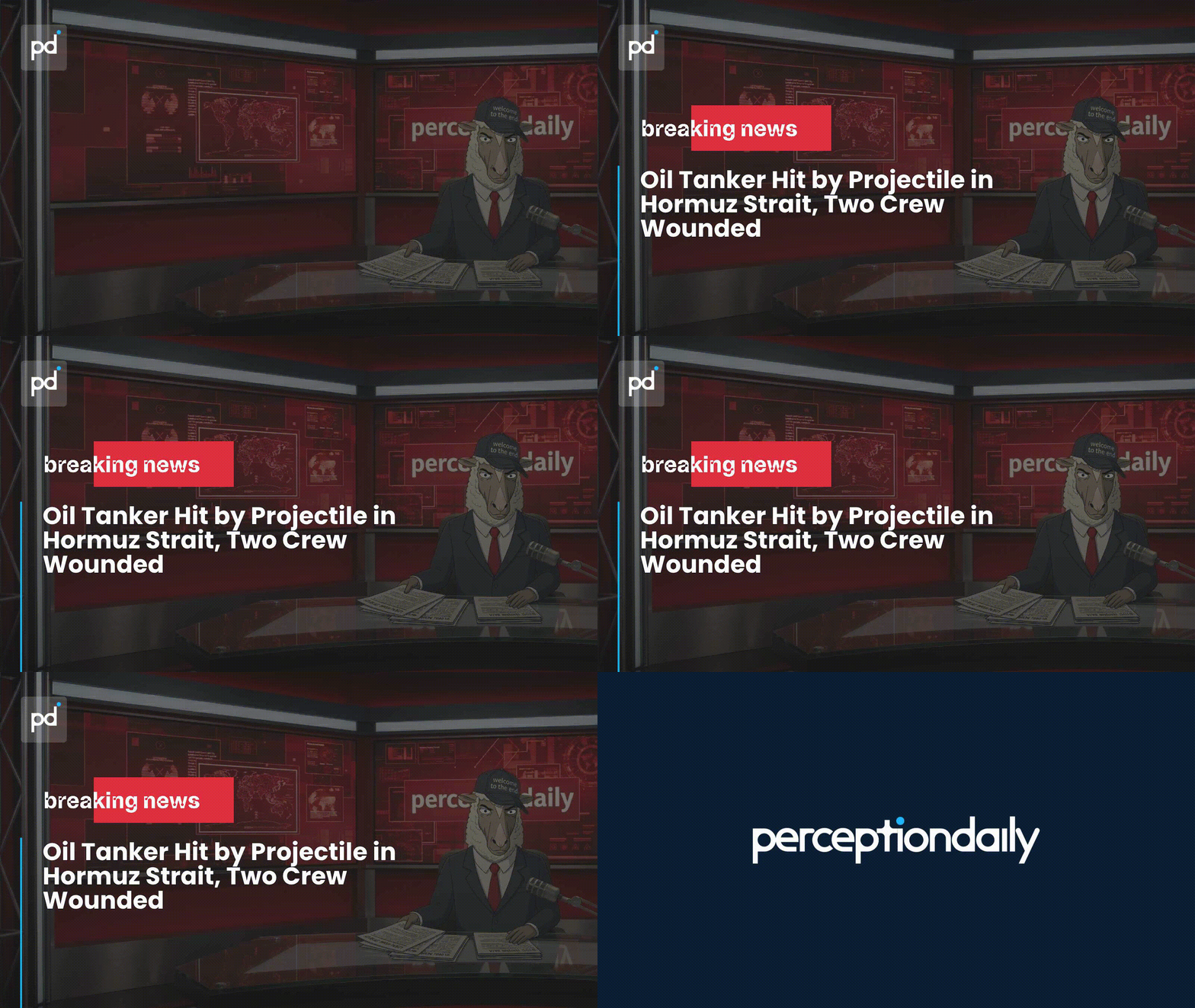
| A tanker captain idles seventeen nautical miles east of Larak Island. His cargo — 2.1 million barrels of Kuwaiti crude — has been sitting at anchor for eleven days. This morning, an IRGC patrol boat circled at 400 meters. No shots. No radio contact. Just presence. The captain knows what this means: the passage is open today, for his vessel, because Tehran decided it is. Not because a treaty says so. Not because Washington won anything. This is not a hypothetical about what peace in the Strait of Hormuz might look like. This is what it already looks like — on Day 87, before a single line of the MOU has been signed. |
|
DEFCON 2 |
ESCALATION CONTROLLED The MOU is advancing but remains unsigned. The ceasefire holds by thread: Israel is not party to any US-Iran framework and has today ordered intensified strikes against Hezbollah in Lebanon, with Netanyahu instructing the IDF to "press the pedal even harder." Iran maintains selective control of Hormuz. A single Israeli strike on a sensitive Iranian site — or an IRGC incident with a US vessel — can collapse everything within hours. |
① THE FACT THAT COUNTS TODAY
The MOU Is Not a Peace Deal. It Is a Deed of Sale for the Strait of Hormuz — and Iran Is the Seller.
The agreement the US and Iran are close to signing involves a 60-day ceasefire extension, during which the Strait of Hormuz would be reopened, Iran would be able to freely sell oil, and negotiations would be held on curbing Iran's nuclear program. That is the American framing. Here is the Iranian framing: Iran's Fars news agency reported that the Strait of Hormuz would remain under Iran's management according to the latest exchanged text — dismissing Trump's announcement of reopening the strait as "incomplete and inconsistent with reality." Both framings are correct. This is the problem.
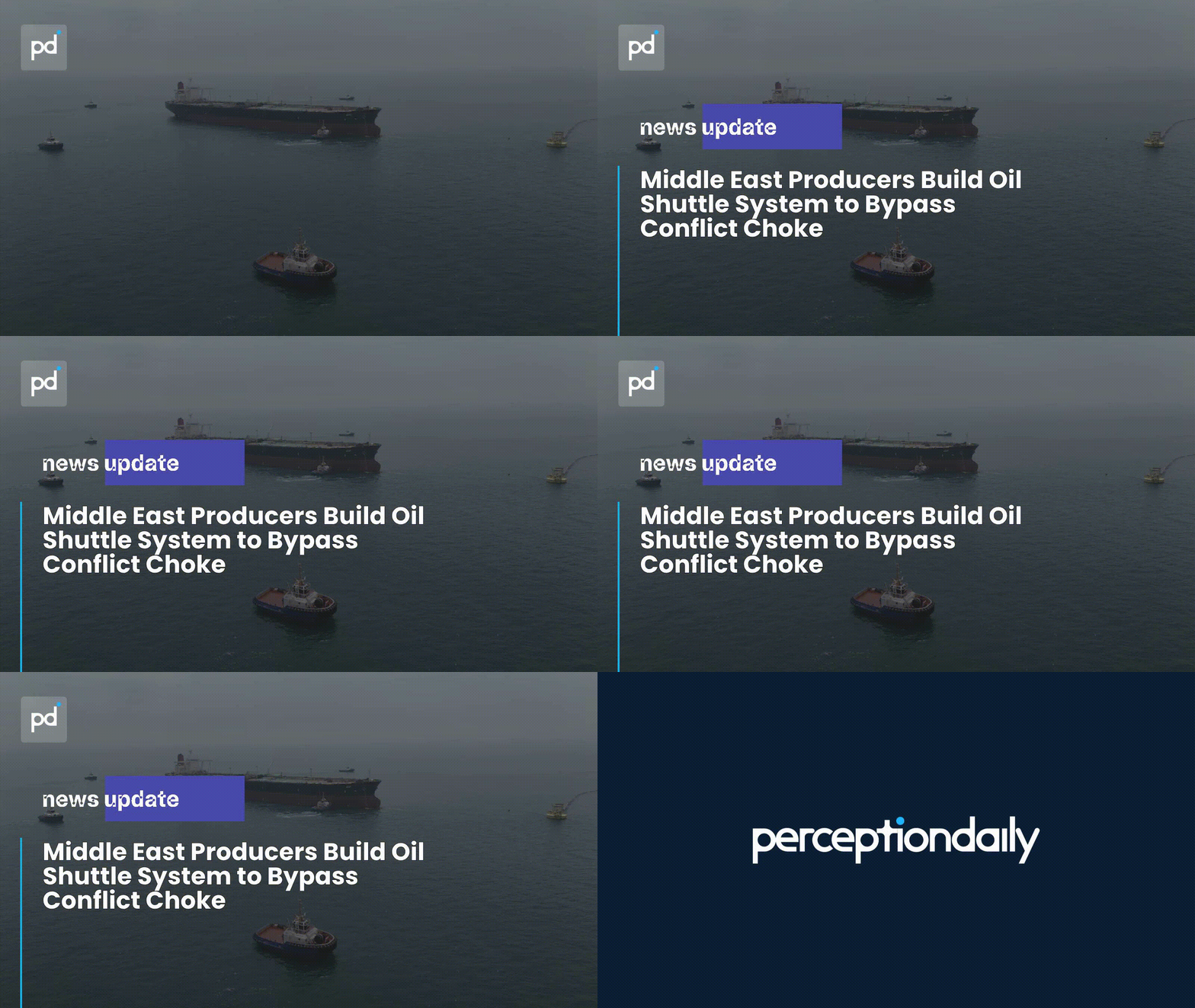
What Washington is calling a "reopening" is, in structural terms, a recognition of Iran's new reality. Tehran created the Persian Gulf Strait Authority in May — a state body that claims regulatory authority over commercial passage, including selective permitting of vessels. During the 60-day period, the Strait of Hormuz would be open with no tolls and Iran would agree to clear the mines it deployed to let ships pass freely. But the mines are Iran's leverage, not Iran's problem. The moment they are cleared under an MOU that does not explicitly dismantle the Persian Gulf Strait Authority, Tehran gets to keep the administrative apparatus it built to govern a waterway it does not legally own — and never did. The US principle in the agreement is "relief for performance" — but what happens when performance ends and the infrastructure of control remains?
The nuclear file is equally sleight-of-hand. Trump failed to mention any agreement on Iran's nuclear program or its highly enriched uranium, both of which his administration has repeatedly cited as critical to ending the war. Iran has sought to put off nuclear talks until after a formal cessation of hostilities. Iran has not yet accepted any actions on its nuclear programme, with the potential agreement allocating 30 days for procedures related to the Strait of Hormuz and 60 days for nuclear talks. The sequence Tehran has engineered — Hormuz first, nukes later, maybe — is the sequence Washington swore it would never accept. And yet here we are. Trump is at Arlington National Cemetery today, paying tribute to the US troops killed in Operation Epic Fury and vowing that Tehran "will never have a nuclear weapon." The gap between that vow and what the MOU actually guarantees is where the next war lives.
| Iran doesn't need to win the war. It just needs the peace deal to leave the Persian Gulf Strait Authority standing. |
The draft MOU also makes clear that the war between Israel and Hezbollah in Lebanon would end — a condition that Israeli Prime Minister Benjamin Netanyahu expressed concern about during a phone call with Trump on Saturday. That concern is now operational: Netanyahu says he instructed the military to "press the pedal even harder" against Hezbollah, adding: "We are at war with Hezbollah. Just in recent weeks, our brave fighters have eliminated more than 600 terrorists." Netanyahu's calculus is transparent — use the window before the MOU is signed to achieve maximum military objectives in Lebanon, then present Washington with a fait accompli. The ceasefire between the US and Iran does not bind Israel. It never did. The question is not whether Netanyahu will comply with a deal Trump signs. The question is whether he will act to prevent Trump from signing it at all.
② THREE FRONTS
|
GEOPOLITICS China's Blocking Statute Goes Live: Beijing Tells Its Companies to Defy US Iran Sanctions On May 2, China's Ministry of Commerce issued an order under its Blocking Statute compelling all Chinese companies and individuals not to comply with US sanctions imposed on five Chinese oil refineries for purchasing Iranian crude. Most analysts read this as a defensive move triggered by the Hormuz crisis. The Blocking Statute, combined with China's cross-border payments system CIPS, renminbi-settled oil transactions, and strategic petroleum reserves exceeding one billion barrels, forms the infrastructure for a scenario no Chinese official ever names openly: a potential Taiwan conflict — because when Washington one day responds to a Chinese action in Taiwan with a comprehensive sanctions architecture, it will find China does not begin from zero. The Iran war is Beijing's dress rehearsal, and almost nobody is watching the rehearsal. |
|
AI & TECH Pope Leo XIV Releases AI Encyclical at the Vatican — Alongside Anthropic's Co-Founder, the Same Week the Company Closes a $900 Billion Funding Round Pope Leo XIV oversaw the release of the 235-page encyclical alongside Chris Olah, co-founder of Anthropic — an AI company in legal dispute with the Trump administration over the use of its technology in military and defense operations. Pope Leo XIV released *Magnifica Humanitas* — focused on "the protection of the human person in the age of artificial intelligence" — signed exactly 135 years to the day after Leo XIII signed *Rerum Novarum* on workers' rights, explicitly framing AI as the Industrial Revolution of our time. The Vatican is not naive about the optics: the one AI lab the Church chose to share a stage with is the same lab the Pentagon tried to blacklist, the same lab closing a $900 billion round this week. Legitimacy is a product. Anthropic just acquired an enormous amount of it, for free, in front of a global audience. |
|
MARKETS Brent Below $100 as Markets Price Peace — But the Fed Is Holding Rates and Europe Is Already in a Stagflation Corridor The European Commission reduced its 2026 eurozone growth forecast to 0.9%, citing a "major energy shock" and a volatile geopolitical environment, while updating its 2026 inflation forecast to 3%, up from the 1.9% previously expected. The Fed maintains its data-dependent stance amid inflation well above target from oil shocks and geopolitical risks, likely holding rates at 3.50%-3.75%. Markets are pricing the MOU as a done deal. The Fed and the ECB are pricing something else: that the energy shock is structural, not episodic, and that reopening Hormuz does not undo four months of embedded inflation. The traders who bought the ceasefire rumor are about to test whether they can sell the peace reality. |
📊 PERCEPTION INDEX
|
⬇️ UNDERESTIMATING ⬆️ OVERESTIMATING 🌡️ CALIBRATE 🔴 MOU imminent signing ⬆️ Trump has already slowed twice — not guaranteed to sign this week.
🔴 Hormuz "reopening" 🌡️ The IRGC is authorizing individual vessels — this is selective control, not freedom of navigation. 🔴 Brent below $100 = end of crisis ⬆️ Energy normalization takes months, not days — the structural shock is already embedded. 🔴 Israel outside the negotiations ⬇️ Netanyahu can blow up any deal with unilateral military action in Lebanon or Iran at any moment. 🔴 Iran's nuclear issue resolved ⬆️ Tehran has explicitly excluded the nuclear file from the current MOU — it's deferred, not solved. 🔴 Pakistan as reliable mediator 🌡️ Islamabad is balancing its own interests — it is not a neutral arbiter. 🔴 GOP hawks' pressure on Trump ⬇️ Underestimated: Graham and Cruz can block any deal ratification in the Senate. |
☄️ DON'T LOOK UP
|
Today: Brent is below $100, but petrol prices at the pump in Europe are not falling yet — refining margins remain high and long-term contracts do not adjust overnight.
Within 30 days: If the MOU is signed and Hormuz demining begins, Brent could fall to $85-90. Pump price effects: visible in 4-6 weeks. But if Netanyahu escalates in Lebanon before the MOU is finalized, the ceasefire framework collapses and oil spikes back above $110. If Hormuz remains contested beyond May: The IEA has warned of a "red zone" for summer oil markets. Global reserves are at record lows. Europe faces stagflation risk by September — with direct impact on energy bills, food prices, and ECB policy credibility. The inflation the Fed and ECB thought was temporary becomes the baseline. |
③ THE HIDDEN THREAD
Three Stories, One Architecture: Who Controls the Infrastructure Wins — Whether It's a Strait, an AI Model, or a Reserve Currency
There is a word that runs through all three stories today, and nobody is using it: infrastructure. Iran's strategic victory — if it materializes — is not military. It is administrative. The Persian Gulf Strait Authority is infrastructure. China has known for years that any serious US-China conflict will inevitably include sanctions on energy and financial institutions, and has been building, methodically, a financial and legal resilience architecture — the Blocking Statute, CIPS, renminbi-settled oil transactions — for that scenario. The Iran war is not a distraction from the China problem. It is China's live training exercise for the infrastructure of sanctions resistance. Every Chinese oil tanker that clears a US secondary sanction this week is a data point in Beijing's model for Taiwan.
Now look at the AI story through the same lens. Anthropic is set to close its latest round of funding at a valuation above $900 billion as soon as next week, vaulting ahead of rival OpenAI to become the world's most valuable AI startup. The Pentagon labeled Anthropic a supply chain risk — the first time such a designation was applied to a US company — and OpenAI quickly signed a contract with the Defense Department in Anthropic's absence. This is not a story about ethics versus profit. It is a story about who controls the AI infrastructure layer in the next military-technological cycle. The Vatican's endorsement of Anthropic today is a geopolitical signal wearing theological clothes: a billion-person institution is choosing sides in the AI infrastructure war.
The connecting thread is this: the post-WWII order was built on physical and financial infrastructure the US controlled — sea lanes, dollar reserves, technology standards. What is being negotiated in all three stories simultaneously is who controls the equivalent infrastructure in the next order. Iran wants the toll booth at Hormuz. China wants the payments rail that bypasses SWIFT. Anthropic wants to be the foundational AI layer that governments cannot blacklist. Hormuz 2026 will be written in history as an energy crisis, a regional war, an inflection point in US-Iran relations — but there is another chapter not yet written: that Beijing used this war to register a legal precedent that will serve it when the harder test arrives. The same sentence applies, mutatis mutandis, to every actor in today's newsletter.
④ WEAK SIGNAL
|
WATCH THIS In Tehran this morning, Iran's president ordered the reopening of international internet access for Iranian citizens, according to state media. It is a small headline on a day crowded with larger ones. But read it slowly. The Islamic Republic — which has spent decades building one of the world's most sophisticated national internet filtering systems — is voluntarily cracking the seal, under economic pressure, at precisely the moment it is negotiating a deal that would reopen its oil exports and unfreeze its assets. This is not liberalization. This is a bargaining chip being placed on a domestic table: the regime signaling to its restive urban middle class that the deal, if it comes, will bring tangible relief.
In six months, this matters for a different reason. If the MOU holds and sanctions begin to ease, the Iranian internet's controlled opening becomes the entry point for a generation of digital commerce, fintech, and consumer technology investment — much of it through Gulf intermediaries and Chinese platforms already positioned to move fast. The West will debate whether to engage. The Gulf and Beijing will not debate. Watch who registers the first Iranian e-commerce license after sanctions relief. That entity will tell you more about the post-war regional order than any diplomatic communiqué. |
If the MOU is signed and the Persian Gulf Strait Authority is left standing — not disbanded, not addressed, simply not mentioned — at what point does the world acknowledge that Iran won?
|
SHEP CLOSES They keep calling it a 'deal' as if both sides agreed on what they're exchanging. Iran thinks it's selling temporary access in return for permanent legitimacy. Washington thinks it's buying peace in return for deferred accountability. The market thinks it's all priced in at $98.76 a barrel. They're all right. They're all wrong. The MOU, if it gets signed, will be celebrated as a diplomatic triumph by the same people who will spend the next decade explaining why Hormuz isn't really free. The Vatican put a pope on a stage with an AI company today and called it theology. Netanyahu is 'pressing the pedal harder' in Lebanon on the same afternoon Trump lays a wreath at Arlington. Pattern recognition isn't a skill in this business. It's a survival mechanism. Day 87. Issue 13. The picture doesn't get clearer. You just get better at reading the blur. — perceptiondaily · the full picture · issue 13 |