perceptiondaily — brief september 13 2026
Iran locks Hormuz. Houthis lock Bab el-Mandeb. Iraqi drones hit Saudi Petroline. For the first time in six months, Saudi oil has no open corridor. The world just lost two chokepoints at once.
🚨 OPENING
IRAN HAS CLOSED THE TRAP. TWO CHOKEPOINTS. ZERO EXITS.
Between September 11 and 12, 2026, something happened that energy analysts had long described as the limit scenario — the one you hope never materializes: Saudi Arabia, the world's largest crude oil exporter, simultaneously lost both of its oil export corridors.
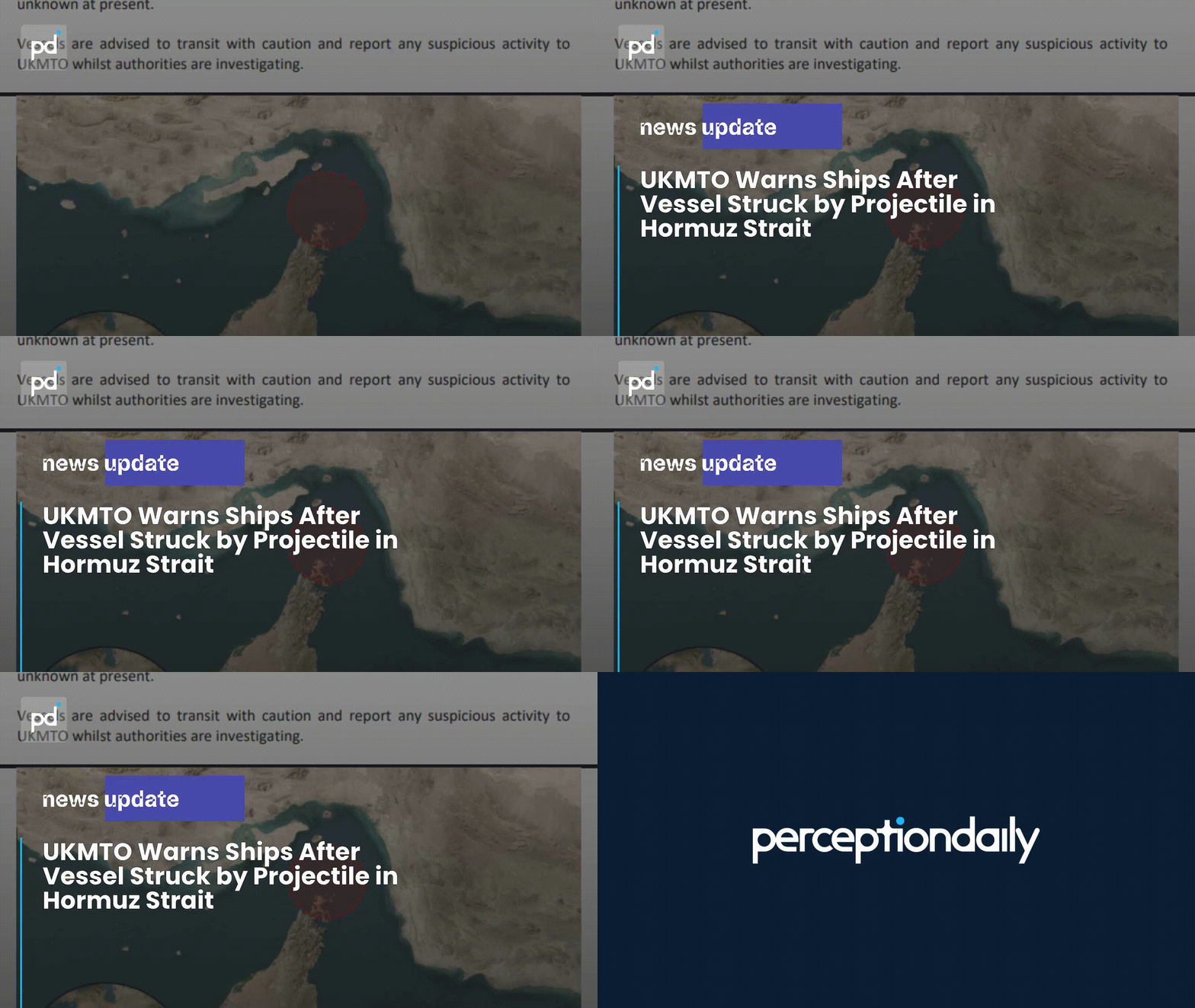
To the east: the Strait of Hormuz has been under an effective blockade for months, with traffic reduced to a trickle of Iran-approved vessels. To the west: Houthi forces completed their seizure of Perim Island, the volcanic island dividing the Bab el-Mandeb into its two navigable shipping lanes, effectively closing that strait too. And in between: drones launched from Iraq — where Iran-backed militias operate — struck pump stations along Saudi Arabia's East-West Crude Oil Pipeline (Petroline), the 1,200-km conduit that had been carrying 4-5 million barrels per day westward as an alternative to Hormuz. Riyadh shut it down as a precaution.
This is not coincidence. It is geometry. Tehran and its network of proxies executed, in 72 hours, a pincer maneuver that has trapped Saudi oil — and with it global energy — in a vice without precedent in modern history. Brent surged past $104-105. Goldman Sachs warns it could reach $120 in 2027 if the Gulf remains blocked. The IEA has already cut its 2026 global oil demand outlook by 2.5 million barrels per day — the largest contraction since Covid — because high prices are already destroying consumption. The entire global energy architecture is under stress.
📍 MILITARY SITUATION
🇾🇪 YEMEN — HOUTHIS COMPLETE CONTROL OF BAB EL-MANDEB
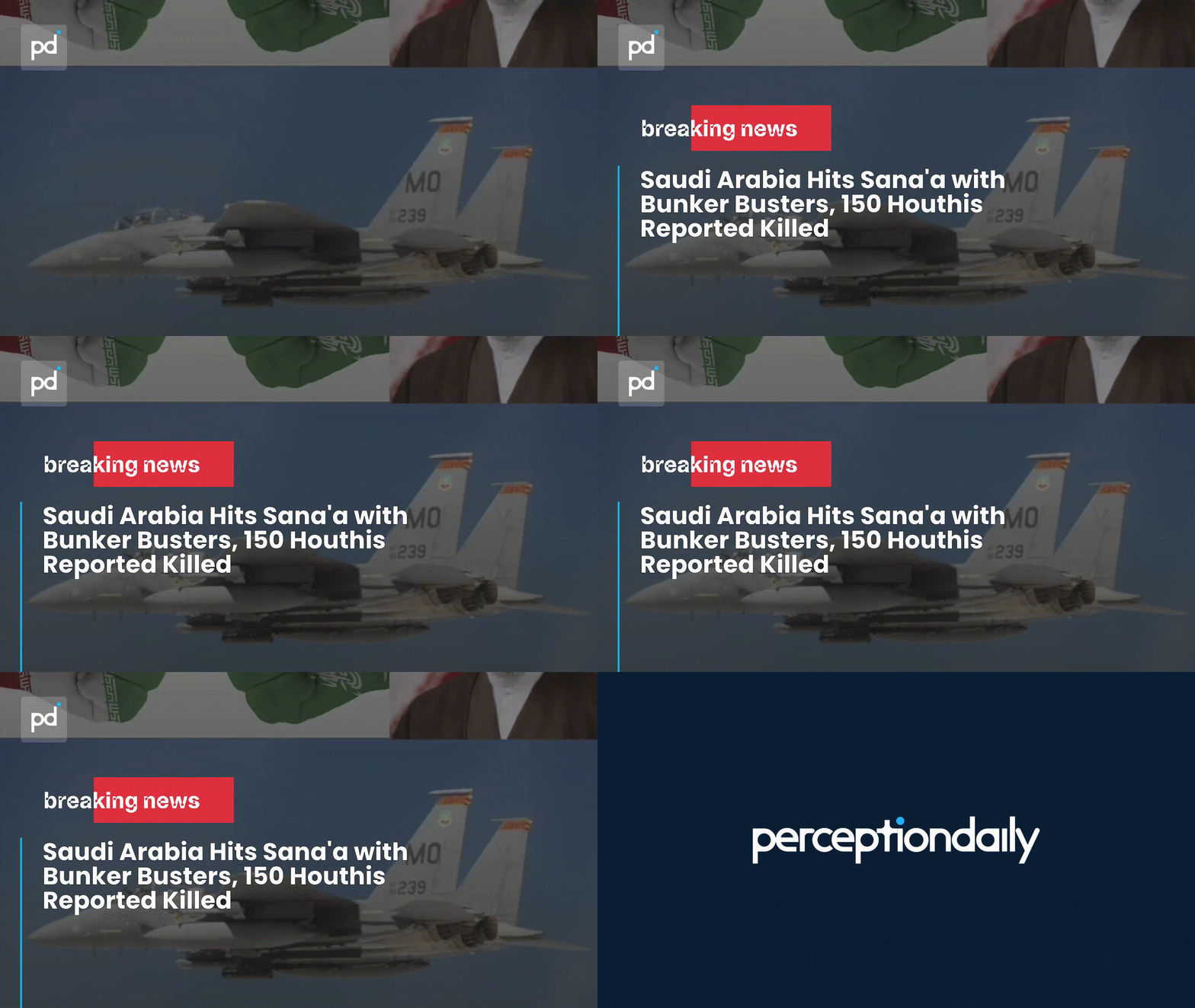
Houthi forces captured Mocha (historic port, September 11), then coastal town Dhubab, then Perim Island. Saudi-backed Yemeni government forces withdrew without fighting. The offensive — guided directly by Iran's Revolutionary Guards according to Reuters — has reduced Bab el-Mandeb transit to 12 vessels per day, down from 29-30 at the start of the week.
🌡️ CALIBRA: Houthis declare "navigation safe for all except Saudi ships" — but armed Houthi presence on the island alone is enough to drive away maritime insurers.
---
🇸🇦 SAUDI ARABIA — PETROLINE SHUT DOWN, NO RETALIATION
The Petroline was struck by Iraqi-launched drones on September 11. Pump stations destroyed in the Riyadh-Medina area. Riyadh shut the pipeline "as a precaution" and announced it would not retaliate militarily, at Iraq's prime minister's request. Baghdad launched an investigation and dismissed a military commander in Maysan province. The IEA reports Saudi crude supply has fallen to its lowest level in more than three decades.
🌡️ CALIBRA: Iraq's restraint bought Saudi Arabia political cover — but without a US military response, the strategic gain for Iran's proxy network is unchallenged.
---
🇺🇸 USA — VICE PRESIDENT BYPASSES THE PENTAGON
The New York Times reported that the Vice President has been requesting assessments directly from CENTCOM generals on objectives, casualties and tactics — bypassing the Pentagon. Signal of internal friction. MBS called Trump twice urging US military action against the Houthis. Trump reportedly replied that everything would "work out fine and dandy."
🌡️ CALIBRA: Washington is providing intelligence and targeting data to Riyadh but no direct intervention. Political calculation: November midterms are close, and expensive gas is an electoral liability.
---
🇮🇷 IRAN — PARALLEL DIPLOMACY
Monday September 15: GCC delegations are expected to meet Iran's foreign minister in Muscat to discuss a possible temporary corridor through the Strait of Hormuz. Brent eased slightly Friday evening on the news, settling around $104 after nearing $105. Tehran's position remains unchanged: no Hormuz opening without an end to the US naval blockade.
⬇️ UNDERRATED: this GCC meeting is the first de-escalation window in weeks — but it arrives while Tehran holds maximum leverage.
🔑 KEY DEVELOPMENT OF THE DAY
THE PETROLINE WAS THE LAST SAFETY VALVE — AND IT WAS DELIBERATELY CLOSED.
The Petroline was not just a pipeline. It was the only reason global energy markets were not already in full crisis: with Hormuz blocked, Saudi Arabia was exporting crude westward through that 1,200-km tube to the Red Sea port of Yanbu — bypassing Hormuz entirely. Markets knew about that valve. They priced it in. The September 10-11 attack eliminated that valve. Simultaneously, the Houthis eliminated the Yanbu exit itself by controlling the Bab el-Mandeb. The circle is closed. There is no longer a viable alternative corridor. Saudi Arabia — which supplies roughly 12% of global oil — is geographically encircled. This is the most dangerous moment of the war from an energy standpoint.
☄️ DON'T LOOK UP
Today: Brent above $104. Petrol rising across Europe. Cape of Good Hope rerouting costs already embedded in supply chains.
Within 30 days: If Petroline stays closed, IEA projects further decline in global inventories. Autumn energy bills at risk of a new spike across Europe.
If Hormuz stays closed beyond May: Goldman Sachs estimates Brent at $120/barrel. Demand-driven recession in Europe and Asia. Industrial supply chains under structural stress before year-end.
⚡ ENERGY AND MARKETS
Brent: ~$104/barrel (September 11), pulling back from $105 on GCC-Iran Muscat talks news. Up 17% over the past month and 55% year-on-year. WTI: ~$101/barrel (October futures). Goldman Sachs: Brent target December 2026 at $85, adverse scenario $120 in 2027. EIA forecasts Brent averaging ~$90/barrel in H2 2026. US Strategic Petroleum Reserve below 300 million barrels — lowest since 1983. IEA: global oil demand contraction of 2.5 million bbl/day in 2026 — worst since Covid.
📌 PERCEPTION INDEX - how to read it
⬇️ YOU'RE UNDERRATING IT - more important than it seems
⬆️ YOU'RE OVERRATING IT - emotional reaction > real weight
🌡️ CALIBRATE - reality is more nuanced than the dominant narrative
📊 PERCEPTION INDEX - SUMMARY
🔴 Houthi seizure of Perim Island / Bab el-Mandeb .... ⬇️ Iranian strategic play at global scale, not just tactical
🔴 Saudi Petroline shutdown ............................. ⬇️ Removes the last Hormuz alternative — vastly underreported
🟡 GCC-Iran talks in Muscat (Mon. Sept. 15) .......... 🌡️ Real opening, but Iran is negotiating from maximum strength
🔴 US Vice President bypasses Pentagon .............. ⬇️ Underestimated signal of command dysfunction in Washington
🟡 Brent at $104 ........................................... 🌡️ High, but not yet the ceiling — $120 scenario still plausible
🟠 MBS urges Trump for military action on Houthis ... ⬆️ Trump won't intervene before midterms: political calculus clear
🔴 IEA cuts 2026 global demand by 2.5M bbl/day ..... ⬇️ Energy recession already underway — ignored by public debate
🎖️ PERCEPTION DEFCON INDEX
🔴 DEFCON 1 — ACTIVE TOTAL WAR
For the first time since the conflict began, Iran and its proxies control both maritime exits of the Arabian Peninsula. Hormuz to the east. Bab el-Mandeb to the west. Petroline neutralized in between. Saudi oil is geographically encircled. Markets have not yet finished pricing this scenario.
ESCALATION TRIGGERS:
— US accepts MBS request and launches military strikes on Houthis in Yemen
— GCC-Iran talks in Muscat collapse; Tehran announces a permanent exclusion zone at Hormuz
DE-ESCALATION SIGNALS:
— GCC-Iran agree on temporary Hormuz corridor (Monday September 15) with US guarantees
— Saudi Petroline restored within 72 hours; Iraq hands over those responsible for the attack
perceptiondaily by thesmallmediacompany warfare intelligence. next brief: tomorrow at 7.00am.