perceptiondaily — brief november 2 2026
Tomorrow is election day. The day after, strikes may resume. Doha talks produced a 48-hour Hormuz plan — but Washington hasn't replied. Trump says the war will end "very soon." Gulf states are bracing for November 4 strikes.
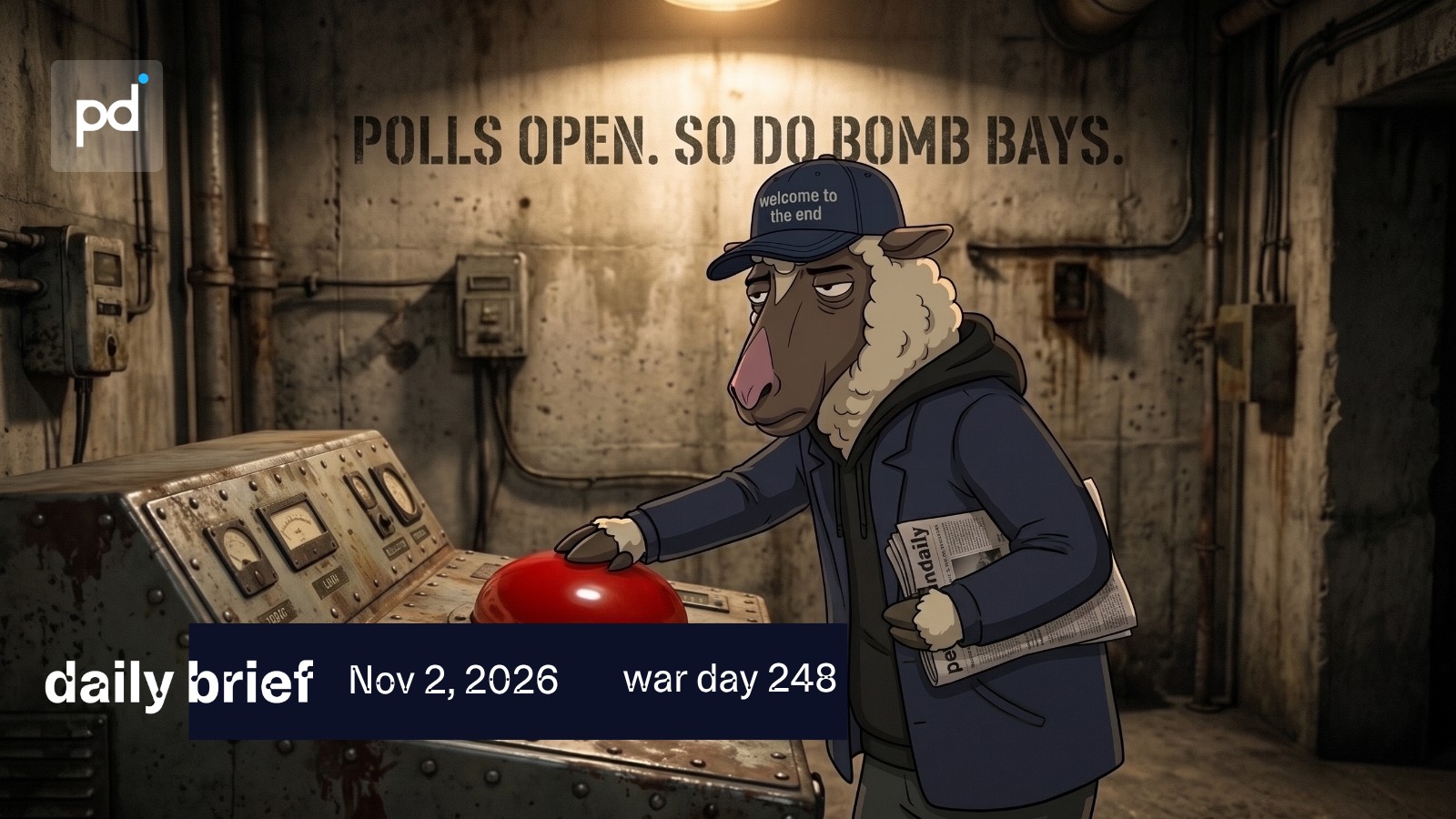
🚨 OPENING
Tomorrow is election day. The day after, strikes may resume.
Iranian negotiators were in Doha for a third consecutive day of talks with Qatari mediators, aimed at pushing for a deal to end the war. The talks come amid concerns that the conflict could escalate again after the November 3 US midterm elections. On the table: a new proposal that would reopen the strategic Strait of Hormuz and institute a regional ceasefire within 48 hours. Iran's Foreign Minister Araghchi described the talks as "ongoing and progressing," adding that Tehran is prepared for "both defence and diplomacy." Washington has not responded.
On the military side, the picture is unambiguous. The Trump camp is warning of possible strikes on Iran as early as November 4, the day after the US midterm elections, according to three senior Gulf Arab officials familiar with the discussions. Trump himself told reporters: "We still have to take care of, I would say, one or two sites, but we can do that in 10 minutes." Secretary Rubio confirmed that Trump has not decided whether to launch new strikes, but would prefer to resolve the conflict diplomatically.
The result is a night suspended between diplomacy and detonation. The November 3 vote is the trigger that unlocks Trump. Hormuz is the variable that can either push Brent lower or send it through the roof. Markets today are pricing both scenarios simultaneously.
📍 MILITARY SITUATION
💥 TANKER STRUCK IN THE PERSIAN GULF
The tanker was travelling southeast, 72 nautical miles east of Saudi Arabia's Ras Al Khafji, when it was hit on its port side at 23:47 UTC on November 1.
---
🚢 MINES IN HORMUZ — IRGC CLAIMS
Two oil tankers "exploded after striking mines" according to the IRGC Navy, which stated the vessels were transiting through what it declared an "unauthorised route."
---
⚓ US NAVY — HOLDING THE LINE
The US Navy has blockaded Iran's ports for months and has been protecting transit through the Strait of Hormuz despite Iran's attempts to choke off the trade route. Hormuz is effectively closed to commercial shipping as of November 2, with only 2% of typical vessel traffic recorded, and the crisis pressure index at 88 — in the extreme band.
---
🛩 ISRAEL — STANDBY POSTURE
Trump and Israeli Prime Minister Netanyahu reportedly spoke by phone on Saturday morning about US plans to resume strikes on Iran. No Israeli military operation confirmed in the last 48 hours. IDF on pre-decision standby.
---
🎯 IRGC — TARGET LIST UPDATED
Iran's Supreme Leader Mojtaba Khamenei ordered the military to update its target list of US and Israeli assets, as Washington was reported to be preparing to resume strikes as early as November 4.
---
🌡️ CALIBRA — Araghchi's 48-hour plan is real, but Tehran simultaneously insists there are no direct talks with Washington. Two positions held in parallel: tactical opening, structural rigidity. Standard Iranian playbook.
🔑 KEY DEVELOPMENT OF THE DAY
The 48-hour Hormuz plan is the most underrated fact of the day.
The trigger was diplomatic, not physical: Iran's foreign minister said the Qatar-brokered proposal had been compressed from seven days to two, with US measures on day one and a reopening of the strait on day two. Markets believed it enough to send oil prices sharply lower by over 2% on Monday.
The problem: Washington has not officially responded. And silence at this stage is not neutrality — it is pre-electoral positioning. Trump does not want to close the war before the vote, but he also cannot afford Hormuz to remain closed indefinitely. November 4 is his exit: fast strikes, then negotiations from a position of strength. The Qatari plan disrupts that calculation.
☄️ DON'T LOOK UP
Today: Brent at $111. European fuel prices above pre-war levels. Winter heating costs rising.
Within 30 days: If US strikes resume on November 4, Brent could spike back toward $120. Maritime insurance costs surging. Gulf ports on high alert.
If Hormuz stays closed beyond May: Structural European energy crisis. Gas rationing cannot be ruled out. Double-digit inflation in parts of the eurozone.
⚡ ENERGY AND MARKETS
Brent fell 1.95% to $111.20 and WTI to $101.92 after Iran's foreign minister announced the Qatar-brokered plan to reopen Hormuz in two days. On Friday October 30, Brent had settled at $117.64 — a six-month high — after the IRGC claimed four tankers had struck mines in Hormuz. Polymarket gives only a 6% probability to Hormuz returning to normal traffic by November 30.
📌 PERCEPTION INDEX - how to read it
⬇️ YOU'RE UNDERESTIMATING IT - more important than it seems
⬆️ YOU'RE OVERESTIMATING IT - emotional reaction > real weight
🌡️ CALIBRATE - reality is more nuanced than the dominant narrative
📊 PERCEPTION INDEX - SUMMARY
🔴 48h Hormuz plan (Araghchi) ............... ⬇️ More concrete than it appears — hinges on US response
🔴 November 4 strikes ....................... 🌡️ Likely but not certain — Trump holds the trigger as leverage
🔴 IRGC mines in Hormuz ..................... ⬇️ Underrated: driving up insurance costs on every alternative route
🔴 Brent at $111 ............................ 🌡️ The decline is real but fragile — one strike could push it back to $117+
🔴 Vance letter to Rezaei ................... ⬇️ Under-the-radar diplomatic signal — could be the real channel
🔴 Gulf states vs US bases .................. ⬇️ One Gulf country refusing basing rights would change everything
🔴 Midterm elections tomorrow ............... 🌡️ The vote doesn't change the war — only the timing of the strikes
🎖️ PERCEPTION DEFCON INDEX
🔴 DEFCON 1 — Critical Threshold
Day 248 carries the most compressed military-diplomatic tension since the conflict began. Tomorrow is election day. The day after, the informal ceasefire may expire. The US administration has told several Persian Gulf countries to prepare for "a short, intense round of strikes as early as November 4." Supreme Leader Mojtaba Khamenei has ordered his forces to respond to any attack immediately and "without geographical restriction."
ESCALATION TRIGGERS:
→ US strikes on November 4 confirmed
→ Iran retaliates by hitting US bases in the region
DE-ESCALATION SIGNALS:
→ Washington responds positively to Araghchi's 48-hour plan
→ Vance-Rezaei channel produces preliminary understanding before November 4
perceptiondaily by thesmallmediacompany warfare intelligence. next brief: tomorrow at 7.00am.