perceptiondaily — brief may 25 2026
Trump says the Iran deal is "largely negotiated" but won't rush. A 60-day ceasefire extension framework would reopen Hormuz — yet Tehran holds firm on uranium. Brent drops below $100. Peace feels close. Until it doesn't.
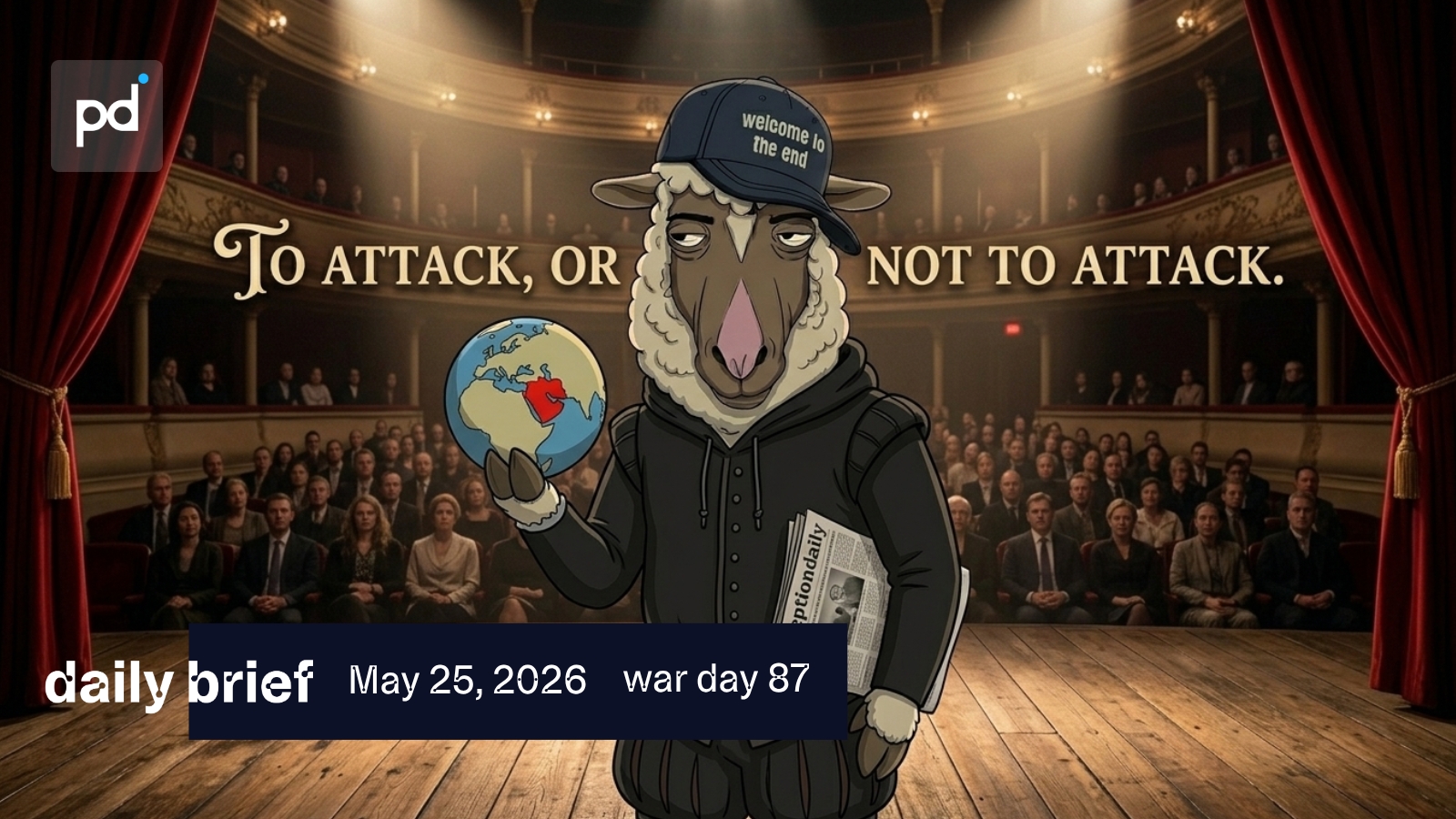
🚨 OPENING
The deal exists. But Trump won't sign it yet.
On Saturday, the US president declared that an agreement with Iran was "largely negotiated, subject to finalization." By Sunday, his tone had shifted: "I won't rush into a deal." The reason is political, not diplomatic. Republican hawks — Graham, Cruz, Wicker — are pushing hard against any deal that doesn't include absolute guarantees on the nuclear program. Trump feels the weight of November's midterms. He doesn't want to be seen as having yielded to Iran.
On the table is a Memorandum of Understanding — an MOU — that would extend the ceasefire by 60 days and, in the meantime, demine and gradually reopen the Strait of Hormuz. It's the most significant diplomatic progress since the war began. But the devil is in the details: Tehran insists the nuclear file is not part of current negotiations and that enriched uranium stays in Iran. Washington wants the opposite. Witkoff and Kushner are still negotiating, with Pakistan as the channel.
The market, however, has already decided: Brent dropped below $100 on Sunday evening. Traders are betting that peace is coming. The risk is that they're wrong.
📍 MILITARY SITUATION
🚢 HORMUZ — The IRGC authorized passage for over 30 vessels in the past 24 hours, according to the Fars news agency. The "Persian Gulf Strait Authority" created by Tehran in May continues to assert a "controlled maritime zone." This is not free navigation: it is selective permission.
---
✈️ LEBANON — Israel continues to strike Hezbollah positions in the south of the country. Four paramedics were killed in an Israeli strike on an ambulance center in Hanawieh, according to Lebanon's health ministry. IDF operations have not stopped despite the peace framework.
---
☢️ NUCLEAR — Iran reiterates: no commitment to transfer enriched uranium abroad. Iranian state media denies any such promise in the circulating draft versions. Leader Mojtaba Khamenei has ordered that uranium remain in Iran.
---
🌡️ CALIBRA — Israel is not part of the main MOU. Netanyahu has already stated: "we still have goals to complete." The US-Iran ceasefire does not mean an end to IDF operations in Lebanon.
🔑 KEY DEVELOPMENT OF THE DAY
The real issue isn't the ceasefire. It's who controls Hormuz after the signing.
Iran has created a new state authority — the Persian Gulf Strait Authority — that claims the right to regulate passage through the strait, including imposing tolls on commercial vessels. Rubio said it is "unacceptable." But if the MOU addresses reopening without explicitly resolving this point, Tehran will have won silently: the strait reopens, but under Iranian oversight. This is the kind of strategic victory that never appears in peace communiqués but reshapes geopolitics for decades.
☄️ DON'T LOOK UP
Today: Brent drops below $100, but European pump prices aren't falling yet — refining margins remain high and long-term contracts don't adjust overnight.
Within 30 days: If the MOU is signed and Hormuz demining begins, Brent could fall to $85-90. Pump price impact: visible in 4-6 weeks.
If Hormuz stays closed beyond May: The IEA warns of a "red zone" for summer oil markets. Global reserves falling at record pace. Stagflation risk in Europe by September, with direct impact on gas bills and food prices.
⚡ ENERGY AND MARKETS
Brent Sunday evening: ~$98.76/barrel (-4.62% from Friday's close). WTI: ~$91.65 (-5%). Markets are pricing in peace ahead of schedule. Friday's close was Brent $103.54 and WTI $96.60. Since February 28, both Brent and WTI are up over 45% from pre-war levels. Full normalization of Hormuz flow is not expected before Q1-Q2 2027, according to the ADNOC CEO.
📌 PERCEPTION INDEX - how to read it
⬇️ YOU'RE UNDERESTIMATING IT - more important than it seems
⬆️ YOU'RE OVERESTIMATING IT - emotional reaction > real weight
🌡️ CALIBRATE - reality is more nuanced than the dominant narrative
📊 PERCEPTION INDEX - SUMMARY
🔴 MOU imminent signing ............... ⬆️ Trump has slowed down twice already: no certainty it's signed this week
🔴 Hormuz "reopening" ............... 🌡️ IRGC authorizes individual vessels — not free navigation, selective control
🔴 Brent below $100 = crisis over ......... ⬆️ Energy normalization takes months, not days
🔴 Israel outside the negotiations ........... ⬇️ Netanyahu can blow up everything with a unilateral military action at any time
🔴 Iran nuclear issue resolved ............. ⬆️ Tehran explicitly excluded nuclear file from current MOU
🔴 Pakistan as reliable mediator ......... 🌡️ Islamabad balances its own interests — it is not a neutral arbiter
🔴 GOP hawk pressure on Trump ......... ⬇️ Underestimated: Graham and Cruz could block Senate ratification of any deal
🎖️ PERCEPTION DEFCON INDEX
⚠️ DEFCON 2 — Controlled Escalation
The MOU is advancing but unsigned. The ceasefire holds by a thread. Israel is not bound by the US-Iran agreement and continues operations in Lebanon. Iran maintains selective control of Hormuz. A single military incident — an Israeli strike on a sensitive Iranian site, or an IRGC attack on a US vessel — could collapse everything within hours.
Escalation triggers:
— Israel strikes Iranian nuclear infrastructure before the MOU is signed
— Iran formally rejects the memorandum and reactivates a full Hormuz blockade
De-escalation signals:
— MOU signed with written commitment to demine the strait within 7 days
— Hezbollah accepts a separate ceasefire in Lebanon, reducing pressure on Tehran
perceptiondaily by thesmallmediacompany warfare intelligence. next brief: tomorrow at 7.00am.