perceptiondaily — brief may 18 2026
Day 80. The Trump-Xi summit closed with no firm commitments on Hormuz. Beijing offers "diplomatic help", Washington keeps the blockade. The IEA warns: OECD oil stocks could reach critically low levels by end of June.
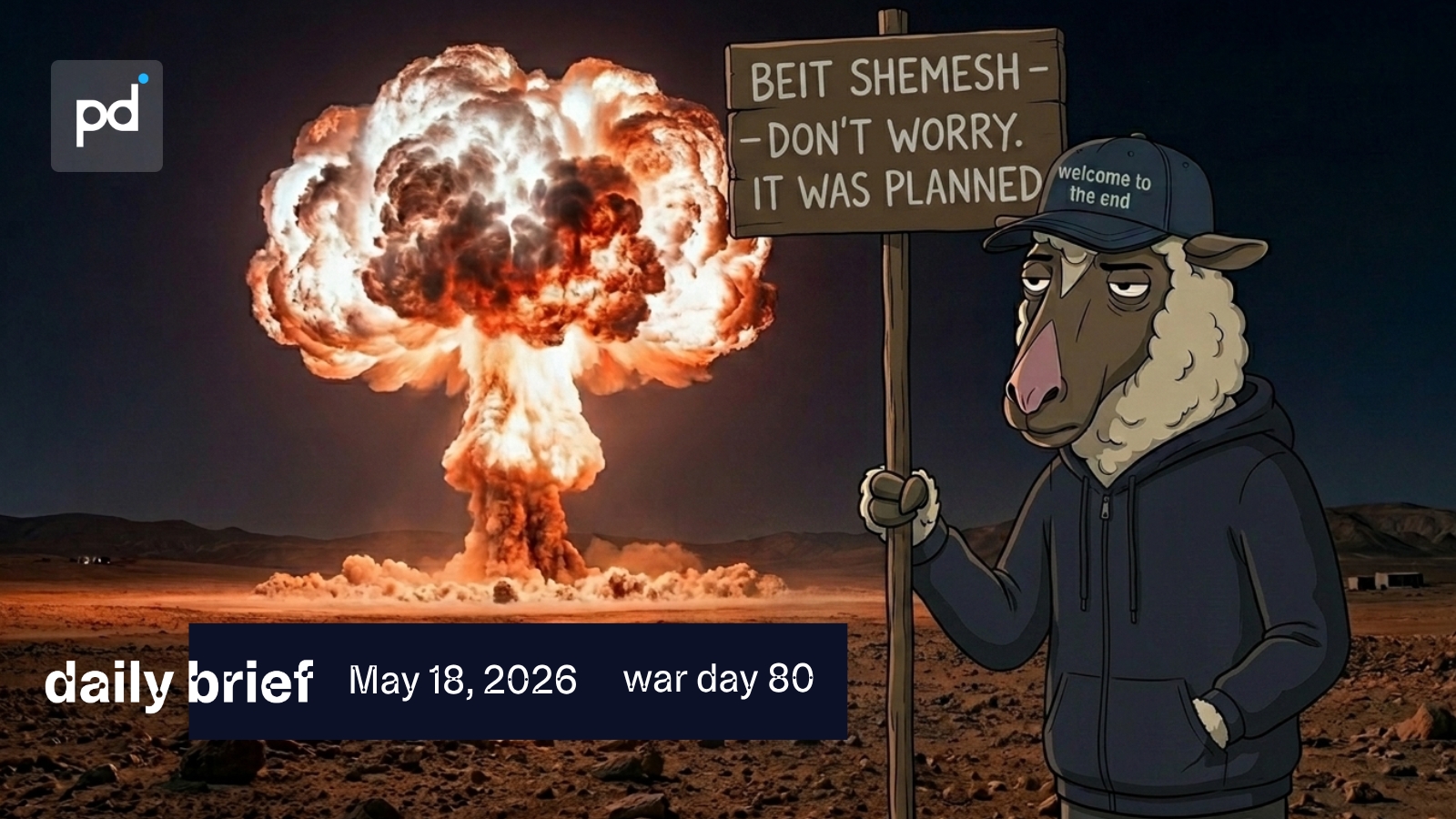
🚨 OPENING
Post-Beijing: Xi offered words, not leverage. The energy collapse is closing in.
Trump returned from Beijing with a statement of principle and no concrete guarantees. Xi Jinping said he wants Hormuz open and is ready to "help" — but analysts are unanimous: China has no intention of using its influence over Tehran in a muscular way. The Eurasia Group's reading of the Beijing summit is blunt: limited coordination on Iran, more likely an understanding on Taiwan. Beijing got what it wanted — positioning itself as a credible mediator — without paying any price.
Meanwhile, the energy picture has become the real battlefield. JPMorgan warned that commercial oil inventories in developed countries could approach operational stress levels by early June. Capital Economics flagged prices between $130 and $140 per barrel next month if Hormuz stays closed and the inventory drawdown rate remains steady. The IEA confirmed that crude and fuel flows through the Strait fell by around 4 million barrels per day in March and April, and that the global market could remain materially undersupplied through October even if the conflict is resolved next month.
Tehran is pocketing the tactical advantage. Foreign Minister Araghchi, speaking at the BRICS summit in New Delhi, said Tehran "cannot trust the Americans at all" and that this lack of trust is "the main obstacle to any diplomatic effort." Iran has no incentive to yield now: every passing day, the economic weight of the blockade falls on the rest of the world, not just on Tehran. And Washington — with inflation at 3.8%, war costs at $29 billion, and plummeting poll numbers — has less and less leverage.
📍 MILITARY SITUATION
🚢 HORMUZ / BLOCKADE
As of May 18, 78 commercial ships have been redirected and 4 disabled by the US Navy to enforce the naval blockade. Traffic through the Strait remains at minimal levels — only one vessel transited on one day last week. Around 1,600 ships remain stranded in the Persian Gulf.
---
🇮🇷 IRGC - DRILLS
The IRGC concluded its five-day "Martyr Commander" drills around Tehran: special forces and commandos simulated operations against "American and Zionist enemies." The message is aimed at the negotiating table, not the battlefield.
---
🇮🇱 ISRAEL / LEBANON
Israel struck around 100 Hezbollah targets in Lebanon over the past week despite the ceasefire. Israel-Lebanon talks in Washington produced a 45-day ceasefire extension. Military talks at the Pentagon are scheduled for May 29.
---
⚓ USS GERALD R. FORD
The USS Gerald R. Ford returned to Norfolk after a record 326-day deployment — the longest for a US carrier in 50 years. A signal of growing operational fatigue in the fleet.
---
🌡️ CALIBRA — Pakistan: Islamabad continues to act as the official mediator between Washington and Tehran, but also allowed Iranian military aircraft to remain parked on its airfields during the truce. Its position is more ambiguous than it appears.
🔑 KEY DEVELOPMENT OF THE DAY
The second consecutive BRICS meeting has closed without a common position on the Iran war. Internal divisions within the bloc — between China, India, Russia and Brazil — prevent any coordinated diplomatic front that could pressure Washington or Tehran. For Iran, this is a structural advantage: it can present itself as an isolated victim before the UN General Assembly and the Global South, without facing a unified bloc. This fact is underestimated by Western narrative, which keeps reading the conflict as a bilateral US-Iran issue, ignoring how Tehran is quietly building international legitimacy piece by piece.
☄️ DON'T LOOK UP
Today: Fuel prices above historical highs across much of Europe. Gas bills still elevated. Flights more expensive as jet fuel is up 95% since the war began.
Within 30 days: If OECD stocks reach operational stress levels by early June, localized fuel rationing in Asia and Southern Europe becomes a real possibility.
If Hormuz stays closed beyond May: Brent potentially between $130 and $140. European energy inflation in double digits. Real stagflation risk for Italy, Spain, Germany.
⚡ ENERGY AND MARKETS
WTI closed the week of May 15 above $103.5 per barrel, up around 10% for the week. Brent remains in the $105–108 range, up more than 45% since the war began. The US Department of Energy expects oil prices to stay firmly above $100 per barrel in the coming weeks. Capital Economics warns of a potential "non-linear" spike toward $130–140 by June if Hormuz stays closed. European TTF gas remains under pressure due to reduced LNG flows from the Gulf.
📌 PERCEPTION INDEX - how to read it
⬇️ YOU'RE UNDERESTIMATING IT - more important than it seems
⬆️ YOU'RE OVERESTIMATING IT - emotional reaction > real weight
🌡️ CALIBRATE - reality is more nuanced than the dominant narrative
📊 PERCEPTION INDEX - SUMMARY
🔴 Impact of Trump-Xi summit on Hormuz ............... ⬆️ No concrete commitment from Beijing — the rhetoric/action gap is enormous
🔴 OECD oil stock crisis ............... ⬇️ Markets have not yet priced in a June collapse
🔴 Iran's diplomatic posture ............... ⬇️ Tehran is quietly building global legitimacy — the West isn't watching
🔴 US-Iran ceasefire ............... 🌡️ Technically in force, practically violated every day by both sides
🔴 IRGC "Martyr Commander" drills ............... 🌡️ Negotiating signal more than real operational readiness
🔴 BRICS divisions on the war ............... ⬇️ Lack of common front benefits Tehran more than is commonly acknowledged
🔴 US war cost ($29 billion) ............... ⬆️ High in absolute terms, but not yet destabilizing for the federal budget
🔴 Lebanon: 45-day truce extension ............... 🌡️ Fragile but real — signals Washington wants at least one front stabilized
🎖️ PERCEPTION DEFCON INDEX
🔴 DEFCON 1 — CRITICAL THRESHOLD
On day eighty of the war, the ceasefire holds in name only. Hormuz is still closed. The Beijing summit produced no real diplomatic leverage. Global oil inventories are approaching operational stress levels. The economic cost of the conflict is landing on Europe and Asia with a delay — but that delay is almost over.
ESCALATION TRIGGERS:
— Trump orders resumption of bombing after new Iranian rejection of the peace plan
— Iran activates Hormuz tolls for non-hostile vessels: Washington responds with naval force
DE-ESCALATION SIGNALS:
— Pakistan presents a new 10-point proposal acceptable to both sides
— China applies real economic pressure on Tehran in exchange for US concessions on Taiwan
perceptiondaily by thesmallmediacompany warfare intelligence. next brief: tomorrow at 7.00am.