perceptiondaily — brief may 15 2026
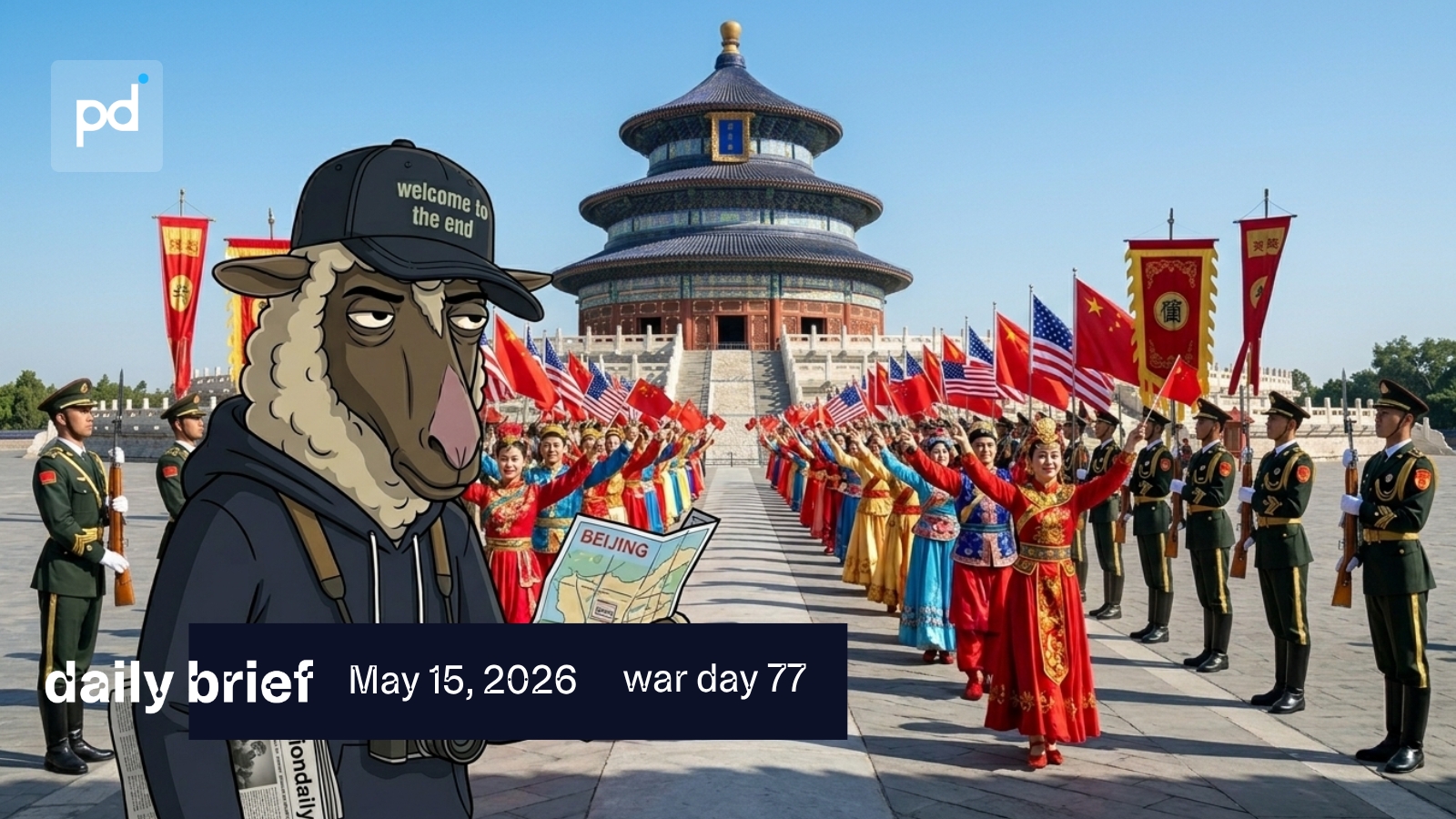
Trump meets Xi in Beijing: verbal agreement on Hormuz, but Tehran won't budge. Ceasefire barely holds as Iran lets some Chinese vessels through. Brent near $105. The war isn't ending — it's freezing.
🚨 OPENING
Beijing talks, Tehran doesn't listen
Trump and Xi met in Beijing on May 14-15 for the most anticipated summit since the war began. The outcome: a White House statement declaring agreement on Hormuz, Xi's assurance that China won't supply weapons to Tehran, and an Iran that meanwhile allowed some Chinese vessels through the strait — without shifting its negotiating position by a single millimeter.
The real signal of the day is this: Iran began opening selective corridors for Chinese ships through the strait while talks with Washington remain deadlocked. This is not a peace gesture toward the US. It's a message to Beijing — and a demonstration that Tehran manages Hormuz as political leverage, opening and closing it at will. Brent dipped slightly to around $105 on the news.
On the diplomatic front, the picture is frozen. Trump posted on Truth Social that the military campaign against Iran is "to be continued", signaling that a resumption of operations is still on the table. Iran conducted a five-day large-scale military exercise called "Martyr Commander" around Tehran. Negotiations are technically alive but effectively frozen: Tehran rejected the US 14-point plan as "a demand for surrender", while Washington declared Iran's counter-proposal "totally unacceptable". The ceasefire, in effect since April 8, holds — but only because neither side is yet ready to break it.
📍 MILITARY SITUATION
🇺🇸 US / HORMUZ
The US naval blockade of Iranian ports has been active since April 13. Dozens of vessels crossed Hormuz in recent hours, mostly Chinese. The Pentagon maintains a presence with three destroyers in the strait area.
🇮🇷 IRAN / EXERCISE
The IRGC launched on May 13 a five-day large-scale exercise called "Martyr Commander" in and around Tehran. An internal and external signal: Tehran demonstrates operational readiness during negotiations.
🌡️ CALIBRA — The exercise is not an immediate prelude to new hostilities. It is strategic communication: Iran tells Trump that resuming bombing carries a cost.
🇮🇱 ISRAEL / LEBANON
Hezbollah claimed two attacks on Israeli military targets in response to alleged ceasefire violations. Israel conducted airstrikes in southern Lebanese areas. The Lebanon ceasefire holds formally but is riddled with daily violations. Over 2,880 people killed in Lebanon since the broader conflict began.
🌡️ CALIBRA — The Lebanon front is secondary to Hormuz, but any escalation risks further complicating the main negotiation.
🇰🇼 KUWAIT / IRGC
Kuwait accused Iran of attempting an armed infiltration of Bubiyan Island on May 1 with six IRGC members. Four captured, two fled. Iran denies it, calling the accusation "absolutely baseless."
⚠️ First documented case of an attempted Iranian military infiltration into a neighboring Arab state during the war.
🛢️ VESSELS / HORMUZ
A Chinese supertanker carrying 2 million barrels of Iraqi crude crossed the strait after being stranded in the Gulf for over two months. A second Japanese-linked vessel completed transit. Iran stated approximately 30 ships crossed Hormuz in recent hours.
🔑 KEY DEVELOPMENT OF THE DAY
Xi promises no weapons to Tehran — but will keep buying its oil
At the Beijing summit, Xi assured Trump that China will not supply military equipment to Iran. It is a significant move: it neutralizes US concerns over intelligence suggesting possible deliveries of Chinese air defense systems to Tehran. But Xi simultaneously confirmed that China will continue purchasing Iranian oil — the primary revenue source that allows Tehran to withstand US sanctions and the naval blockade. In short: no weapons, but the economic lifeline stays. It is a carefully calibrated position designed to please Trump without actually pressing Iran. Beijing is using Iran as leverage over Washington, not as a problem to solve.
☄️ DON'T LOOK UP
Today: Brent at ~$105, European fuel prices still above pre-war highs, TTF gas under pressure.
Within 30 days: if negotiations collapse and Trump resumes bombing, new oil spike above $115.
If Hormuz stays closed beyond May: Saudi Arabia warns global energy markets won't normalize before 2027, making stagflation in Europe virtually certain.
⚡ ENERGY AND MARKETS
Brent (July) at approximately $105.72 per barrel — slightly down after news of Chinese transits at Hormuz. WTI at approximately $101.17. Since the war began, Brent and WTI are both up over 45%. The US Department of Energy forecasts oil will remain above $100 in the coming weeks. Saudi Arabia's Aramco CEO warns: if Hormuz stays blocked beyond mid-June, market normalization will slip to 2027.
📌 PERCEPTION INDEX - how to read it
⬇️ YOU'RE UNDERESTIMATING IT - more important than it seems
⬆️ YOU'RE OVERESTIMATING IT - emotional reaction > real weight
🌡️ CALIBRATE - reality is more nuanced than the dominant narrative
📊 PERCEPTION INDEX - SUMMARY
🔴 Trump-Xi agreement on Hormuz ............... ⬆️ Political statement, not a binding commitment
🔴 Iran opens Hormuz to Chinese vessels ............... ⬇️ Underrated Iranian strategic move — Tehran chooses who passes
🔴 Xi pledge: no weapons to Iran ............... 🌡️ Significant, but doesn't touch oil purchases or intelligence
🔴 Ceasefire "on life support" ............... 🌡️ Real but no imminent collapse — both sides buying time
🔴 IRGC exercise "Martyr Commander" ............... ⬇️ Political-military signal underreported in Western media
🔴 IRGC infiltration attempt in Kuwait ............... ⬇️ First documented case, serious regional implications
🔴 US war cost at $29 billion ............... 🌡️ Official figure: internal estimates already near $50 billion
🔴 Brent at $105 ............... 🌡️ Stabilized, but one shock away from $115+
🎖️ PERCEPTION DEFCON INDEX
🔴 DEFCON 1 — Critical threshold maintained
The ceasefire formally holds, but Trump has signaled the military campaign is "to be continued". The IRGC conducts large-scale exercises around Tehran. No concrete signs of a diplomatic deal in the coming weeks.
Escalation triggers:
— Definitive collapse of negotiations and a new round of US strikes
— Iranian attack on US vessels or Gulf infrastructure outside ceasefire parameters
De-escalation signals:
— Iran accepts a minimum framework on nuclear issues and formal reopening of Hormuz
— China applies direct, verifiable pressure on Tehran through economic channels
perceptiondaily by thesmallmediacompany warfare intelligence. next brief: tomorrow at 7.00am.