perceptiondaily — brief june 3 2026
Iran fires on Kuwait and Bahrain, US strikes Qeshm Island. The ceasefire holds by name only. Trump says a Hormuz deal is "one week away." Netanyahu has other plans. The gap between the two is the whole story.
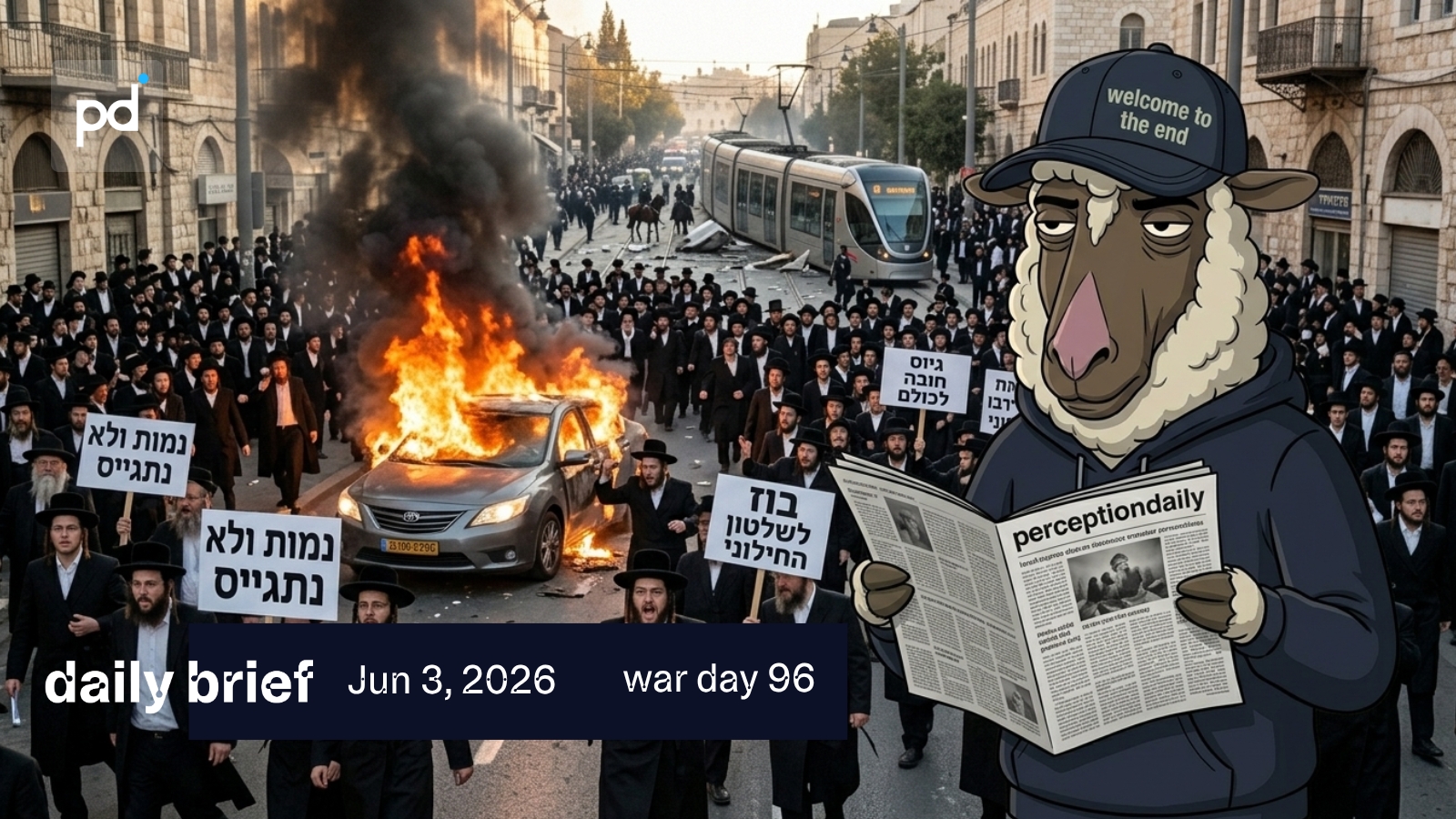
🚨 OPENING
The ceasefire that is not a ceasefire
In the night between June 2 and 3, Iran fired ballistic missiles at Kuwait and Bahrain, including a declared strike against the US Fifth Fleet headquarters in Manama. The US responded by striking an Iranian military ground control station on Qeshm Island, near the Strait of Hormuz. CENTCOM confirmed that all Iranian attacks were intercepted or fell short of their targets. No US personnel were harmed. But none of that changes the picture: we are on day 96 and missiles are still flying over the Gulf.
The paradox is this: while Washington and Tehran exchange fire, their negotiators keep working on a draft 60-day MoU. Trump told ABC News that a deal to reopen Hormuz is reachable "over the next week." Regional sources told CNN that talks are "back on track" after Iran suspended them days earlier. Yet Iran also launched a second wave of drones against US forces in Kuwait — all of which failed. This is not incoherence: it is a low-intensity war being fought while negotiations continue in parallel.
The real destabilising variable is not Tehran. It is Tel Aviv. Netanyahu continues to strike southern Lebanon in defiance of both Trump's de-escalation requests and the nominal ceasefire. Iran used Israeli operations in Lebanon as a pretext to suspend talks. Trump had a heated phone call with Netanyahu. Hezbollah accepted a US proposal to halt strikes on Beirut but continued hitting southern Lebanon. Israel-Lebanon talks resumed at the State Department. The mechanism is jammed on all three fronts simultaneously.
📍 MILITARY SITUATION
🎯 QESHM ISLAND — US strikes Iranian military ground control station in response to attacks. CENTCOM describes it as a "self-defense" operation.
🚀 KUWAIT & BAHRAIN — Iran fires ballistic missiles. Two intercepted over Kuwait, three shot down over Bahrain by US and local air defenses. No significant damage reported.
🛸 IRANIAN DRONES → KUWAIT — Second wave of Iranian drones aimed at US forces in Kuwait. All failed or were shot down. Confirmed by CENTCOM.
🚢 TANKER DISABLED — US Navy strikes an oil tanker with a Hellfire missile as it attempted to reach an Iranian port in violation of the blockade. Engine room destroyed, vessel stopped.
🇱🇧 LEBANON — Israel continues operations in southern Lebanon. Eight civilians killed by Israeli drone strikes. IDF advances in the Nabatiyeh region. Israel-Lebanon talks resume in Washington.
CALIBRA: The distinction between "state of war" and "active ceasefire" has lost all operational meaning. On the ground, it is indistinguishable.
🔑 KEY DEVELOPMENT OF THE DAY
The Strait of Hormuz is splitting into two de facto lanes. Fortune reports that transit is structuring itself informally into a "US lane" and an "Iranian lane." This is not a formal agreement — it is tactical adaptation. Ships transiting under US escort proceed; those attempting to do so independently are stopped or struck. This pattern is not in the MoU draft, has not been announced by any government, yet it is becoming the operational reality of the strait. If this informal division consolidates, it will redraw global energy geopolitics without anyone having signed off on it.
☄️ DON'T LOOK UP
Today: Brent around $96, fuel prices elevated across Europe, energy inflation persisting.
Within 30 days: If Hormuz does not formally reopen, the US Strategic Petroleum Reserve drains faster, shrinking the global buffer.
If Hormuz stays closed beyond May: Saudi Aramco's CEO warned that oil market normalisation would slip to 2027 — European household bills, transport and industrial output would remain under structural pressure for at least 18 months.
⚡ ENERGY AND MARKETS
Brent crude: approximately $96.65 on June 2 — up 4.2% on Monday after news of Iran suspending talks, then partially corrected on Tuesday. WTI around $91-92. Markets swing 4-5 dollars per barrel on every diplomatic-military news cycle. UBS notes that crude loadings inside the Gulf remain "extremely low." Hormuz is not yet operating at normal scale.
📌 PERCEPTION INDEX - how to read it
⬇️ YOU'RE UNDERESTIMATING IT - more important than it appears
⬆️ YOU'RE OVERESTIMATING IT - emotional reaction > real weight
🌡️ CALIBRATE - reality is more nuanced than the dominant narrative
📊 PERCEPTION INDEX - SUMMARY
🔴 Iran-US ceasefire ............... 🌡️ Exists on paper, violated daily
🔴 Strikes on Kuwait and Bahrain ............... ⬆️ All intercepted, zero military impact
🔴 60-day MoU negotiations ............... ⬇️ More advanced than media coverage suggests
🔴 Trump-Netanyahu friction ............... ⬇️ The most underrated variable in the conflict
🔴 Hormuz informal dual-lane ............... ⬇️ Silent geopolitical reconfiguration underway
🔴 Brent at $96 ............... 🌡️ Down from peak, but structurally high through 2027
🔴 US SPR draining ............... ⬇️ 357 million barrels — declining every week
🎖️ PERCEPTION DEFCON INDEX
🔴 DEFCON 1 — Active war with parallel diplomacy
The conflict is technically under an indefinite ceasefire, but direct exchanges of fire in the Persian Gulf occur daily. Iranian ballistic missiles fired at two Gulf capitals, US response on Iranian soil: this is the operational definition of low-intensity war. Negotiations proceed in parallel, but on a razor-thin line.
ESCALATION TRIGGERS:
— Netanyahu orders strike on Beirut or directly hits Iranian assets
— Iran formally abandons the MoU and reactivates strategic missile capabilities
DE-ESCALATION SIGNALS:
— Formal signing of 60-day MoU by end of week (Trump: "within one week")
— Operational Israel-Hezbollah agreement covering all Lebanese territory
perceptiondaily by thesmallmediacompany warfare intelligence. next brief: tomorrow at 7.00am.