perceptiondaily — brief june 27 2026
Iran fires drones at Hormuz, hits a cargo ship, violating the ceasefire signed ten days ago. The US strikes back. Diplomacy at Bürgenstock holds — barely — with Lebanon as the thread it all hangs on.
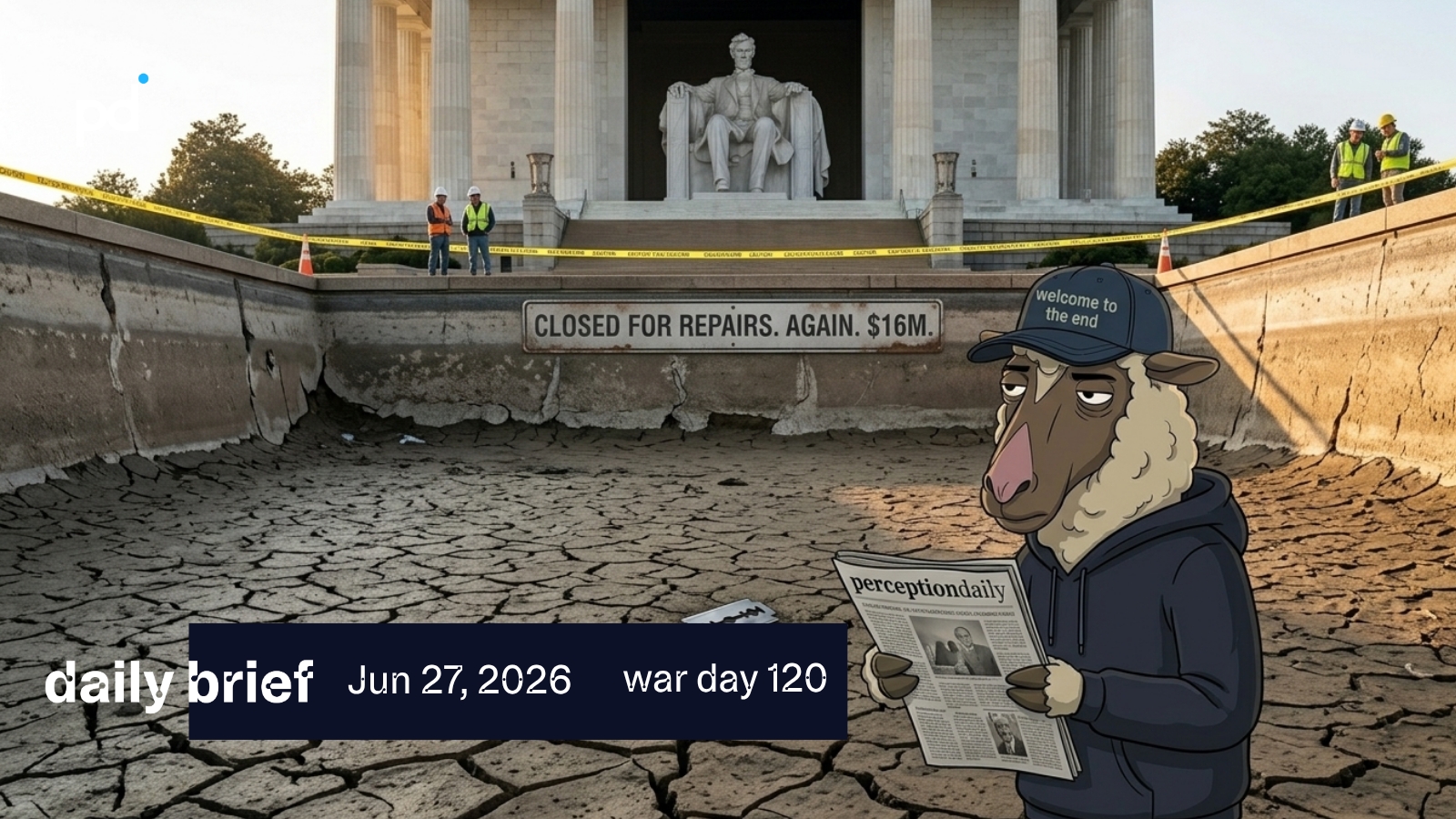
🚨 OPENING
The ceasefire is ten days old. Iran already fired.
On June 25, an Iranian drone struck a Singapore-flagged cargo ship in the Strait of Hormuz. The vessel sustained damage but continued its route. The US shot down three additional drones. Trump publicly called it a "foolish violation of our ceasefire agreement." The American response came swiftly: six US warplanes struck four targets along the Iranian coastline — missile, drone, and radar sites — in an operation lasting roughly one hour. That was June 26.
This marks the first US military strike on Iran since the Memorandum of Understanding was signed on June 17 at the Palace of Versailles. An agreement that was supposed to open a 60-day diplomatic window. That window is still open — but it now has a visible crack.
The US logic is surgical: a response strong enough to send a message on freedom of navigation, limited enough not to blow up the Bürgenstock table. If Tehran chooses to respond to the response, we are in a dangerous loop. The ceasefire holds formally. In substance, both sides are already shooting.
📍 MILITARY SITUATION
🚁 HORMUZ — Iranian drone strikes Singapore-flagged cargo ship on June 25. The IMO temporarily suspends its evacuation plan for vessels stranded in the area.
---
✈️ US RESPONSE — On June 26, six US aircraft strike four targets: missile, drone, and radar sites along the Iranian coastline. Operation lasted approximately one hour.
---
🛢️ NAVAL TRAFFIC — Despite the incident, vessels continue transiting. Hormuz is not closed. Traffic flows are approaching pre-war levels, but the strait still needs to be cleared of mines.
---
🇱🇧 LEBANON — Israel continues to strike southern Lebanon despite the Hezbollah ceasefire brokered by the US, Qatar, and Iran on June 19. Netanyahu confirms Israeli troops will remain in the "security zone" south of the Litani River.
---
🎯 CALIBRA — Iran's Revolutionary Guard declared the strait closed. The US military denied the claim. The strait is not closed — but it is contested in the narrative, and that matters as much as facts on the ground.
🔑 KEY DEVELOPMENT OF THE DAY
The real fault line is not Hormuz — it's the financial terms of the MOU. The US and Iran are already clashing over the use of funds covered by the agreement. Washington insists that unfrozen Iranian assets must be used to purchase American agricultural products. Tehran is pushing back. This disagreement — quiet, technical, far from the headlines — is more dangerous than the drone attack. If the economic terms of the deal collapse, so do the military ones. And nobody will be watching until it's too late.
☄️ DON'T LOOK UP
Today: Brent climbed back above $73 following the attack, energy prices across Europe remain unstable.
Within 30 days: If technical talks in Bürgenstock stall, a new energy price spike becomes a real possibility.
If Hormuz remains contested beyond July: European natural gas markets enter autumn emergency territory, with direct impact on household bills and manufacturing.
⚡ ENERGY AND MARKETS
Brent August: $71.99 per barrel at the close of June 26 (-4.34%), after topping $76 on Thursday at the height of the incident. WTI August: $69.23 (-3.74%). WTI closed below $70 for the first time since February 27 — the day before the war began. Prices are rapidly converging toward pre-conflict levels, but volatility remains elevated: every new incident in the strait triggers immediate spikes.
📌 PERCEPTION INDEX - how to read it
⬇️ YOU'RE UNDERESTIMATING IT - more important than it seems
⬆️ YOU'RE OVERESTIMATING IT - emotional reaction > real weight
🌡️ CALIBRATE - reality is more nuanced than the dominant narrative
📊 PERCEPTION INDEX - SUMMARY
🔴 Iran's ceasefire violation ............... ⬇️ Not an accident — a deliberate test of the MOU
🔴 US strikes on Iranian coastline ............... 🌡️ Calibrated to avoid killing diplomacy, not a resumption of war
🔴 Bürgenstock negotiations ............... ⬇️ Still ongoing despite everything — the most underrated signal of the day
🔴 Lebanon and Hezbollah ............... ⬆️ Militarily stagnant, but remains the real detonator of the diplomatic process
🔴 Dispute over MOU funds ............... ⬇️ Silent technical knot that can sink the deal before 60 days are up
🔴 Brent falling toward pre-war levels ............... 🌡️ Markets are optimistic — perhaps too much, given residual tensions
🔴 Iraq threatens OPEC exit ............... ⬇️ Ignored energy variable that could redraw the supply map
🎖️ PERCEPTION DEFCON INDEX
⚠️ DEFCON 2 — Active war with diplomatic window
The MOU is formally in force. The US and Iran have already exchanged fire after signing it. The Bürgenstock diplomacy holds on institutional inertia more than mutual trust. Lebanon is the thread that could unravel everything: every Israeli strike south of the Litani gives Tehran the pretext to declare the agreement violated.
Escalation triggers:
— Iranian military response to the US strikes of June 26
— New tanker attack or declared closure of Hormuz
De-escalation signals:
— Technical agreement on the unfrozen MOU funds
— Effective cessation of Israeli operations in southern Lebanon
perceptiondaily by thesmallmediacompany warfare intelligence. next brief: tomorrow at 7.00am.