perceptiondaily — brief june 22 2026
First round of US-Iran Switzerland talks ends with "encouraging progress" but Hezbollah keeps fighting. Israel strikes Lebanon again. The Strait of Hormuz is back at the center: Tehran threatens closure, Washington threatens bombs.
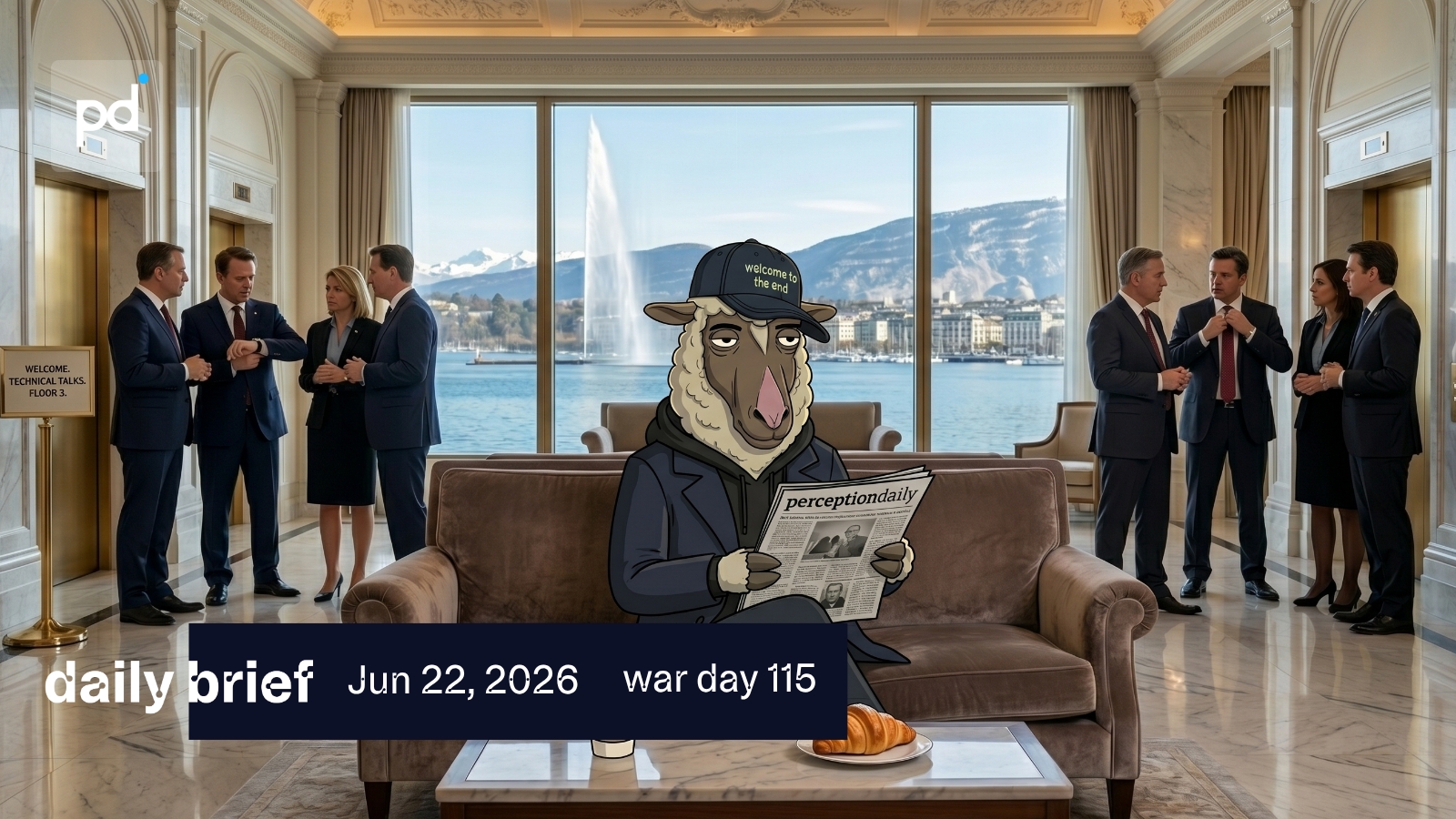
🚨 OPENING
Switzerland, round one: "encouraging progress" — but Lebanon can blow it all up
The first round of direct US-Iran talks at the Bürgenstock resort in Switzerland concluded with what mediators Qatar and Pakistan described as "encouraging progress," including the creation of a mechanism for further technical talks. The delegations agreed on the creation of a High-Level Committee and a roadmap toward reaching a final deal within 60 days. But the most important signal isn't what was said in the communiqué — it's what still isn't working.
The knot is Lebanon. The Memorandum of Understanding signed by the presidents of the US and Iran calls for hostilities to end on all fronts, including in Lebanon — though neither Israel nor Hezbollah were parties to the memorandum. Iran has alleged the Israeli military's presence in Lebanon constitutes a ceasefire violation, but Israel says it is not bound by the deal. On June 20, Iran announced the closure of the Strait of Hormuz, citing Israeli actions as a violation of its agreement with the US.
Trump escalated on Fox News. Trump threatened to resume bombing Iran and take over the Strait of Hormuz, saying "If they don't make a deal, we'll collect tolls." Senator Graham declared that if diplomacy fails, Trump will take Hormuz by force, the US will run it and charge a fee to all who pass through. Iran's delegation nearly walked out before Pakistani mediators convinced them to stay.
📍 MILITARY SITUATION
🇱🇧 LEBANON — Hezbollah ignores the ceasefire
The IDF said Hezbollah launched more than 50 rockets targeting Israeli soldiers in southern Lebanon overnight, despite a ceasefire that had supposedly taken effect on Friday at 4 p.m. local time.
---
💥 BEIRUT — Israeli strikes continue
More than a dozen people were killed in Lebanon by Israeli strikes overnight Saturday, hours after three diplomats told CBS News that Israel and Hezbollah had reached a ceasefire agreement.
---
🌊 STRAIT OF HORMUZ — Open, but under threat
The Strait of Hormuz remains open to commercial traffic according to CENTCOM, despite Iranian claims of closure. "Iran does not control the Strait of Hormuz," a US military spokesperson stated. The Islamic Revolutionary Guard Corps warned vessels not to approach the strait or their "security could be at risk."
---
🇺🇸 VANCE IN SWITZERLAND — De-confliction cell established
The US and Iran agreed to set up a "de-confliction cell" on Lebanon, facilitated by Qatar and Pakistan. The Lebanon conflict had continued to threaten the peace talks. The joint statement cites "the creation of a de-confliction cell, between the parties, the Lebanese Republic and facilitated by the Mediators, to ensure the adherence of the termination of military operations in Lebanon."
---
🌡️ CALIBRA — The de-confliction cell is a technical mechanism, not a political guarantee. Israel and Hezbollah are not party to it. It can reduce accidental incidents, not the will to fight.
🔑 KEY DEVELOPMENT OF THE DAY
The IRGC uses Hormuz as negotiating leverage, not as a real weapon
Iran declared the Strait of Hormuz would be closed again, accusing the US and Israel of violating the memorandum of understanding by not withdrawing Israeli troops from southern Lebanon. But no physical closure followed. Oil prices climbed after Trump's Fox News threats: Brent rose 1.35% to $81.66 a barrel.
An analyst warned that while the MOU announcement brought relief to markets, "the hardest part, on delivering the pledges and promises, is yet to come." "Crude's slide is entirely sentiment-driven," she noted, adding that the market is "front-running the prospective reopening of the Strait of Hormuz" without adequately pricing in the risks. This is the tool Tehran still holds: not military force — already heavily degraded — but the ability to generate energy uncertainty with an announcement. And it works.
☄️ DON'T LOOK UP
Today: Brent ~$81, European fuel and energy bills remain 20-30% above pre-war levels.
Within 30 days: if technical talks collapse, new energy price volatility; risk of return toward $95-100 per barrel.
If Hormuz remains closed beyond August: oil market normalization slips to 2027; a technical recession in Germany and Italy cannot be ruled out.
⚡ ENERGY AND MARKETS
Following Trump's Fox News threats, Brent rose 1.35% to $81.66 a barrel, and WTI climbed 2.4% to $77.66 a barrel. After rising more than 50% during the conflict, crude is now only about 7% higher than before the US-Israeli attacks on February 28. Experts warn that even if the Strait is considered "reopened," traffic will not normalize immediately — delayed vessels will need time to complete voyages, a process that could take roughly 2-3 months. Kpler estimates about 500 large commercial vessels are currently stuck in the region.
📌 PERCEPTION INDEX - how to read it
⬇️ YOU'RE UNDERESTIMATING IT - more important than it seems
⬆️ YOU'RE OVERESTIMATING IT - emotional reaction > real weight
🌡️ CALIBRATE - reality is more nuanced than the dominant narrative
📊 PERCEPTION INDEX - SUMMARY
🔴 Swiss talks progress ............... ⬆️ Communiqué is positive, the deal is extremely fragile
🔴 Iran "closes" Hormuz ............... ⬆️ Rhetorical announcement, no physical action confirmed
🔴 Trump threats on Fox ............... 🌡️ Real negotiating pressure, not immediate prelude to new strikes
🔴 Hezbollah-Lebanon ............... ⬇️ The real detonator of the deal: underestimated by markets
🔴 De-confliction cell ............... 🌡️ Useful technical tool, not a political solution
🔴 Brent ~$81 ............... ⬆️ Market pricing in peace before it's signed
🔴 Israel's position in the deal ............... ⬇️ Israel outside MOU = uncontrolled variable for everyone
🎖️ PERCEPTION DEFCON INDEX
⚠️ DEFCON 2 — Controlled escalation
The June 17 MOU formally closed the US-Iran war, but the Israel-Hezbollah conflict in Lebanon remains active and threatens to drag the parties back toward direct confrontation. Technical talks continue, but every night of Israeli bombing in Beirut is a potential crisis. Hormuz is open but under real and declared threat.
Escalation triggers:
— An Israeli strike on Iranian targets inside Iran or a high-profile casualty event in Beirut
— Iran physically closing Hormuz through IRGC military action
De-escalation signals:
— First operational meeting of the de-confliction cell with verifiable results on the ground
— Direct Israel-Lebanon agreement in the round of talks scheduled for the week of June 22
perceptiondaily by thesmallmediacompany warfare intelligence. next brief: tomorrow at 7.00am.