perceptiondaily — brief june 19 2026
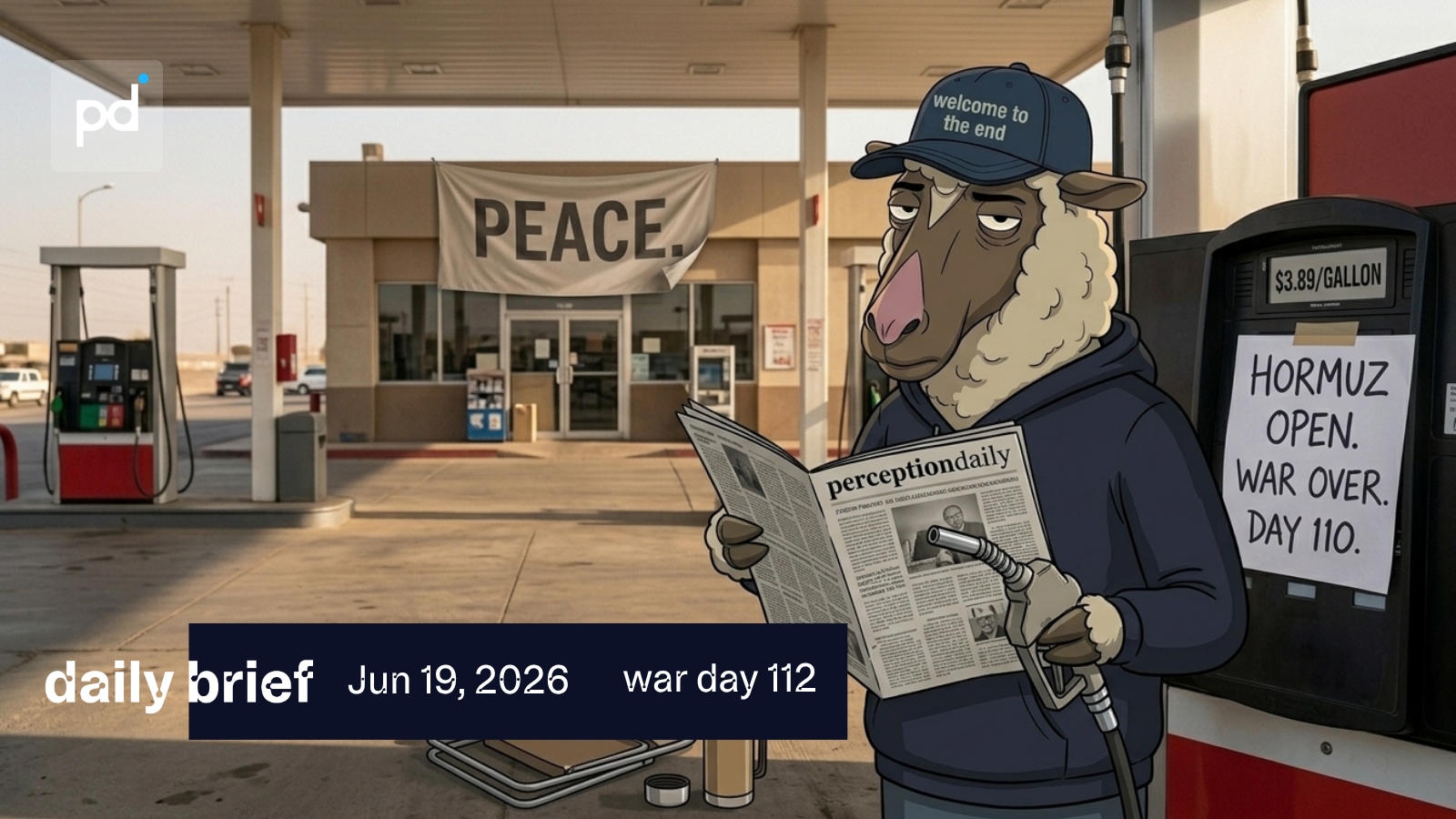
Today in Geneva the US-Iran MOU is signed: 60 days to formally end the war, Hormuz reopens. Brent crashes below $80. But the real negotiation — nuclear, Lebanon, sanctions — hasn't started yet.
🚨 OPENING
GENEVA, 10:00 AM. IT'S SIGNED. BUT IT'S NOT PEACE.
Today is the day many had been waiting for weeks. In Geneva, the US and Iran put their signatures on the memorandum of understanding announced on June 14 by Pakistani Prime Minister Shehbaz Sharif — the key mediator of this entire endgame. The MOU provides for a 60-day ceasefire, the reopening of the Strait of Hormuz, the removal of the US naval blockade on Iranian ports, and the launch of technical negotiations on the nuclear program. On paper, it's the end of the war. In reality, it's only the end of the acute military phase.
Brent has already responded: it had already fallen below $83 on Monday, and on Tuesday hit $78.24 — the lowest level since early March, just days after hostilities began. The market was already front-running the signing, pricing in the best-case scenario. Now comes the moment of truth: does Hormuz actually reopen? Do ships pass through? Do insurers cover them? Shipowners, crews and insurance companies need to be convinced the waters are safe before traffic returns to normal.
The structural point, however, is different. As CSIS noted, both the US and Iran will claim victory — but both have lost in important ways. The framework deal kicks all the hard issues down the road: nuclear program, proxy militias, permanent sanctions, Iran's role in the Levant. Iran gets almost everything upfront — economic relief, unfrozen assets, removal of the naval blockade. The US gets very little of substance. Israel gets even less. Today's signing is the beginning of a very hard negotiation, not its conclusion.
📍 MILITARY SITUATION
🏛️ GENEVA — MOU SIGNING
The MOU is signed today in Switzerland. It includes: cessation of hostilities on all fronts, end of Iranian restrictions on Hormuz, reduction of US military assets from the region, partial sanctions relief for Tehran.
---
☢️ NUCLEAR — FORMAL BUT VAGUE COMMITMENT
Iran repeats its old formal pledge not to acquire nuclear weapons. Technical negotiations with the US on the future of the program to begin. No verification mechanism defined yet.
---
🇮🇱 ISRAEL — NOT AT THE TABLE
Israel is not a signatory to the MOU. The IDF struck southern Lebanon again on June 14, days after a new local ceasefire. Tehran had threatened retaliation: US intervention blocked the Iranian response to allow the MOU to move forward.
---
🚢 HORMUZ — THEORETICAL REOPENING UNDERWAY
Trump had already announced the removal of the US naval blockade on June 14. Iran must now lift its own restrictions. Markets are watching actual ship movements. Logistics, insurance and security remain concrete obstacles in the coming days.
---
🇱🇧 LEBANON — UNRESOLVED KNOT
The MOU formally includes a cessation of hostilities in Lebanon. But Israel has not acknowledged this constraint. It is the Achilles' heel of the agreement: another IDF offensive in Beirut could blow the whole deal up.
🔑 KEY DEVELOPMENT OF THE DAY
The detail no one is reading closely enough: Iran gets almost everything now, the US gets almost nothing concrete.
The CSIS analysis is scathing: the framework deal is lopsided. Tehran pockets immediate economic relief — unfrozen assets, naval blockade lifted, sanctions partially eased — before nuclear negotiations have even properly begun. Washington takes home the victory narrative and falling oil prices. But it has obtained neither the dismantlement of the nuclear program, nor guarantees on proxies, nor a structural change in Iran's regional behavior. The real risk is that in 60 days, when the MOU expires, Tehran will sit at the table from a position of strength, with concessions already in hand and nothing to lose.
☄️ DON'T LOOK UP
Today: gas prices already falling in Europe; energy bills still high due to inertia of forward contracts.
Within 30 days: if Hormuz returns to operation, energy prices fall further; but volatility remains elevated.
If Hormuz stays closed past May: scenario overtaken — but if the MOU collapses within 60 days, Hormuz can reclose and Europe returns to acute energy crisis with winter approaching.
⚡ ENERGY AND MARKETS
Brent: $78.24/b on June 17 — lowest since early March, down over 7% from pre-war levels and roughly 30% below the conflict's peak. WTI: closed at $80.75/b on June 15, -4.8% in a single session on the deal announcement. The market was already discounting the signing: analyst Vandana Hari (Vanda Insights) warns the drop is "entirely sentiment-driven" and that the real logistical risks around Hormuz are not yet priced in. US gas: below $4 per gallon for the first time since March, still +25% year-over-year.
📌 PERCEPTION INDEX - how to read it
⬇️ YOU'RE UNDERESTIMATING IT - more important than it seems
⬆️ YOU'RE OVERESTIMATING IT - emotional reaction > real weight
🌡️ CALIBRATE - reality is more nuanced than the dominant narrative
📊 PERCEPTION INDEX - SUMMARY
🔴 MOU signing as "end of war" ...................... ⬆️ It's a timed armistice, not a peace
🔴 Brent crash as signal of stability ............... 🌡️ Market priced in best case: watch for the rebound
🔴 Hormuz opening as fait accompli .................. ⬇️ Logistics, insurers and security will take weeks
🔴 Iran weakened after 112 days of war .............. ⬆️ Tehran exits with concessions pocketed before real talks
🔴 Israel aligned with the agreement ................ ⬇️ Not a signatory: Lebanon remains the silent detonator
🔴 Iranian nuclear issue resolved ................... ⬆️ Formal pledge, no verification mechanism defined
🔴 European energy crisis over ...................... 🌡️ Real relief but slow: forward contracts remain elevated
🎖️ PERCEPTION DEFCON INDEX
🟡 DEFCON 2 — Agreement signed, peace not guaranteed
The acute military conflict is suspended. The MOU is signed in Geneva. But the framework is fragile by design: it defers everything that is hard. The 60 days of the agreement are a timer, not a solution. DEFCON drops from 1 to 2 — but not to 3, because the triggers for a reopening of the conflict are still all present and active.
Escalation triggers:
— An IDF offensive in Lebanon that exceeds Iranian tolerance in the coming days
— Collapse of technical nuclear negotiations within the first weeks
De-escalation signals:
— Commercial ships transiting Hormuz without incident in the next 72 hours
— US-Israel agreement on a formal pause of operations in Lebanon
perceptiondaily by thesmallmediacompany warfare intelligence. next brief: tomorrow at 7.00am.