perceptiondaily — brief july 27 2026
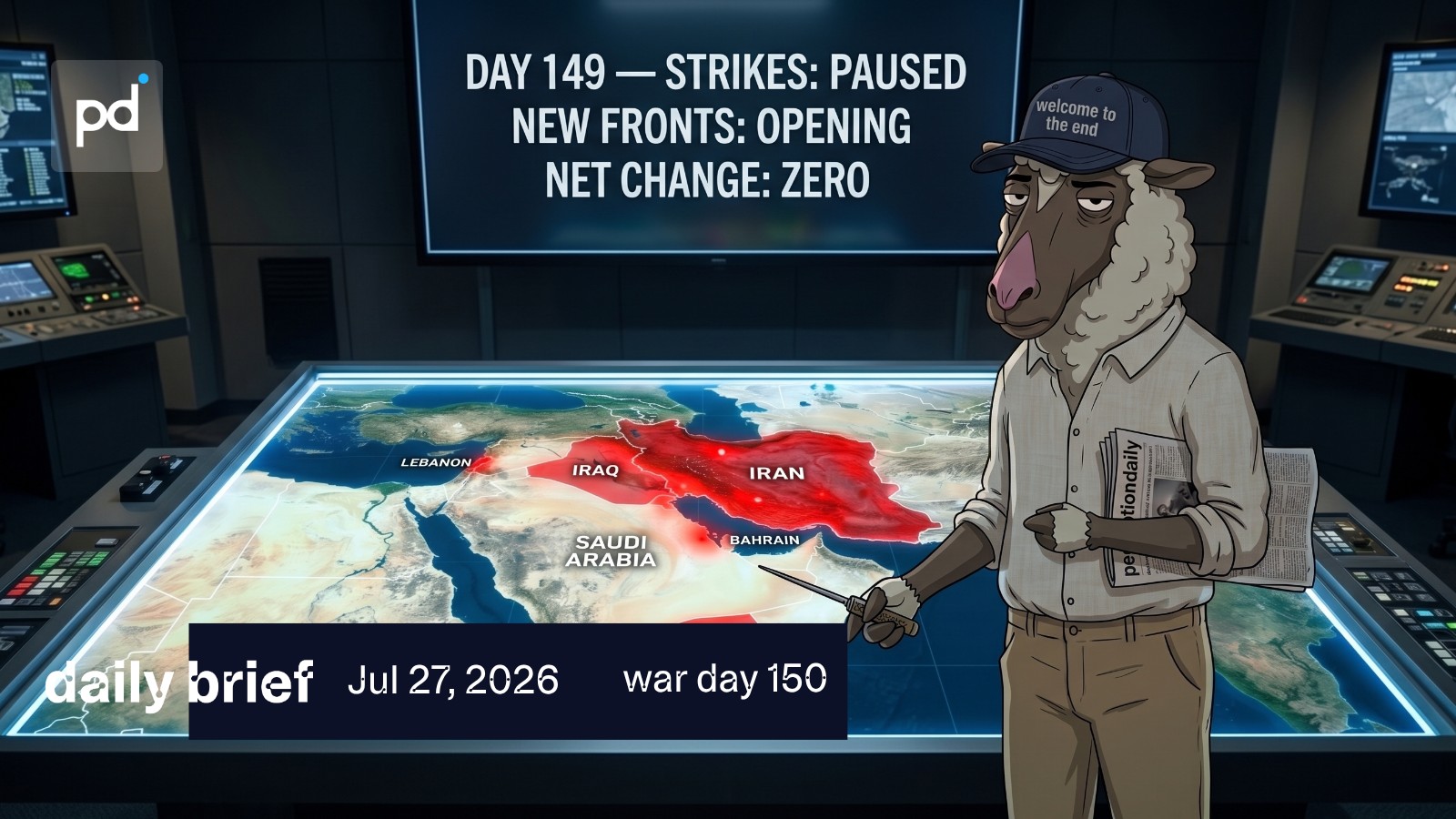
Real pause or tactical lull? The US and Iran hold fire for a second straight day. Oman mediates on Hormuz. Brent drops to $96 but Saudi's Red Sea route faces Houthi threat. The silence of guns is not yet peace.
🚨 OPENING
THE PAUSE NOBODY ANNOUNCED
Day 150 of the war. For the second consecutive night, neither the United States nor Iran has struck. No official American statement. No Pentagon explanation. Just silence — and silence in a war, at this point, is already a political fact.
Trump signaled through UN Ambassador Mike Waltz that he is "giving space to negotiations." Talks are ongoing "at every level," from technical to the highest diplomatic tiers. But the military message remains unchanged: US forces are "locked and loaded" and ready to resume. This is not a ceasefire. It is a window — and it can close.
The real reason for the pause is unclear. Some sources attribute it to Omani diplomacy over Hormuz. Others, more discreetly, point to pressure on stocks of Patriot interceptors and long-range munitions. If the second hypothesis is correct, the picture is more complicated than it appears: the US may need this pause as much as Iran does.
📍 MILITARY SITUATION
🛑 US STRIKES PAUSED
After 13 consecutive nights of bombing Iran, US operations appear suspended since the evening of July 24. The Pentagon did not respond to questions from journalists.
🇮🇷 IRAN CONFIRMS THE SILENCE
Tehran declared it halted its retaliatory attacks. The Iranian army warned, however: "if the US insists on continuing the war and airstrikes, the geography of the war will expand."
🛳️ HORMUZ — NEARLY EMPTY CORRIDOR
Daily transits through the Strait collapsed 70% by July 23. From 45 ships per day during the truce, down to 13. Non-Iranian-linked vessel transits plummeted from 108 to 25 per week.
🇾🇪 HOUTHIS — RED SEA FRONT
Houthis attacked Saudi oil tankers in the Red Sea and announced a maritime blockade against Riyadh. Saudi Arabia is exporting millions of barrels per day from Yanbu as a Hormuz bypass — that route is now under threat.
🇺🇦 UKRAINE — CASPIAN SEA STRIKE
Kyiv struck ships in the Caspian Sea involved in transporting military equipment from Iran to Russia, according to President Zelensky. A lateral front opening that further complicates Tehran's position.
🇯🇴 US CASUALTIES — JORDAN
The Pentagon officially identified a US soldier killed in the July 17 attack on Muwaffaq Salti Air Base in Jordan. The official US death toll stands at 14, though the DoD website showed discrepancies in recent days.
📌 CALIBRA: Netanyahu flies to Washington for high-level meetings with Trump. The timing is not accidental — Israel is not part of the diplomatic pause and maintains its own operations.
🔑 KEY DEVELOPMENT OF THE DAY
THE IRAN-OMAN HORMUZ TALKS ARE THE REAL BATTLEFIELD
The deputy foreign ministers of Iran and Oman met in Tehran over the past two days to discuss "operational mechanisms for safe vessel passage through the Strait of Hormuz, while respecting the sovereign rights of both coastal states." Tehran described the talks as "constructive" with "progress made." The Omani delegation then departed the Iranian capital.
The crux of the matter is who controls traffic through the strait. Iran wants to manage transit through its own waters — and collect fees. The US and Oman prefer a corridor running closer to Omani waters, stripping Tehran of operational control. This is the exact breaking point that collapsed the June MoU agreement. A compromise allowing Iran to "oversee" passage with fewer restrictions could be the way out — but it still needs time.
☄️ DON'T LOOK UP
Today: Fuel prices in Europe remain elevated; insurance premiums for non-Iranian vessels in the Gulf remain prohibitive.
Within 30 days: If Hormuz does not reopen, European LPG and petroleum product stocks tighten; noticeable price increases at the pump.
If Hormuz stays closed beyond August: Industrial rationing in some European sectors; production chain crisis in automotive and chemicals.
⚡ ENERGY AND MARKETS
Brent: ~$96.78/barrel on July 27 (down from the $102 peak on Thursday, but up 23% over the past month and +31% year-on-year). WTI around $91. The decline is linked to the diplomatic pause and to Houthis not striking further vessels after the first two Saudi tankers. But volatility remains extreme — the weekly range hit $95–$102. The Bab al-Mandeb, Saudi Arabia's Hormuz bypass, is now in the crosshairs: any new Houthi escalation in the Red Sea can trigger an immediate spike.
📌 PERCEPTION INDEX - how to read it
⬇️ YOU'RE UNDERESTIMATING IT - more important than it seems
⬆️ YOU'RE OVERESTIMATING IT - emotional reaction > real weight
🌡️ CALIBRATE - reality is more nuanced than the dominant narrative
📊 PERCEPTION INDEX - SUMMARY
🔴 Strike pause ............... ⬇️ Not peace: undeclared tactical breathing room
🔴 Iran-Oman Hormuz talks ............... ⬇️ The real negotiation — underreported by media
🔴 Brent at $96 falling ............... ⬆️ The dip is fragile: one Houthi strike reverses it
🔴 Netanyahu heads to Washington ............... ⬇️ Israel is not pausing — signal of coalition tension
🔴 Patriot stockpile pressure ............... ⬇️ The real US constraint, rarely mentioned
🔴 Ukraine strikes Caspian ............... 🌡️ Real lateral front but limited short-term impact
🔴 Hormuz traffic -70% ............... ⬇️ The real energy crisis is already underway, quietly
🎖️ PERCEPTION DEFCON INDEX
⚠️ DEFCON 2 — Active crisis in negotiation phase
The pause in fighting lowers the operational temperature but does not change the structure of the conflict. Hormuz is still nearly closed. Houthis remain active in the Red Sea. Weapons are still, not withdrawn. The risk of resumed operations within the next 24–72 hours is real if negotiations fail.
Escalation triggers:
— New Iranian attack on US vessels or bases in the region
— Collapse of Iran-Oman talks without a Hormuz agreement
De-escalation signals:
— Formal announcement of a technical agreement on the Hormuz transit corridor
— Joint US-Iran declaration extending the operational pause
perceptiondaily by thesmallmediacompany warfare intelligence. next brief: tomorrow at 7.00am.