perceptiondaily — brief july 17 2026
The June MoU is dead on paper. US strikes Iran for a sixth straight night, reinstates naval blockade, threatens power plants and bridges. Qatar and Pakistan scramble to mediate. Time is running out.
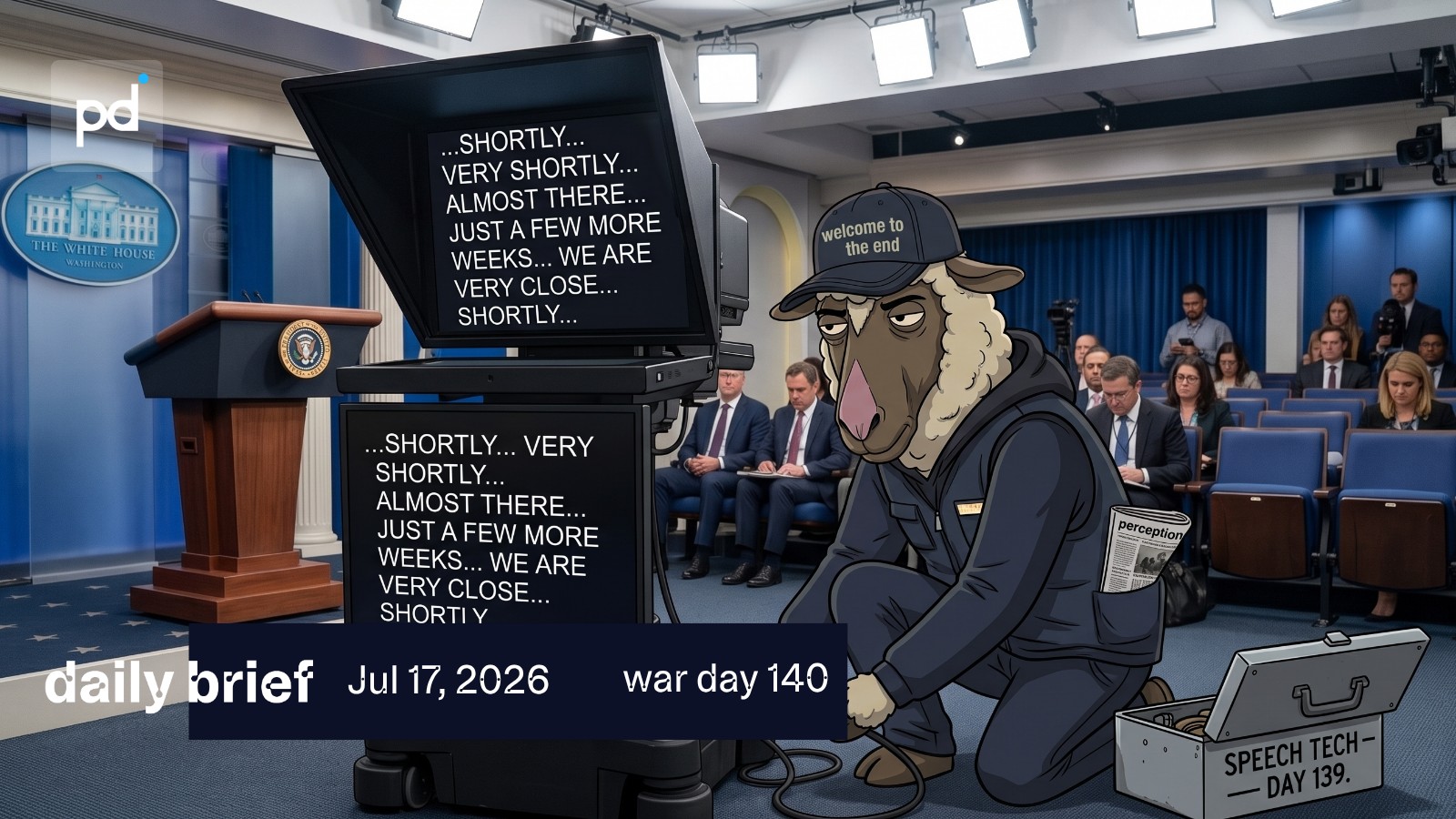
🚨 OPENING
SIX NIGHTS OF FIRE. THE MoU IS DEAD ON PAPER, BUT NO ONE WILL SAY IT OUT LOUD.
On June 17, Trump and Pezeshkian signed the Memorandum of Understanding at Versailles: 60 days to negotiate a final peace deal, Hormuz reopened, naval blockade lifted. It looked like a breakthrough. It was a timed illusion.
On July 8, Trump declared the MoU "over" after fresh Iranian attacks on commercial vessels in the Strait. Since then, CENTCOM has struck Iran every night — six consecutive nights — with precision munitions from fighter jets, drones and warships. Washington reimposed the naval blockade. Traffic at Hormuz has collapsed: just three ships in the last 24 hours, against the 130 daily crossings recorded before the war. Diplomacy hasn't stopped — Qatar and Pakistan are still in play — but on the ground only one thing matters: Trump said "next week gets really bad for them," threatening to hit power plants and bridges if Tehran doesn't return to the table.
Iran is responding with attacks on US military sites in the Gulf — Kuwait and Bahrain on alert — and accuses Washington of "war crimes" against civilian infrastructure. Foreign Ministry spokesperson Esmaeil Baghaei said Tehran has "no plans for negotiations." But the White House says the opposite: Iran still wants a deal. In this war, both can be true at the same time.
📍 MILITARY SITUATION
🇺🇸 USA — Sixth consecutive night of strikes
CENTCOM announced the completion of another wave of strikes on Iranian military targets, using precision munitions from fighter jets, drones and warships. The sixth night in a row.
🚢 NAVAL BLOCKADE
The US naval blockade was reimposed last week. More than 10,000 US service members — sailors, Marines and airmen — alongside two aircraft carriers and over 20 warships are executing the blockade mission. A tanker (M/T Belma, Curaçao-flagged) was disabled as it attempted to breach the blockade toward Kharg Island.
🇮🇷 IRAN — Strikes Gulf states in response
The IRGC struck US military bases in Kuwait and Bahrain. Air raid sirens sounded in both countries. No confirmed casualties. Tehran vows to respond to any attack on its infrastructure with reciprocal strikes across the Middle East.
🌊 HORMUZ — Traffic at historic lows
Just 3 ships transited in the last 24 hours according to MarineTraffic, the lowest figure since the war began. Before the conflict: approximately 130 ships per day.
🌡️ CALIBRA — Hormuz is not formally "closed" in legal terms: the IRGC enforces routes and protocols. Ships that don't comply get attacked. The practical outcome is nearly identical to a full closure.
🇮🇱 ISRAEL — Coordination confirmed
US Defense Secretary Pete Hegseth spoke with Israeli Defense Minister Israel Katz, confirming ongoing military cooperation. US-Israel-Lebanon talks also proceeding on IDF withdrawal from pilot zones in southern Lebanon.
🏠 QATAR — Child injured by shrapnel
At least one child was injured by shrapnel in Qatar during interception operations. The first confirmed civilian incident on Qatari soil. Qatar is simultaneously mediator and collateral victim of the conflict.
🔑 KEY DEVELOPMENT OF THE DAY
TRUMP THREATENS CIVILIAN INFRASTRUCTURE: A DOCTRINAL SHIFT.
Until now, the US has struck military targets: missiles, radar, drones, IRGC naval assets. Now Trump has explicitly threatened power plants and bridges. This is not rhetoric — it's a categorical shift. Hitting electrical infrastructure means blackouts for millions of Iranian civilians, hospitals in crisis, undrinkable water. It also means Iran could justify retaliatory strikes on Gulf infrastructure — including desalination plants critical for survival in Saudi Arabia and the UAE. Vice President Vance has explicitly ruled out ground troops: "We're not in that business anymore." But the line between "military degradation" and "civilian coercion" is thinning fast, and mediators — Qatar above all — are working frantically to prevent next week from becoming the point of no return.
☄️ DON'T LOOK UP
Today: fuel prices rising, Brent above $85, Middle East flight routes still at risk of cancellation.
Within 30 days: if Hormuz stays under blockade, European LNG supplies for autumn are at real risk, with TTF prices rising.
If Hormuz stays closed beyond May: energy rationing in Europe cannot be excluded, double-digit energy inflation, technical recession in Germany and Italy likely.
⚡ ENERGY AND MARKETS
Brent (September): around $84–85 per barrel, highest since June — up 19% from pre-war February levels. WTI: around $79–80. Markets are not yet pricing a "forever war" scenario, but analysts warn: the US Strategic Petroleum Reserve buffer used to absorb the shock is nearly depleted. Goldman Sachs estimates 45% of Gulf exports will be insulated from Hormuz by 2027, but in the short term the hit is full. European TTF under pressure as Hormuz traffic hits historic lows.
📌 PERCEPTION INDEX - how to read it
⬇️ YOU'RE UNDERESTIMATING IT - more important than it seems
⬆️ YOU'RE OVERESTIMATING IT - emotional reaction > actual weight
🌡️ CALIBRATE - reality is more nuanced than the dominant narrative
📊 PERCEPTION INDEX - SUMMARY
🔴 Threat to power plants and bridges ... ⬇️ Underestimated — doctrinal escalation, not a bluff
🔴 June 17 MoU ......................... ⬆️ Overestimated — hollowed out in practice for weeks
🔴 Hormuz traffic at historic lows ...... ⬇️ Underestimated — real impact > media coverage
🌡️ Qatar/Pakistan diplomacy ............. 🌡️ Still alive, but without real leverage on the ground
🔴 "Forever war" threat ................. 🌡️ Real but not yet structural — short cycles for now
🔴 US Strategic Petroleum Reserve ....... ⬇️ Underestimated — buffer nearly exhausted
🔴 Mojtaba Khamenei .................... ⬇️ Absent from public view, a source of internal instability
🎖️ PERCEPTION DEFCON INDEX
🔴 DEFCON 1 — ACTIVE WAR, DIPLOMACY ON LIFE SUPPORT
Sixth consecutive day of US strikes. Naval blockade reimposed. Iran hitting back at Kuwait and Bahrain. The June 17 MoU exists on paper, not on the ground. Trump has explicitly raised the stakes by threatening civilian infrastructure.
Escalation triggers:
— Trump orders strikes on Iranian power plants or bridges
— Iran launches ballistic missile at a US base or Israeli territory
De-escalation signals:
— Iran accepts a public declaration of free passage at Hormuz without conditions
— Qatar secures a direct Leavitt-Araghchi agreement to resume Switzerland negotiations
perceptiondaily by thesmallmediacompany warfare intelligence. next brief: tomorrow at 7.00am.