perceptiondaily — brief july 10 2026
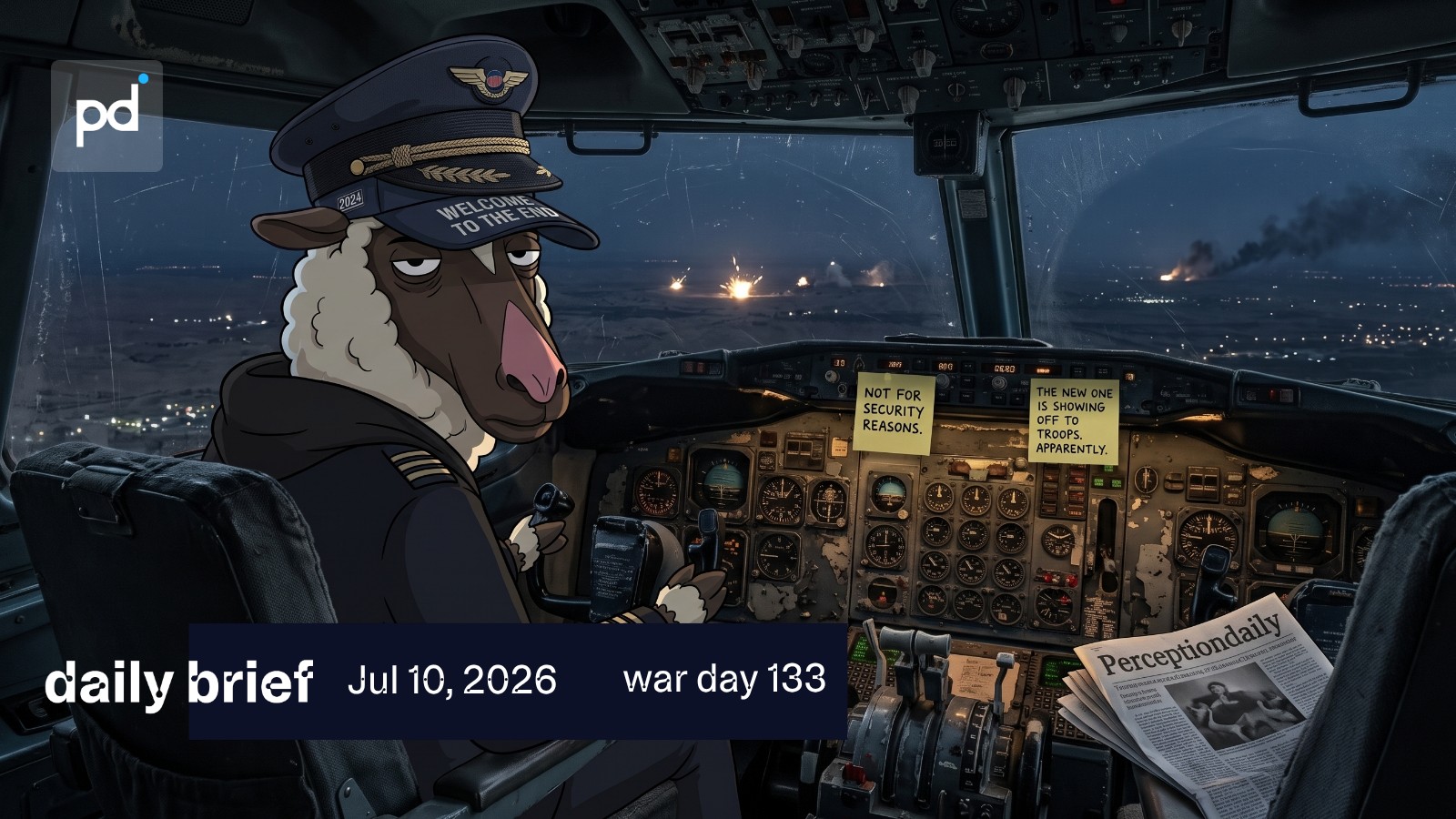
The MoU is dead on paper. Trump declared the ceasefire "over," CENTCOM struck 90 Iranian targets, the IRGC hit Kuwait, Bahrain and Jordan. Hormuz is empty again: 13 ships in 24 hours vs. 110 pre-war. Pakistan and Qatar negotiate in silence.
🚨 OPENING
THE CEASEFIRE IS DEAD ON PAPER. NOW THE QUESTION IS WHETHER THE ABYSS CAN BE AVOIDED.
The MoU signed on June 17 in Islamabad — meant to end the conflict within 60 days — collapsed in three weeks. Trump, speaking from the NATO summit stage in Ankara, declared the ceasefire "over." CENTCOM struck approximately 90 Iranian military targets along the country's southern coastline to "further degrade Tehran's ability to threaten freedom of navigation in the Strait of Hormuz." This is not rhetoric: it was the second consecutive night of large-scale strikes.
The trigger was Iran's attack on three commercial vessels on July 6–7 in Hormuz waters, including the Qatari LNG tanker Al-Rekayyat, struck and at risk of explosion. The IRGC responded to the US raids by launching drones and missiles against American bases in Kuwait, Bahrain, Qatar and — for the first time — Jordan, where eight missiles were intercepted by Amman's air defenses. The geographic escalation is the most alarming data point: this conflict is no longer bilateral.
Behind the explosions, however, diplomacy has not stopped. US sources confirmed to CNN that Washington is deliberately striking and then pausing to allow negotiators room to work. Pakistan, Qatar, Turkey, Egypt and Saudi Arabia held multiple calls with US and Iranian officials in the past 48 hours. The thread is not broken — but it is razor thin. And on July 17, the Iranian oil export license revoked by the US Treasury expires: an economic countdown nobody wants to ignore.
📍 MILITARY SITUATION
💥 US VS IRAN — CENTCOM struck approximately 90 Iranian military targets concentrated on the southern coasts, including air defense systems, command and control networks, radar sites and anti-ship missile capabilities.
🌡️ CALIBRA — A US official told CNN that on July 9 the US was not conducting new airstrikes in Iran: the confusion over the authorship of attacks is part of the strategy.
🚀 IRGC — Kamikaze drones launched against: a Patriot system in Kuwait, an early warning system in Qatar, fuel tanks in Bahrain. A US base in Jordan was also targeted: 8 missiles intercepted by the Jordanian army.
⬇️ DON'T UNDERESTIMATE — The extension to Jordan is unprecedented: Amman is not a proxy, it is a direct NATO ally. It means the IRGC has deliberately raised the geographic stakes.
🛢️ HORMUZ — Only 13 commercial vessels transited in the past 24 hours according to MarineTraffic. Before the war, the figure was 110 per day. Traffic had recovered during the ceasefire, then collapsed again. GPS spoofing is increasing in the area.
⬆️ OVERESTIMATED — Trump said he does not believe a return to full-scale war is coming. Markets absorbed part of the spike.
⚰️ KHAMENEI'S FUNERAL — Ali Khamenei was buried in Mashhad after days of ceremonies. Mojtaba Khamenei — his son and successor as supreme leader since March 8 — was not present even at the private family burial. He has not appeared in public since February 28.
⬇️ DON'T UNDERESTIMATE — Mojtaba's absence even from his father's funeral signals either regime fragility or extreme security precaution. Either way, Iranian leadership is invisible — and that feeds negotiating uncertainty.
✈️ ISRAEL — Defense Minister Israel Katz declared that Israeli forces are "alert and prepared for the resumption of the campaign" in Iran and ready to carry out independent "blue-and-white" strikes "even for a third time." Netanyahu meanwhile says Israel will remain in Lebanon "as long as necessary."
🌡️ CALIBRA — Israel is not party to the MoU: it can act independently, and this asymmetry is what makes every US-Iran agreement structurally fragile.
🏥 CASUALTIES — Iran's Health Ministry confirmed 14 deaths in the July 8–9 attacks. The port area of Chabahar, on the Gulf of Oman, was also struck.
🔑 KEY DEVELOPMENT OF THE DAY
The MoU died from an interpretive flaw, not just from violence.
The MoU text states that Iran "will make arrangements using its best efforts for the safe passage of commercial vessels." Tehran interpreted this as legitimizing its control over the strait — including the right to impose pre-approved routes. The US, meanwhile, was secretly helping ships navigate using a route closer to Oman's coastline, outside Iranian control. Iran saw this as a violation of the agreement and struck. The crucial point: the MoU was so vague that both sides could consider themselves in the right. It wasn't bad faith that blew up the table — it was the deliberate ambiguity engineered to get everyone to sign. And now that same ambiguity is the bomb that detonated everything.
☄️ DON'T LOOK UP
Today: Fuel prices still rising, maritime insurance premiums spiking, less LNG available after the Al-Rekayyat attack.
Within 30 days: From July 17, transactions involving Iranian oil must be wound down. Global stocks already depleted. Further spike in European energy prices likely.
If Hormuz stays effectively closed beyond May: Europe, which depends on Qatari LNG for around 20% of its needs, faces winter rationing risks and a new freeze on industrial energy plans.
⚡ ENERGY AND MARKETS
Brent closed at $78.02 per barrel (+5.2%) on July 9. WTI at $73.52 (+4.4%). After hours, following the revocation of Iran's oil export license, Brent jumped to $76.04 (from an already elevated base). The US Treasury gave companies until July 17 to wind down transactions involving Iranian oil. Hormuz: traffic collapsed to 13 ships per 24 hours vs. 110 pre-war. GPS spoofing intensified in strait waters.
📌 PERCEPTION INDEX - how to read it
⬇️ YOU'RE UNDERESTIMATING IT - more important than it seems
⬆️ YOU'RE OVERESTIMATING IT - emotional reaction > real weight
🌡️ CALIBRA - reality is more nuanced than the dominant narrative
📊 PERCEPTION INDEX - SUMMARY
🔴 MoU collapse ............... ⬇️ More serious than expected: fragile by design from the start
🔴 IRGC strikes Jordan ............... ⬇️ Geographic escalation underreported by media
🔴 Hormuz: 13 ships/24h ............... ⬇️ Near-empty: immediate energy impact
🟡 Brent at $78 ............... 🌡️ High but far from April peak ($188)
🟡 Pakistan-Qatar diplomacy ............... 🌡️ Active but without real guarantees
🟡 Trump: "won't be full-scale war" ............... ⬆️ Political statement, not strategic one
🔴 Mojtaba absent from funeral ............... ⬇️ Sign of legitimacy crisis or extreme security
🟡 Israel threatens independent strikes ............... 🌡️ Credible threat but not yet executed
🎖️ PERCEPTION DEFCON INDEX
🔴 DEFCON 1 — TOTAL ACTIVE WAR
The ceasefire signed on June 17 has effectively collapsed. The US and Iran exchanged attacks for two consecutive nights. The IRGC expanded its targets across four countries in 24 hours. Diplomacy still exists, but operates under active fire — which makes it structurally unstable. July 17 is the next critical date: if the oil deadline is not managed, the escalation cycle begins again.
Escalation triggers:
— Israel launches independent strikes on Iran without US coordination
— Iran formally and completely closes Hormuz with an implicit nuclear threat
De-escalation signals:
— Pakistan/Qatar secure a new technical negotiation window before July 17
— Iran agrees to suspend attacks on commercial vessels as a unilateral gesture
perceptiondaily by thesmallmediacompany warfare intelligence. next brief: tomorrow at 7.00am.