perceptiondaily — brief august 7 2026
Tehran moves to legally bar US and Israeli ships from Hormuz, torpedoing Oman talks. Trump claims unlimited munitions as Saudi Arabia braces for coordinated Houthi-militia attacks. Diplomacy exists, Iran plays both sides.
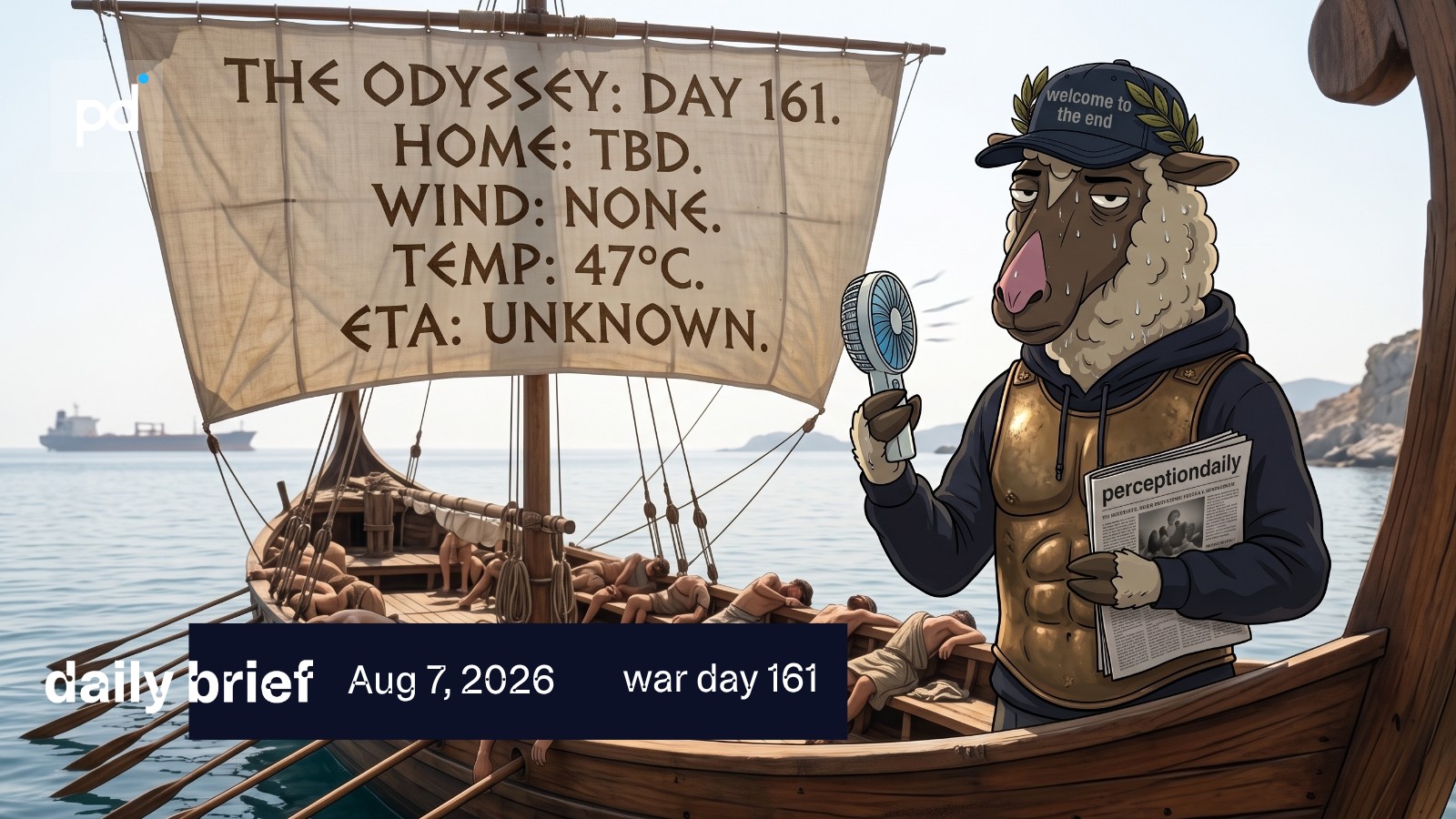
🚨 OPENING
TEHRAN'S DOUBLE GAME: NEGOTIATING WITH OMAN, LOCKING DOWN HORMUZ BY LAW
While Iranian and Omani diplomats describe themselves as being in the "final stages" of a deal to reopen the Strait of Hormuz to commercial traffic, Iran's parliament is moving in the opposite direction. An Iranian parliamentary committee is reviewing a preliminary bill that would bar US, Israeli and other "hostile" vessels from transiting the Strait of Hormuz. The draft bill would impose fines of up to 20% of a ship's cargo value for violations of the proposed restrictions. The US appeared to quickly reject those terms, telling CNBC: "Any temporary routes will be without any impediments."
This is the central knot of day 161: Iran is not choosing between war and peace. It is trying to secure both — an international agreement that formalises its control over the strait, and a domestic law that enforces it on everyone else. The move follows Iran and Oman reaching an understanding on the geographic coordinates for a shipping route through the strait, with the two countries finalising a joint announcement, provided no third parties interfere. The parliamentary bill is, however, an initiative entirely separate from the talks with Oman on commercial shipping through the waterway.
For markets and for Europe, this is the worst short-term scenario: neither the certainty of war, nor the clarity of peace. Trump has repeatedly said negotiations with Iran are underway, telling Fox News "they had an all-day negotiation today, and it looks like things are very good," while Tehran denied any US-Iran talks are taking place. Trump said over the weekend that he had called off what he described as the biggest US attack on another country since World War II because Iran wanted to negotiate.
📍 MILITARY SITUATION
⚔️ HORMUZ / NAVAL FRONT
Iran and Oman are close to finalising a proposed framework for commercial shipping through the Strait of Hormuz, but Tehran's deputy foreign minister warned the agreement would not automatically reopen the waterway.
🏛️ IRANIAN PARLIAMENT — DRAFT BILL
Under the bill, ships from the US, Israel and other countries Iran considers hostile would be barred from the waterway. Military or civilian cargo linked to Israel and vessels involved in actions against Iran and its proxies would also be banned from the strait. The lawmaker said the legislation is still under expert review and that parliament had invited specialists to submit recommendations before the draft is finalised.
🇸🇦 SAUDI FRONT
Saudi Arabia is bracing for "multiple coordinated attacks" by Iraqi militias working with Iran-backed Houthis, a Saudi official told CNN, as the Middle East conflict threatens to continue to broaden in the region. The official cited "multiple intelligence reports" from Saudi Arabia and regional countries that the Iraqi militias "in coordination with the Houthis" are planning to attack the Gulf nation "in the very near future" under the guidance of Iran's Islamic Revolutionary Guard Corps (IRGC).
🔴 US MUNITIONS — PARTIAL ADMISSION
Trump acknowledged certain munitions are in "tighter" supply after months of war with Iran, but insisted the United States had other, less advanced types of weapons to continue fighting if necessary. Despite the reported significant depletion of US air defense stockpiles, Trump insisted the US has "massive amounts of munitions" available for use.
🇱🇧 LEBANON — ISRAEL-HEZBOLLAH TALKS
The now-concluded talks between Israel and Lebanon in Rome "were productive on the technical and expert levels," a US State Department spokesperson said. "The two sides are a lot closer on what needs to be done to advance and expand the pilot zone process."
CALIBRATE — Saudi Arabia: the alert for imminent attacks is real, but Riyadh is also leveraging it diplomatically toward Washington to secure additional protection and arms supplies. The pattern has repeated since the start of the conflict.
🔑 KEY DEVELOPMENT OF THE DAY
THE DRAFT LAW NOBODY WANTS TO SEE
The most underreported story of the day is not the (non-)deal on Hormuz. It is that Iran is transforming the selective blockade of the strait into domestic law. The effort to draft this bill was first announced in March. The following month, a draft was released targeting vessels from countries considered hostile to Iran. The latest version expands the proposed restrictions to more vessels and also covers cargo.
If the bill were to pass, it would no longer be a temporary war measure revocable by decree — it would become law of the Islamic Republic. This fundamentally changes the geometry of negotiations: any agreement is likely contingent on the US lifting its naval blockade of Iranian ports, but the Trump administration has previously ruled out any deal that would cement Iran's grip over the strait. The bill is a negotiating pressure tool. But pressure tools, sometimes, become facts on the ground.
☄️ DON'T LOOK UP
Today: Brent rebounds to $82 after Iran's parliamentary bill — fuel and energy prices remain elevated across Europe.
Within 30 days: If no Iran-Oman deal is formalised, maritime insurance premiums will rise further, raising the cost of every imported good.
If Hormuz stays closed past September: Europe risks a second autumn energy crisis — gas reserves are filling slowly and spot LNG contracts are already under pressure.
⚡ ENERGY AND MARKETS
Brent closed on August 6 at $82.49 per barrel (+3.8%) while WTI gained about 2.8% to settle at $77.29. Prices had fallen about 8% over the week after Treasury Secretary Scott Bessent told CNBC that a deal to open Hormuz with freedom of movement could come as soon as Wednesday. Brent had dipped below $80 during peak diplomatic optimism. Markets are pricing a deal probability before end of August, but with wide uncertainty bands tied to Tehran's dual-track strategy.
📌 PERCEPTION INDEX - how to read it
⬇️ YOU'RE UNDERESTIMATING IT - more important than it appears
⬆️ YOU'RE OVERESTIMATING IT - emotional reaction > real weight
🌡️ CALIBRATE - reality is more nuanced than the dominant narrative
📊 PERCEPTION INDEX - SUMMARY
🔴 Iranian parliamentary bill on Hormuz ........ ⬇️ More dangerous than the headline: it codifies sovereignty, not just war
🔴 Iran-Oman deal "in final stages" ............. 🌡️ "Final stages" for weeks — the technical gap is still wide
🔴 Trump: "unlimited munitions" ................. ⬆️ Partial denial: admits stocks are "tighter" — not a zero-problem
🔴 Saudi Arabia on maximum alert ................ ⬇️ Secondary front that can become primary within hours
🔴 Israel-Lebanon Rome talks "productive" ....... 🌡️ Technical progress, but Hezbollah and IDF keep striking each other
🔴 Oil prices: Brent $82.49 ..................... 🌡️ Volatile, not falling — peace is hoped for, not priced in
🔴 Houthi-Iraqi militia IRGC coordination ....... ⬇️ Potential conflict widening largely ignored by European media
🎖️ PERCEPTION DEFCON INDEX
🔴 DEFCON 1 — ACTIVE WAR
We are on day 161 of open war. Iran's parliament is drafting laws that categorically exclude US ships from Hormuz. Saudi Arabia is on alert for imminent attacks. Trump denies munitions shortages but partially admits them. No deal signed — only performative optimism on both sides.
Escalation triggers:
— Passage of the Iranian parliamentary bill and first seizure of a non-Iranian vessel under its terms
— Coordinated Houthi-Iraqi militia attack on Saudi energy infrastructure
De-escalation signals:
— Formal signing of Iran-Oman deal with verified geographic coordinates and commencement of commercial transit
— Suspension of parliamentary review of the Hormuz bill as a diplomatic goodwill gesture
perceptiondaily by thesmallmediacompany warfare intelligence. next brief: tomorrow at 7.00am.