perceptiondaily — brief august 6 2026
Iran and Oman have agreed on coordinates for a Hormuz shipping route. The joint statement is in final drafting. But Tehran warns: no reopening while the US naval blockade holds. The deal is on the table. So is the knife.
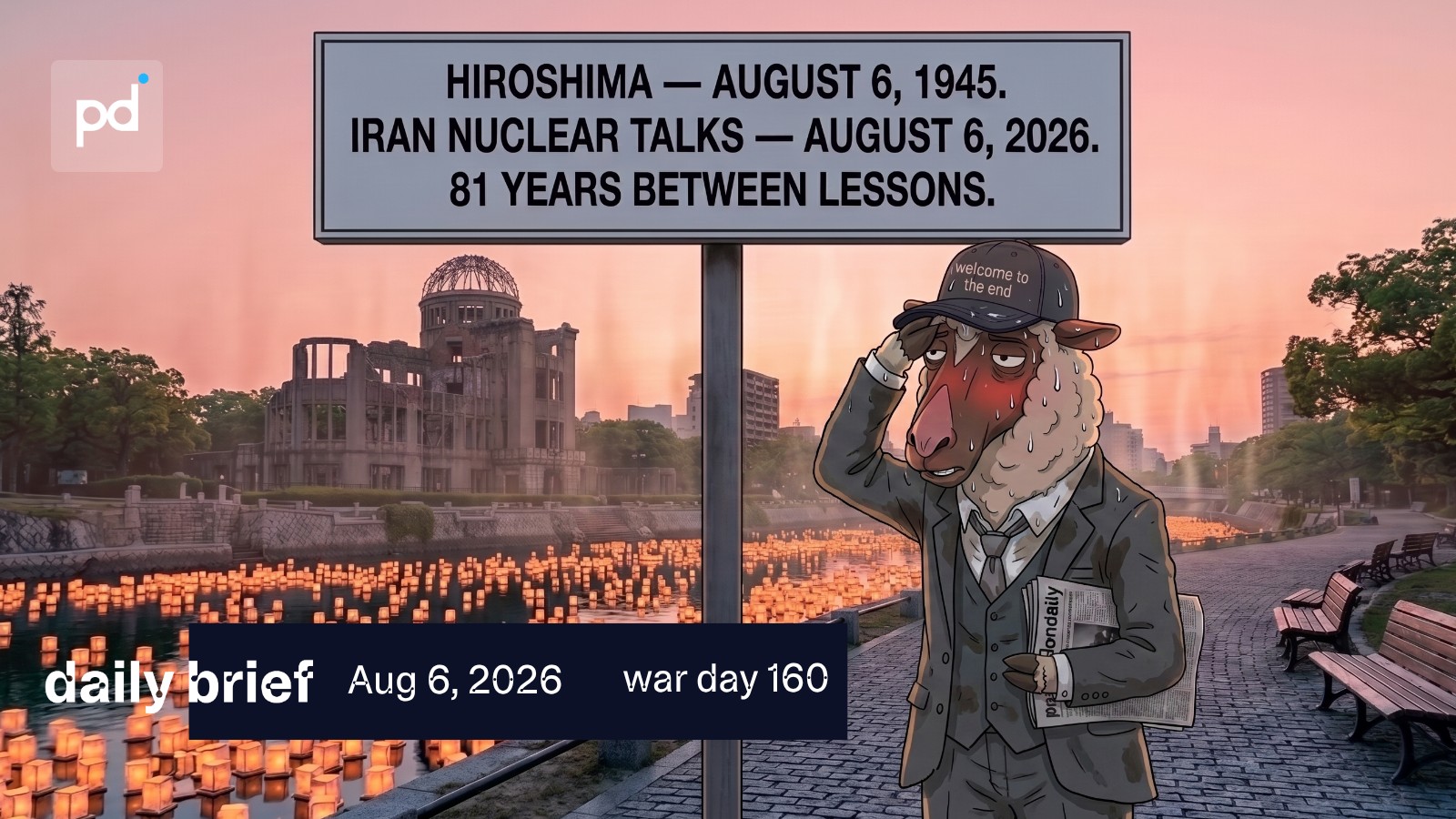
🚨 OPENING
Hormuz: the deal exists. The peace doesn't.
Iran and Oman have reached a technical agreement: a route has been agreed upon, geographic coordinates have been defined, and a joint statement is in its final drafting stage. It is the most concrete diplomatic signal in weeks. Trump said an announcement is coming "soon." The US Treasury had already floated a deal "today or tomorrow." Markets responded with a drop in crude oil at the start of the week.
But the structural problem hasn't gone away. Tehran has made clear, once again, that any agreement on a shipping route does not automatically mean reopening the strait. Iran is conditioning everything on the end of the US naval blockade on Iranian ports — a condition Washington has not yet accepted. Iranian Foreign Ministry spokesman Baghaei explicitly stated that "the factors making the Strait of Hormuz insecure still exist on the part of the United States." Translation: signing a document means nothing while American warships stay in place.
The real risk today is not that negotiations collapse — it's that they produce an agreement that is formally valid but operationally impossible. A deal no one openly violates but that opens nothing. Meanwhile, tankers keep getting attacked, prices stay high, and the world waits.
📍 MILITARY SITUATION
🚢 HORMUZ — A tanker reported hearing two explosions while transiting the strait, approximately nine nautical miles southeast of Kumzar, Oman. UKMTO confirmed the incident. No sinking, but transit remains dangerous.
---
⚓ HORMUZ — MarineTraffic recorded at least 10 commercial vessels transiting the strait in the last 24 hours. A minimal sign of residual traffic, still far below pre-war levels.
---
🇾🇪 HOUTHIS — Yemen's Houthi rebels claimed to have struck a Saudi oil tanker in the Gulf of Aden with a ballistic missile, forcing it to turn back. A second attack was claimed near Yanbu on the Red Sea. No confirmation from Riyadh.
---
🇱🇧 LEBANON — Israel carried out its most intense strikes on southern Lebanon in weeks, accusing Hezbollah of a ceasefire violation. US-mediated talks between Israel and Lebanon ended earlier than expected. Washington downplayed the development, stating talks would resume Thursday.
---
🇮🇱 ISRAEL — The IDF issued its first evacuation order in southern Lebanon since June, signaling possible imminent ground operations in the area.
---
🌡️ CALIBRA — US military casualties: as of August 4, DCAS recorded 18 American soldiers killed and 687 wounded since the start of the war. Official numbers are considered understated by independent analysts.
🔑 KEY DEVELOPMENT OF THE DAY
CBS News revealed that the United States has used nearly all of its global stockpile of long-range precision missiles during the war with Iran. Two sources with direct knowledge of the matter confirmed this to the network. Defense Secretary Hegseth had previously dismissed any concerns about stockpiles. This detail — if confirmed — fundamentally changes the geometry of the war: Trump can still threaten "massive attacks" on Iran, but the real capacity to carry them out would be drastically reduced. It also explains why Washington is suddenly projecting diplomatic optimism.
☄️ DON'T LOOK UP
Today: Brent above $83, European energy bills still 30-40% higher than pre-war levels.
Within 30 days: If the Iran-Oman deal collapses, crude oil could spike again toward $90-95 a barrel.
If Hormuz stays closed past May: Energy rationing in southern Europe, double-digit inflation across several EU countries, industrial crisis in German and Italian manufacturing.
⚡ ENERGY AND MARKETS
Brent trading around $83-84 a barrel, down from late July peaks near $90. WTI hovering around $79-80. The decline reflects this week's diplomatic optimism, but traders remain cautious: the strait is technically still closed and attacks continue. Goldman Sachs estimated a return to $80 "if Hormuz fully reopens" by year-end. European natural gas TTF remains under structural pressure for the fifth consecutive month.
📌 PERCEPTION INDEX - how to read it
⬇️ YOU'RE UNDERESTIMATING IT - more important than it seems
⬆️ YOU'RE OVERESTIMATING IT - emotional reaction > real weight
🌡️ CALIBRATE - reality is more nuanced than the dominant narrative
📊 PERCEPTION INDEX - SUMMARY
🔴 Iran-Oman Hormuz agreement ............... ⬇️ More fragile than it looks — political conditions still incompatible
🔴 Trump's optimism on imminent deal ......... ⬆️ Same narrative for two weeks, still no signature
🔴 US precision missile stockpile depleted ... ⬇️ Crucial and underreported — reshapes entire US military posture
🔴 Houthi attacks on Saudi tankers ........... 🌡️ Real escalation but not yet strategically decisive
🔴 Israel-Lebanon talks cut short ............ 🌡️ Friction signal, but Washington has already scheduled resumption
🔴 Oil prices down this week ................. ⬆️ Markets pricing in peace that hasn't been signed
🔴 Pezeshkian: "hardest period since 1979" ... ⬇️ Domestic pressure on Iran: signal of possible negotiating concession
🎖️ PERCEPTION DEFCON INDEX
🔴 DEFCON 1 — Critical threshold
Day 160. The technical agreement on Hormuz exists, but it is conditioned on a political move neither Washington nor Tehran has yet made. US missile stockpiles are nearly depleted. The Houthis continue attacking in the Gulf of Aden. Israel just cut short talks in Lebanon. The system is in unstable equilibrium: one incident in the strait or one miscalculated strike could unravel everything.
Escalation triggers:
— US naval blockade strikes an Iranian civilian vessel / Tehran responds with missiles on a US base
— Iran-Oman agreement sabotaged by IRGC faction opposed to negotiations
De-escalation signals:
— Iran-Oman joint statement signed and first escorted transit completed without incident
— Washington announces partial suspension of naval blockade as a confidence-building measure
perceptiondaily by thesmallmediacompany warfare intelligence. next brief: tomorrow at 7.00am.