perceptiondaily — brief august 3 2026
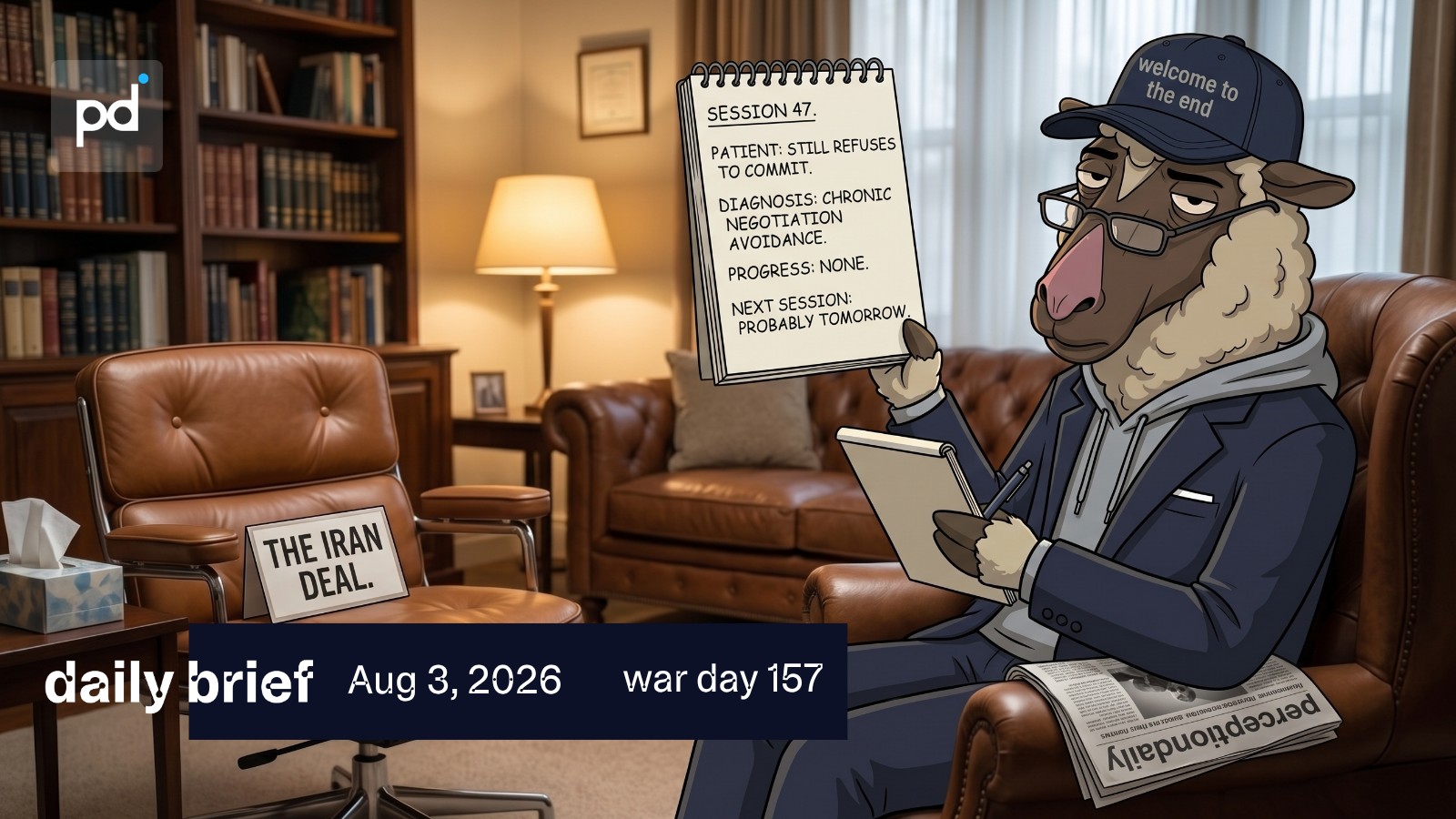
Trump calls off the biggest planned attack since WWII and restarts Iran talks for Monday. Hormuz and denuclearization on the table. But Tehran hasn't moved an inch. A deal has been "imminent" for months.
🚨 OPENING
The attack that never happened — and the negotiations starting from scratch
Everything was in place. According to Trump, it would have been "the biggest attack since World War II." Then, Saturday evening, the phone rang: on the other end were Mohammed bin Salman, the Qatari prime minister, and the UAE. All asked him to stand down. Trump obliged. On Sunday he announced that negotiations with Tehran would resume Monday afternoon — without disclosing the venue or participants — and that a deal on Hormuz and Iran's denuclearization was "imminent."
The problem is that "imminent" is the most overused word of this conflict. It was imminent in April, when the Pakistan-mediated ceasefire held for two weeks. It was imminent in June, when a memorandum of understanding was signed and then ignored. The structural situation remains unchanged: Washington wants Hormuz open and zero nuclear capability, Tehran wants to preserve sovereignty over the strait and has no intention of dismantling what remains of its atomic program.
The most significant fact of the day is not that Trump cancelled the strikes. It is that he did so at Riyadh's request — not Washington's. Saudi Arabia is the real architect of this pause. MBS cannot afford an escalation that hits regional energy infrastructure while the Houthis are already threatening the Red Sea corridor. This is the true balance of power governing the conflict right now.
📍 MILITARY SITUATION
🛡️ NIGHT OF AUGUST 2-3 — TACTICAL CALM
No strikes reported from either side overnight. First significant operational pause in weeks.
---
🚢 HORMUZ — TRAFFIC IN FITS AND STARTS
Iran stopped two tankers in recent days. Kpler confirms two VLCCs managed to exit the Gulf. Hormuz is not sealed but is a diplomatic and physical minefield.
---
🇮🇱 ISRAEL — INTERNAL COMMAND FRICTION
Defense Minister Katz attempted to dismiss IDF Central Command chief Bluth without coordinating with Chief of Staff Zamir. The IDF blocked the move. A signal of internal friction at the Israeli military's top tier.
---
🇾🇪 HOUTHIS — SAUDI EMBARGO CONFIRMED
Houthis maintain their maritime embargo against Saudi Arabia. The Saudi pipeline to Yanbu — the Hormuz alternative — remains under pressure.
---
🇮🇶 IRAQ — MILITIAS UNDER PRESSURE
The US and Saudi Arabia conducted joint strikes against Iran-backed militias in Iraq. The Iraqi front consolidates as a secondary but persistent theater.
🔑 KEY DEVELOPMENT OF THE DAY
The Oman-Iran negotiation on Hormuz is in its "final stages" — but it's not about reopening.
While Trump sells the narrative of an imminent deal, Iranian Foreign Ministry spokesman Baghaei clarifies that the talks with Muscat concern a new transit route through the strait — not its reopening or closure. Two parallel tracks that never meet. Tehran is building a technical solution that preserves its operational control over Hormuz even in the event of a political agreement. It is the smartest move Iran has made in weeks: concede the form, keep the substance.
☄️ DON'T LOOK UP
Today: elevated energy prices, Brent around $88-90, expensive fuel across Europe.
Within 30 days: if Monday's negotiations fail, new strikes likely, Brent heading toward $100.
If Hormuz stays closed beyond May: energy rationing in Europe, technical recession for Germany and Italy before year-end.
⚡ ENERGY AND MARKETS
Brent sits around $87-90 per barrel. Recent session range between $84 and $91. WTI around $84. Trump's diplomatic pause brought temporary relief to Gulf markets, with Riyadh stocks rising on Sunday. Goldman Sachs estimates Brent at $80 by year-end only if Hormuz fully reopens in Q4 — still a hypothetical scenario. European TTF gas remains under pressure due to limited alternative supply options.
📌 PERCEPTION INDEX - how to read it
⬇️ YOU'RE UNDERESTIMATING IT - more important than it seems
⬆️ YOU'RE OVERESTIMATING IT - emotional reaction > real weight
🌡️ CALIBRATE - reality is more nuanced than the dominant narrative
📊 PERCEPTION INDEX - SUMMARY
🔴 Trump's "imminent" deal ............... ⬆️ Recurring rhetoric, no concrete guarantees
🔴 MBS's role in stopping the attack ............... ⬇️ Riyadh's moves underestimated — they are decisive
🔴 Oman-Iran Hormuz negotiation ............... 🌡️ Not a reopening: it's a redesign of control
🔴 IDF internal tension (Katz vs Zamir) ............... ⬇️ Real friction, potential destabilizing factor
🔴 Overnight operational pause ............... 🌡️ Tactical, not structural — can end within hours
🔴 Houthis and Saudi embargo ............... ⬇️ Underestimated: second chokehold on global energy
🔴 Brent at $88-90 ............... 🌡️ Markets already pricing in escalation — reaction asymmetric
🎖️ PERCEPTION DEFCON INDEX
⚠️ DEFCON 2 — Critical threshold maintained
The pause in strikes does not reduce the alert level. The conflict is in tactical standby, not structural de-escalation. The conditions for a resumption of hostilities remain intact: Hormuz is not open, Iran's nuclear program is not genuinely on the table, Israel operates independently in Lebanon.
Escalation triggers:
— Failure of Monday's negotiations or breakdown over Tehran's preconditions
— New Houthi attack on Saudi infrastructure prompting a direct US response
De-escalation signals:
— Oman-Iran technical accord on Hormuz transit corridor ratified within 72 hours
— Shipping traffic recovery verified by Kpler above 40% of pre-war volumes
perceptiondaily by thesmallmediacompany warfare intelligence. next brief: tomorrow at 7.00am.