perceptiondaily — brief august 11 2026
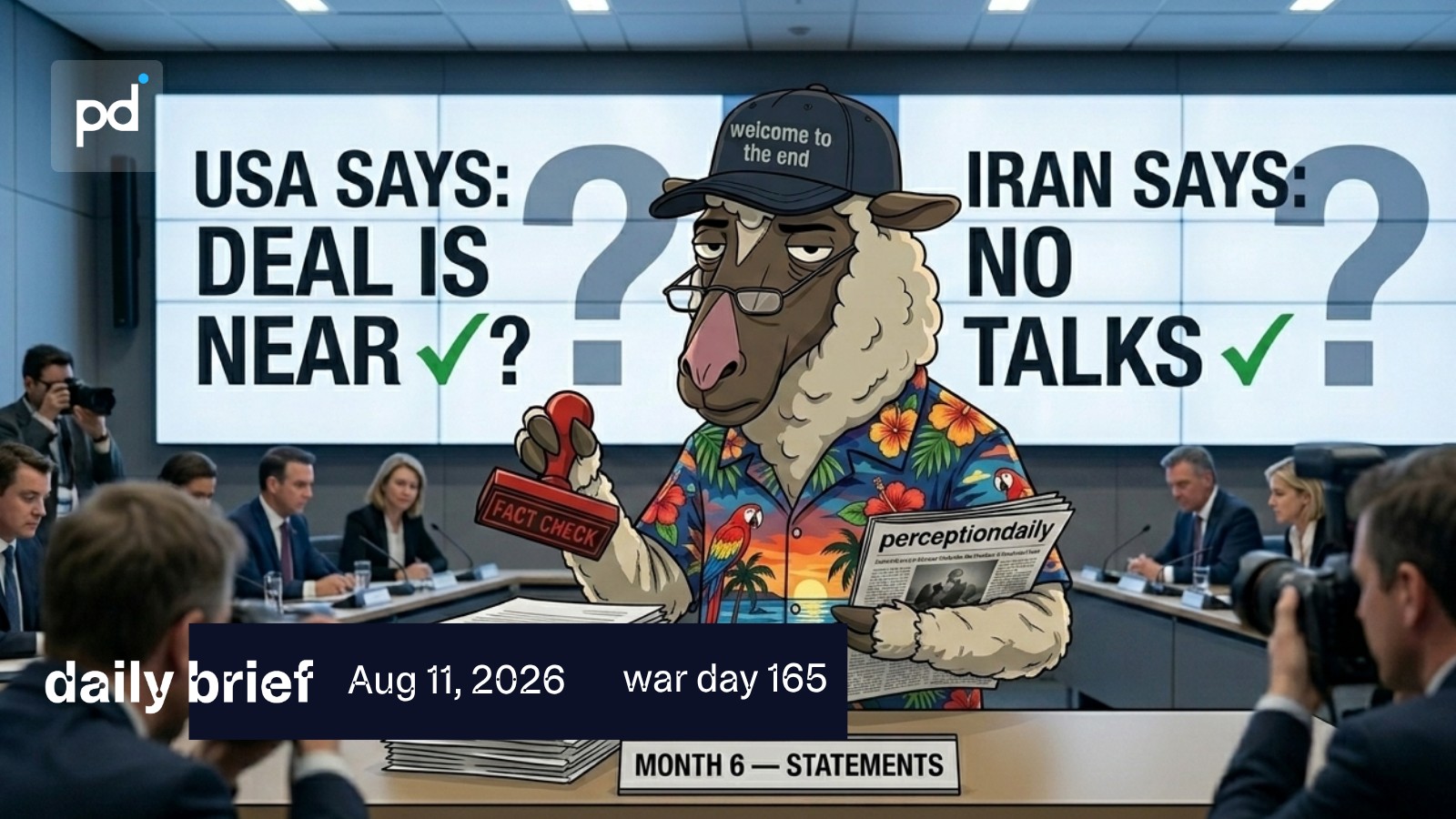
Trump demands reparations from Tehran — mirroring Iran's own claims. Hormuz nearly paralyzed at 6 Sunday crossings. Talks have become a duel of impossible demands as oil climbs and time runs out.
🚨 OPENING
THE REPARATIONS WAR: TRUMP MIRRORS TEHRAN'S OWN MOVE
On August 10, Donald Trump made the most disruptive diplomatic move of recent days: he posted on Truth Social that the United States would demand financial compensation from Tehran for all damages inflicted by Iran on the US over the past decades — not just in the current war, but going back to the bombing of the USS Cole in 2000. The response was instant and geometric: Iran had just formalized its own war reparations demands as a precondition for reopening Hormuz. Trump simply raised with the same card.
The mechanism is clear: Tehran uses reparations as a diplomatic lever to stall negotiations and extract concessions on sanctions and the naval blockade. Trump uses counter-reparations to neutralize that lever, erase Iran's negotiating advantage, and shift the burden of the impasse to the other side. The practical result is that both parties have locked themselves into a public position from which retreat would mean losing face. The negotiation is formally alive. In substance, it is frozen.
This comes as the Strait of Hormuz hits historic transit lows: Sunday recorded just 6 ship crossings, versus roughly 130 daily before the war. Brent climbed nearly 5% in two days. The eighth round of US sanctions of 2026 was announced Friday, targeting Iran's shadow banking system. Tehran says sanctions will not break it. The cycle repeats — but each iteration leaves less room for a negotiated exit.
📍 MILITARY SITUATION
⚓ HORMUZ — TRAFFIC AT HISTORIC LOWS
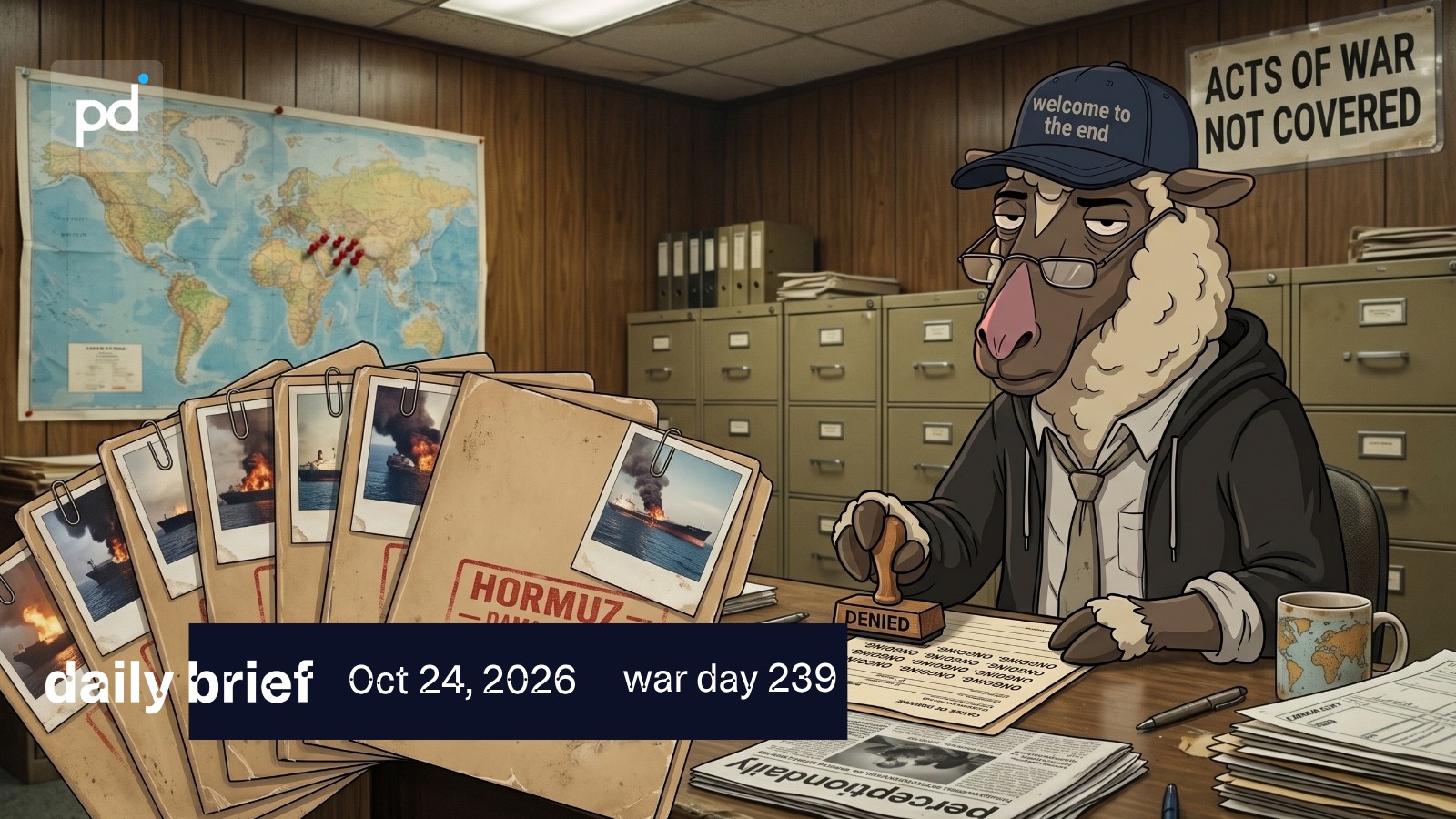
Sunday August 9: only 6 confirmed transits through the Strait. Saturday: 11, Friday: 15. Kpler describes traffic as "subdued" and "weakened further over the weekend." Iran approves the northern route (Iranian waters) for inbound traffic, Oman the southern route for outbound — but the final agreement is not yet signed.
---
🚢 HORMUZ — IRAN-OMAN DEAL STALLED
Iran and Oman are close to a framework, but Tehran insists: the US naval blockade must end before any reopening. The Iranian parliament approved a first reading of a draft law that would ban transit by US, Israeli and vessels of nations deemed to have "harmed Iran" until compensation is paid. Proposed penalty: 20% of the value of cargo aboard.
---
🎯 HOUTHIS — STRIKE ON ARAMCO JAZAN REFINERY
August 9: Houthis claim a drone attack on Saudi Aramco's Jazan refinery on the Red Sea coast. Saudi Aramco confirms a fire, subsequently extinguished. No injuries reported. Houthi operations against Saudi targets are multiplying, following the killing of at least 30 pro-government Yemeni soldiers the previous week.
---
🤝 SAUDI-TURKEY-PAKISTAN MUTUAL DEFENSE PACT
August 7, Mecca: Saudi Arabia, Turkey and Pakistan sign a NATO-style mutual defense agreement. An attack on one is an attack on all. A Saudi move to secure its flanks as Houthi escalation grows and US security guarantees appear insufficient.
---
🔄 IRANIAN LEADERSHIP — REZAEI APPOINTED TO SECURITY COUNCIL
Mojtaba Khamenei on Sunday appointed Mohsen Rezaei — former IRGC commander and Iran-Iraq war veteran — as his representative to the Supreme National Security Council, replacing Zolghadr. Rezaei is a hardliner. The appointment comes as the first video footage of Mojtaba Khamenei surfaces — he had not appeared publicly since March.
---
📰 PRESS FREEDOM UNDER ATTACK
On August 8, photojournalist Yalda Moaiery announced on social media a 15-year prison sentence handed down in absentia by Tehran's Revolutionary Court. HRANA documents a growing crackdown on media inside Iran throughout the conflict.
---
🛢️ RUSSIA — SHADOW FLEET MONITORED
A vessel suspected of belonging to Russia's "shadow fleet" was reported in Strait waters. Moscow uses uninsured aging tankers to circumvent Western sanctions on its oil exports.
🔑 KEY DEVELOPMENT OF THE DAY
THE REPARATIONS REVERSAL IS A DIPLOMATIC TRAP
Trump's move is being underestimated. This is not rhetoric — it is a structural trap. Iran had inserted reparations into its preconditions knowing Washington would never accept them, but that gave Tehran a public justification for the non-deal. Trump defused that trap by mirroring the same demand. Now both sides hold a precondition the other finds unacceptable, and neither can be seen as the one who "blinked first." This is not an accident: it is a deliberate choice to freeze negotiations without formally closing them. The danger is that this standoff lasts long enough to make the economic situation irreversible — both in Iran (runaway inflation, empty coffers) and in Europe (spiraling energy costs). The Chairman of the US Joint Chiefs has already privately warned that military escalation options "could backfire." Time is not neutral here: it works against everyone.
☄️ DON'T LOOK UP
Today: Fuel prices at the pump rising across Europe as Brent climbs back to $87.72.
Within 30 days: If Hormuz stays below 10 transits per day, European LNG supply enters early winter rationing territory.
If Hormuz stays closed beyond May: Technical recession in Germany and Italy, residential gas bills at 2022-level highs, unsustainable pressure on European manufacturing.
⚡ ENERGY AND MARKETS
Brent (August 10 close): $87.72 per barrel, +5% in two days. WTI: $82.13, +5%. Brent is up approximately 16% since the start of the war. Hormuz Sunday transits: 6 ships (vs. 130 pre-war). The US naval blockade has pushed US Strategic Petroleum Reserve below 300 million barrels — lowest since January 1983. European TTF under growing pressure due to disrupted LNG supply chains.
📌 PERCEPTION INDEX - how to read it
⬇️ YOU'RE UNDERESTIMATING IT — more important than it seems
⬆️ YOU'RE OVERESTIMATING IT — emotional reaction > actual weight
🌡️ CALIBRATE — reality is more nuanced than the dominant narrative
📊 PERCEPTION INDEX - SUMMARY
🔴 Trump-Iran cross-reparations ................... ⬇️ Structural diplomatic trap, not rhetoric
🔴 Hormuz — 6 Sunday transits ..................... ⬇️ Near-total collapse, markets underpricing it
🟠 Iran-Oman Hormuz deal .......................... 🌡️ Close on paper, far in substance
🟠 Houthis — Jazan refinery strike ................ ⬇️ Systematic proxy escalation, not episodic
🟡 Saudi-Turkey-Pakistan defense pact ............. 🌡️ Relevant geopolitical signal, real capability to verify
🟡 Rezaei appointment to Iran Security Council .... ⬇️ Hardliners gaining ground, moderate negotiators losing it
🟢 Trump "low-keying" negotiations ................ ⬆️ Not moderation — substitute economic pressure
🟢 Mojtaba Khamenei video footage ................. 🌡️ Propaganda, but signals the regime wants to project stability
🎖️ PERCEPTION DEFCON INDEX
🔴 DEFCON 1 — Active War / Deep Diplomatic Deadlock
The conflict is technically in a phase of reduced direct military action (no major US-Israel strikes on Iran in recent weeks), but the diplomatic standoff has just hardened further with the reparations war. Hormuz is at minimum transit levels. Iranian proxies (Houthis) are escalating against Saudi Arabia. Economic pressure on Tehran is real but insufficient to produce capitulation.
Escalation triggers:
— Final breakdown of Iran-Oman Hormuz talks + new US/Israeli strike on Iranian energy infrastructure
— Large-scale Houthi attack on Aramco facilities or US warships in the Red Sea
De-escalation signals:
— Signing of an Iran-Oman framework agreement with first commercial routes restored
— Opening of a direct US-Iran channel mediated by Oman with suspension of the naval blockade
perceptiondaily by thesmallmediacompany warfare intelligence. next brief: tomorrow at 7.00am.