perceptiondaily — brief april 19 2026

📌 PERCEPTION INDEX - how to read it
⬇️ YOU'RE UNDERESTIMATING THIS - more important than it seems
⬆️ YOU'RE OVERESTIMATING THIS - emotional reaction > real weight
🌡️ CALIBRATE - reality is more nuanced than the dominant narrative
🚨 OPENING
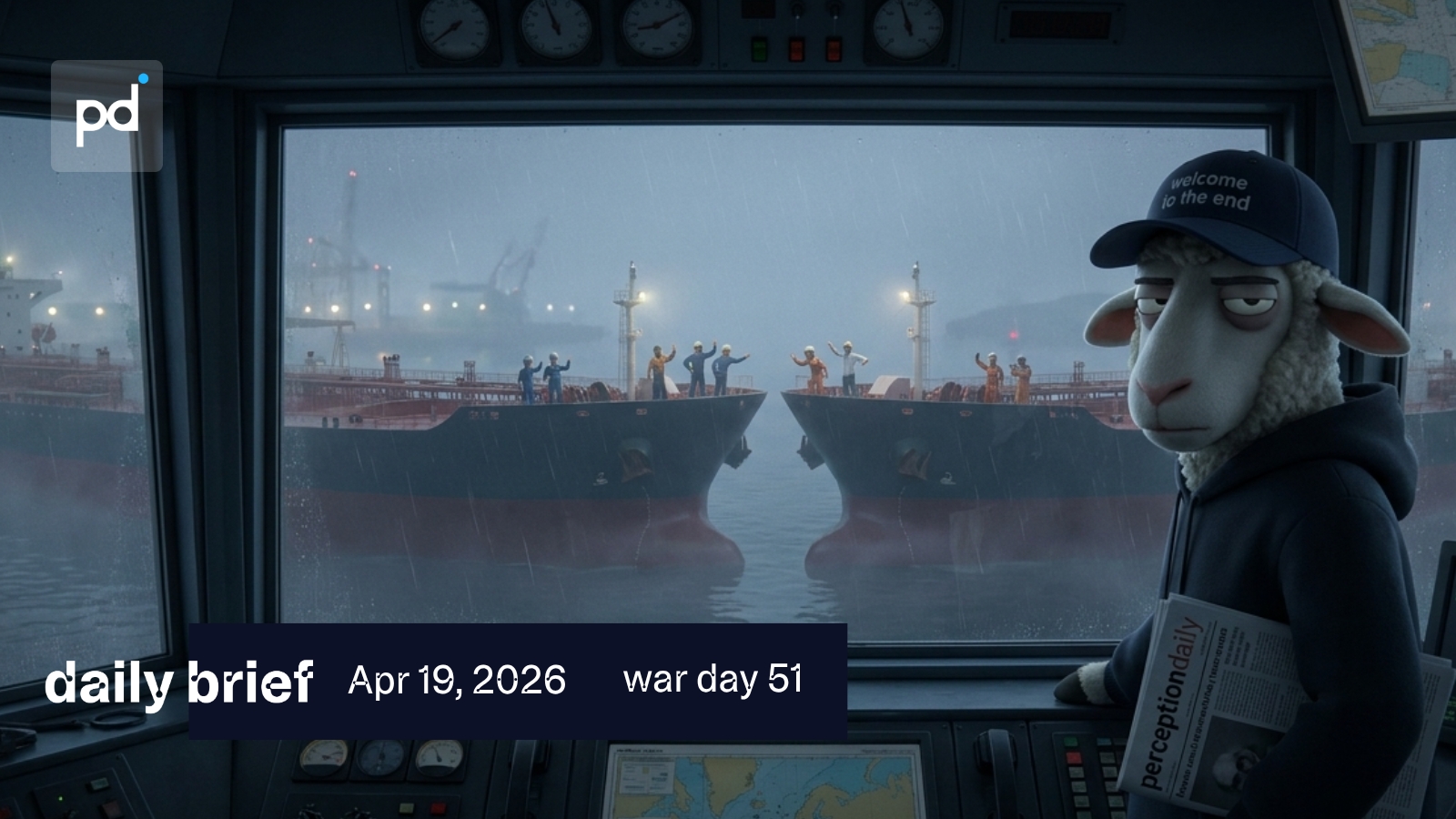
The Strait as a weapon: open, closed, open. Tehran's game has a name.
Oil markets experienced a brutal swing in the past hours: after Iran declared the Strait of Hormuz "completely open" for commercial vessels on Friday, prices plunged. Then Tehran turned the tap off again. Brent bounced back toward $95-96 per barrel, WTI climbed toward $90+, as supply shortage fears returned to global markets.
This is not disorganization. It is a deliberate strategy. The ceasefire announcement leaves more questions than answers for Gulf oil and gas exports: Iran remains in control of whether and when ships can pass — and how much it might cost under a potential new tolling scheme.
The real problem is structural. The US-Iran ceasefire is set to expire on Tuesday, April 21. Tanker traffic through the Strait remains at a trickle, with no clear path to fully reopening the vital maritime route. In 48 hours, if there is no deal or extension, the world goes back to square one. With everything that entails.
📍 MILITARY SITUATION
⚓ US NAVAL BLOCKADE — CONFIRMED
The US military declared its blockade of Iranian ports "fully implemented," stating that US forces have "completely halted economic trade going into and out of Iran by sea." Since the blockade began, 10 ships have been turned back. Trump thanked Iran for reopening the Strait but confirmed in a second post that the naval blockade will remain in "FULL FORCE" until the US reaches a deal with Tehran.
CALIBRATE: the US blockade and Iran's Strait reopening coexist on paper — neither is worth anything until the other side yields.
🛡️ IRANIAN MISSILE CAPABILITY — STILL PARTLY INTACT
The US-Israeli bombing campaign has caused "significant degradation of Iranian military capabilities." However, roughly half of Iran's missile launchers remain intact, and Tehran still retains thousands of one-way attack drones and a large number of missiles. Satellite images from April 10 show debris-clearing activity at missile base tunnels near Khomeyn and south of Tabriz — a sign Iran is rebuilding its "missile cities."
CALIBRATE: Israel claims it "crushed" the program. Intelligence data tells a different story.
🇱🇧 LEBANON — ISRAEL-HEZBOLLAH CEASEFIRE
Israel and Lebanon agreed to a 10-day ceasefire. Netanyahu said he agreed to the truce "to advance" peace efforts. Defense Secretary Pete Hegseth said the US naval blockade will last "for as long as it takes" and that the military is prepared to resume attacks on Iran if a lasting ceasefire deal is not reached soon.
CALIBRATE: the Lebanon ceasefire is separate from the Iran-US one — but the collapse of one drags the other down.
💣 IRAN — SHIITE MILITIAS, HUNDREDS OF ATTACKS
Iran-backed Shiite militias have conducted "hundreds" of attacks on US forces since the war began in February, according to Lt. Gen. James Adams, head of the Defense Intelligence Agency.
CALIBRATE: nearly invisible in mainstream media, this front quietly drains resources and troop morale.
🔑 KEY DEVELOPMENT OF THE DAY
Trump says "they agreed to everything." Tehran says "no."
Trump told CBS News that Iran "agreed to everything" and will work with the US to remove its enriched uranium. US officials could return to Pakistan to resume negotiations within days. However, an Iranian foreign ministry spokesperson stated in a release that the transfer of uranium to the US is "not an option."
Same dynamic as before. The US demands a 20-year moratorium on enrichment; Iran proposes five. This is the real knot: not a question of willingness, but of who blinks first on a point neither side can concede. Vance expressed optimism, but an Iranian analyst stated that surviving US pressure has strengthened Tehran's hand at the table.
☄️ DON'T LOOK UP
Today: Brent oscillates between $94 and $96 per barrel as markets react in real time to Strait geopolitics. Expensive fuel, energy bills under pressure, gas supply still disrupted.
Within 30 days: The IMF warns that further escalation could push the global economy toward recession. If the ceasefire collapses on April 21, expect an immediate energy shock in Europe with gas and electricity prices spiking again.
If Hormuz stays closed past May: The physical market tightens every day without resumed flows. ING estimates roughly 13 million barrels per day of supply have been disrupted — a figure that could rise further. Energy rationing in Europe by summer is not an extreme scenario: it is arithmetic.
⚡ ENERGY AND MARKETS
On Friday, WTI plunged 11.4% to $83.85 per barrel after the Strait reopening — the second-largest single-day drop since the war began. Brent fell 9% to $90.38. Then Iran closed it again. Brent bounced back toward $95-96, WTI toward $90+. Goldman Sachs estimates Strait flows remain at just 10% of normal levels, roughly 2.1 million barrels per day. European TTF gas remains under structural pressure since Qatar lost 17% of its LNG export capacity to March strikes.
📊 PERCEPTION INDEX - SUMMARY
🔴 Hormuz open/closed ............... ⬇️ A negotiating lever, not a peace gesture
🔴 April 21 ceasefire deadline ............... ⬇️ Expires in 48h — underpriced by markets
🔴 Nuclear negotiations ............... 🌡️ The 20yr vs 5yr gap is real but not insurmountable
🔴 Iranian military capacity ............... ⬆️ Not destroyed — half the launchers still intact
🔴 Lebanon 10-day ceasefire ............... 🌡️ Fragile, Israel keeps troops in the south
🔴 Energy impact on Europe ............... ⬇️ Swinging hourly — volatility is the new gas price
🔴 US naval blockade ............... ⬇️ Ongoing even with Hormuz "open" — barely reported
🔴 IMF recession warning ............... ⬇️ The warning is real, buried under diplomatic news
🎖️ PERCEPTION DEFCON INDEX
🔴 DEFCON 1 — Critical Threshold
The ceasefire expires April 21. No deal has been reached. Iran is using the Strait as a negotiating pressure tool, opening and closing it within hours. The US naval blockade continues in parallel. The risk of a full ceasefire collapse in the next 48 hours is real and underestimated.
Escalation triggers:
— No deal or extension by April 21: resumption of strikes
— Naval incident in the Strait between US fleet and IRGC vessels
De-escalation signals:
— Announcement of a confirmed second round of talks in Pakistan
— Formal ceasefire extension of at least 14 days agreed by both sides
perceptiondaily by thesmallmediacompany warfare intelligence. next brief: tomorrow at 7.00am.