perceptiondaily — brief april 18 2026

📌 PERCEPTION INDEX - how to read it
⬇️ YOU'RE UNDERESTIMATING IT - more important than it seems
⬆️ YOU'RE OVERESTIMATING IT - emotional reaction > real weight
🌡️ CALIBRATE - reality is more nuanced than the dominant narrative
🚨 OPENING
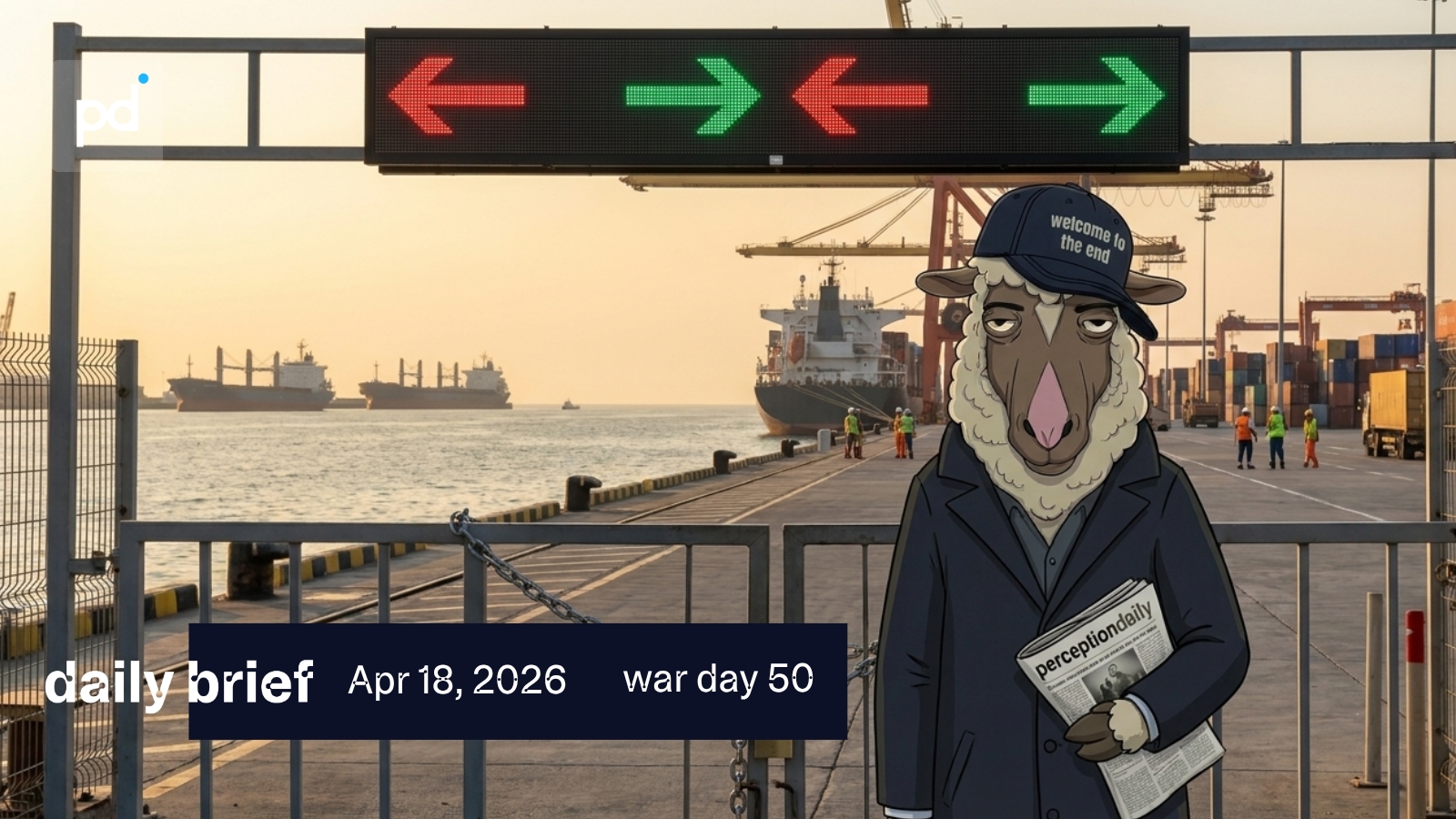
HORMUZ IS "OPEN". BUT THIS IS NOT A VICTORY — IT'S A CHESS MATCH
Day 50. The announcement came on Friday April 17: the oil price drop came almost immediately after Iranian Foreign Minister Abbas Araghchi announced on social media that Hormuz would reopen after weeks of closure. Brent crude, the international standard, fell 9.1% to settle at US$90.38 per barrel. Friday was the second largest one-day drop since the war began for both U.S. and Brent crude oil. Markets cheered.
But be careful. This is not a free Hormuz. It is a time-limited rental. The foreign minister made it clear that the strait stays open only as long as the ceasefire holds. Minutes after the Iranian foreign minister's announcement, Trump said on his social media network that the U.S. Navy's blockade of Iranian ports remains "in full force" until both sides reach a deal on the war.
The ceasefire expires on April 21. A fresh round of meetings between Iranian and American negotiators is expected to take place in Islamabad, Pakistan, on Monday, according to Iranian officials. But no date is confirmed. On April 18, Secretary of State Marco Rubio urged European countries to quickly decide on reimposing sanctions against Iran, warning that Iran is violating the existing agreement and nearing the capability to develop a nuclear weapon. Rubio also said Iran can have a civilian nuclear energy program rather than a military WMD atomic weapons program. Day 50 is not a celebration. It is the moment that will determine whether this war closes or restarts.
📍 MILITARY SITUATION
⚓ U.S. NAVAL BLOCKADE
The U.S. military said its blockade of Iranian ports "has been fully implemented" and that U.S. forces "have completely halted economic trade going into and out of Iran by sea." A U.S. official told Reuters that the military blockade of Iran involving more than 10,000 personnel remains in effect.
🌡️ CALIBRATE: A "open" Hormuz and an active naval blockade coexisting are not a tactical contradiction — it is deliberate. Washington wants Tehran economically strangled even while allowing other nations' oil to pass through.
🚢 USS GERALD R. FORD REPOSITIONED
The USS Gerald R. Ford aircraft carrier and two destroyers are now operating in the Red Sea after leaving the Eastern Mediterranean and transiting the Suez Canal. The movements are part of a broader effort by the U.S. military to maintain a ready stance to resume combat operations against Iran should the ceasefire not hold.
⬇️ YOU'RE UNDERESTIMATING IT: The Ford in the Red Sea is not a defensive presence. It is a signal. The April 21 diplomatic window has real military teeth behind it.
💣 IRAN: MISSILE CITIES REBUILDING
Satellite images from April 10 show a front-end loader atop debris blocking a tunnel entrance, as dump trucks wait nearby — at two separate missile base sites. This aligns with the overall concept of operations for the missile city, which was: absorb the first attack, dig yourself out, and then launch again.
🌡️ CALIBRATE: This was expected. A ceasefire implies your adversary will reconstitute. But the speed of restoration changes the strategic calculus.
🛡️ HEZBOLLAH: LEBANON TRUCE IN EFFECT
Israel and Lebanon agreed to a 10-day ceasefire. Israeli Prime Minister Benjamin Netanyahu said he agreed to the truce "to advance" peace efforts with Lebanon. Netanyahu said Israel will keep troops in southern Lebanon.
⬆️ YOU'RE OVERESTIMATING IT: The Lebanon truce is real but fragile. It is not peace — it is a 10-day window.
🧬 MOJTABA KHAMENEI: THE GHOST IN COMMAND
The Strait of Hormuz "has been a key and decisive factor in the recent war and, according to statements by the Supreme Leader, should remain closed." Iran's new spiritual leader Mojtaba Khamenei has not been seen in public since his inauguration, sparking questions over who is leading the decision-making in Iran.
⬇️ YOU'RE UNDERESTIMATING IT: An invisible leader commanding through military intermediaries is a massive source of instability. Nobody truly knows who approves what in Tehran.
🔑 KEY DEVELOPMENT OF THE DAY
RUBIO TELLS EUROPE: DECIDE NOW
This is the least discussed development but potentially the most significant for the next 30 days. Secretary of State Marco Rubio urged European countries to quickly decide on reimposing sanctions against Iran, warning that Iran is violating the existing agreement and nearing the capability to develop a nuclear weapon. Rubio also said Iran can have a civilian nuclear energy program rather than a military WMD atomic weapons program. It is a veiled ultimatum to European partners. The United States has proposed a 20-year pause to enrichment, while the Iranians offered a 3- to 5-year pause, according to Iranian sources speaking to Reuters. The gap is enormous. The April 21 deadline is not just a U.S.-Iran date — it is also the moment Europe must show its hand.
☄️ DON'T LOOK UP
Today: Brent has dropped below $90 but the U.S. naval blockade on Iran remains active — energy prices are still above pre-war averages.
Within 30 days: If talks collapse on April 21, Hormuz closes again, Brent returns above $100 and European flights begin fuel rationing.
If Hormuz stays closed beyond May: The head of the International Energy Agency said that Europe has "maybe six weeks or so" of remaining jet fuel supplies. Flight rationing, exploding gas bills, and technical recession in Germany and Italy by summer.
⚡ ENERGY AND MARKETS
U.S. crude oil plunged 11.4% to $83.85 per barrel, its lowest level since March 10, while international Brent crude slid 9% to $90.38 per barrel. Heating oil futures, which are a proxy for jet fuel, dropped 10%. Wholesale RBOB gas futures also fell 5%. Goldman Sachs estimated that flows through the strait remain constrained, running at just about 10% of normal levels, or roughly 2.1 million barrels per day on a four-day moving average. Before the Iranian announcement, Brent had approached $99.39 on Thursday April 16.
📊 PERCEPTION INDEX - SUMMARY
🔴 Hormuz "reopened" ................. ⬆️ Temporary, conditional, reversible within 72 hours
🔴 Oil price crash ................... 🌡️ Market reaction to hope, not to reality
🔴 Ceasefire expires April 21 ........ ⬇️ Underestimated deadline: the real point of no return
🔴 Mojtaba Khamenei invisible ........ ⬇️ Who decides in Tehran is the question nobody can answer
🔴 Nuclear negotiations .............. 🌡️ 20 years vs 3-5 year enrichment pause: a real abyss
🔴 Rubio and European sanctions ...... ⬇️ Silent ultimatum to Europe: barely debated
🔴 Iran missile cities rebuild ....... ⬆️ Expected and already factored into military calculations
🔴 Lebanon 10-day truce .............. 🌡️ Real relief but not structural — Hezbollah stays armed
🎖️ PERCEPTION DEFCON INDEX
⚠️ DEFCON 2 — ARMED TRUCE
The ceasefire holds, Hormuz is technically open, markets are celebrating. But the U.S. naval blockade is active, the second round of negotiations has no confirmed date, and April 21 is three days away. The architecture of this peace resembles a building balanced on a single beam. Negotiators are still arguing over decades of uranium enrichment.
2 escalation triggers:
— Collapse of negotiations on April 21 without a ceasefire extension
— Naval incident in the Gulf between U.S. fleet and IRGC vessels
2 de-escalation signals:
— Official confirmation of a second round of talks in Islamabad with a fixed date
— A written framework agreement on enriched uranium (even a statement of principles)
perceptiondaily by thesmallmediacompany warfare intelligence. next brief: tomorrow at 7.00am.